
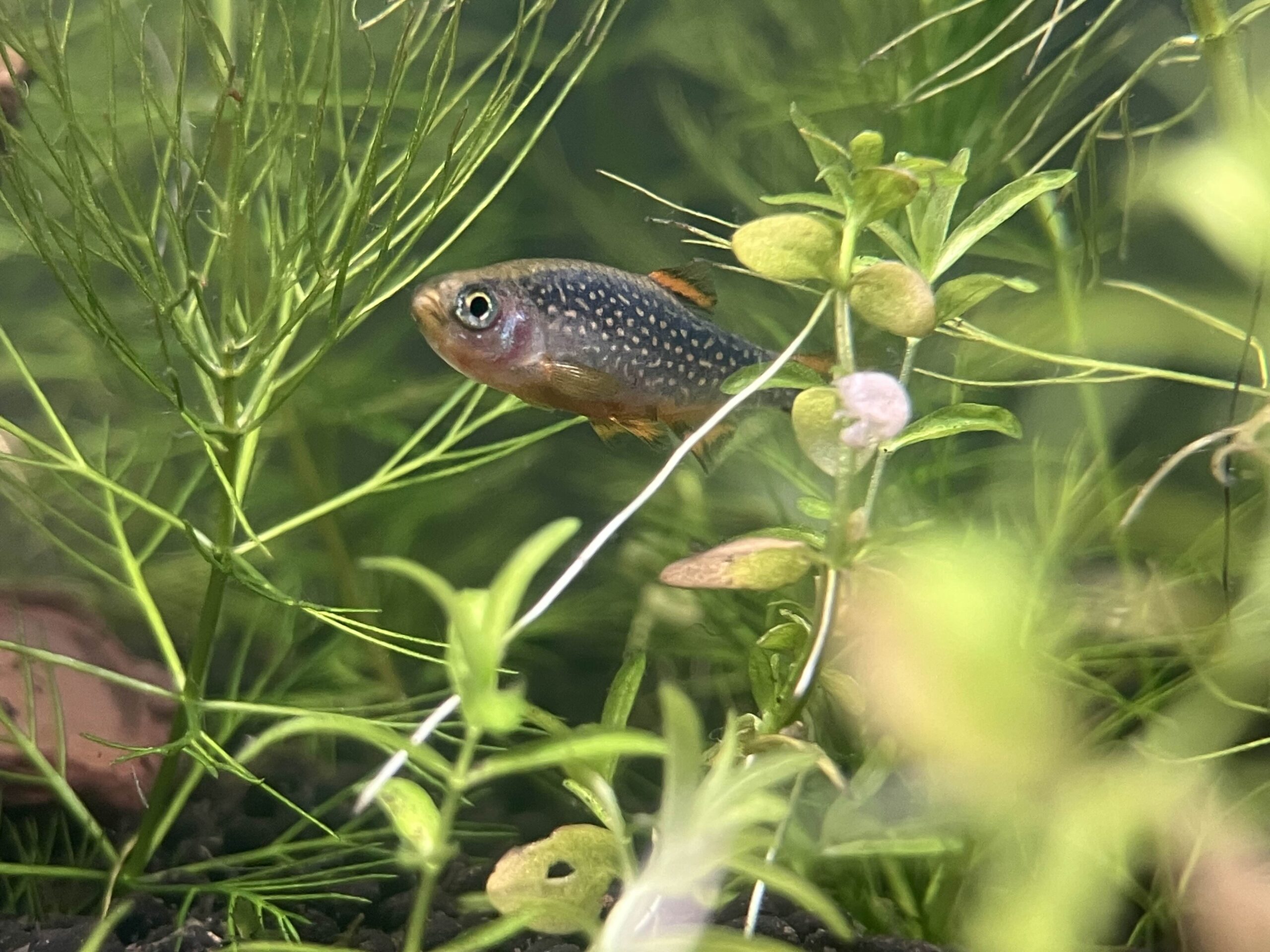
Celestial pearl danio care is mostly easy — these jewel-like nano fish are hardy, adaptable, and breed almost on their own. But two things trip up beginners, and neither appears on a typical care tag. First, they prefer cooler water than most “tropical” advice assumes, so a heater is often optional. Second, the males spar and display constantly, which turns into real bullying if your group is set up wrong. Sort those two out and the celestial pearl danio (also sold as the galaxy rasbora) is one of the most spectacular fish you can keep in a nano tank.
Most guides repeat the same generic chart and skip the things that actually matter: the right male-to-female ratio, planted sightline breaks to defuse sparring, and the conservation story that should decide where you buy. This guide fills all three gaps with honest numbers, three original reference tables, and a realistic timeline so your group stays bold, colorful, and stress-free.
Why Celestial Pearl Danios Are Easy (With Two Catches)
At roughly 0.8 to 1 inch, the celestial pearl danio packs an absurd amount of color into a tiny body: a deep blue flank dotted with pearl spots, finished with red-and-black striped fins. They are genuinely hardy and tolerate a wide range of water chemistry, which is what earns them their beginner-friendly reputation. The catch is that “hardy” does not mean “set and forget” — their temperament and temperature needs are where people go wrong.
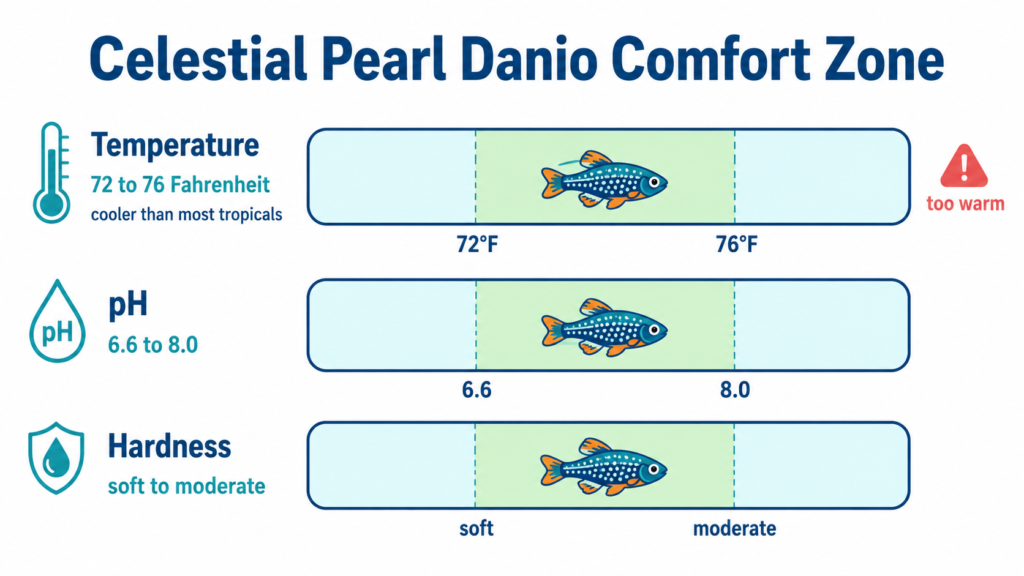
Catch one is temperature. Despite being sold beside tropical fish, celestial pearl danios come from cool highland ponds and actually thrive in the low-to-mid 70s Fahrenheit, often with no heater at all in a normal room. Catch two is behavior: dominant males display and chase rivals nonstop. It is mostly harmless posturing, but in a bare tank or with too few females it tips into stressful bullying. The comfort-zone table below lays out the essentials.
| Parameter | Comfortable range | How fussy? | What actually matters |
|---|---|---|---|
| Temperature | 72–76°F (22–24°C) | Prefers cooler | Tolerates up to ~78°F but thrives cool; heater often optional |
| pH | 6.6–8.0 | Very adaptable | Wide range; stability beats hitting a target |
| GH (hardness) | Soft to moderate (~5–15 dGH) | Adaptable | Tolerates most tap water if changes are gradual |
| Ammonia / Nitrite | 0 ppm | Zero tolerance | Non-negotiable; only a cycled tank passes |
| Nitrate | Below 20 ppm | Moderate | Keep low with plants and weekly changes |
| Adult size | ~0.8–1 in (2–2.5 cm) | — | Small mouths need small foods |
| Group & ratio | 6+ minimum, more females than males | Critical | Extra females spread out male sparring and reduce stress |
The temperature row is the one most worth re-reading. If you keep celestial pearl danios in a warm room, you may not need a heater at all — and they will be healthier for the cooler water. For the bigger picture on heated versus unheated nano tanks, see our coldwater versus tropical nano tank comparison.
Buy Captive-Bred: The Conservation Story That Matters
Here is the part most care guides leave out. The celestial pearl danio was only discovered in 2006 in a small area of Myanmar, and within months its dazzling looks drove such intense wild collection that the population crashed and exports were briefly restricted. The good news: the species breeds so readily that the hobby quickly became supplied almost entirely by tank-raised fish. When you buy today, choose captive-bred stock — it is hardier, already adapted to aquarium life, and keeps pressure off the wild population.
Captive-bred fish are also a better bet for your tank. They arrive less stressed, are accustomed to prepared foods, and adapt to your water chemistry far more easily than wild-caught imports. Ask your store or breeder; reputable sellers will know, and the vast majority of celestial pearl danios in the trade are now tank-bred.
| Factor | Captive-bred (choose this) | Wild-caught |
|---|---|---|
| Hardiness | Adapted to aquarium life | More sensitive, higher losses |
| Diet | Already eats prepared foods | May refuse pellets/flake at first |
| Conservation | No pressure on wild stock | Adds collection pressure |
| Availability | The vast majority of the trade | Uncommon and unnecessary |
Tank Size, Layout, and the Cycle That Comes First
A 10-gallon comfortably holds a small group of five to seven celestial pearl danios, while a larger school of 10 to 15 is happiest in a 20-gallon. The footprint matters because of the sparring: more horizontal space lets subordinate males escape dominant ones. If you are choosing a tank, our nano tank size guide comparing 3, 5, and 10 gallon setups covers the trade-offs.
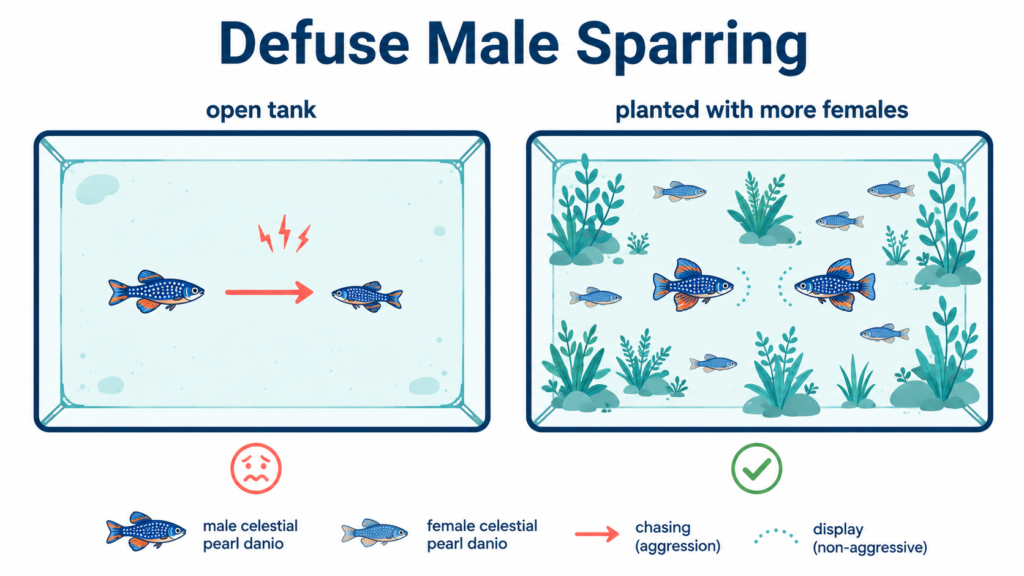
Layout is your best tool for managing male behavior. A heavily planted tank with broken sightlines — tall stems, floating plants, driftwood, and mosses — means a displaying male cannot dominate the whole tank at once, which spreads out aggression and gives shy fish places to retreat. Combined with a female-skewed ratio, dense planting turns potential bullying into the harmless, beautiful sparring these fish are known for. Easy cover options are in our guide to the best low-light aquarium plants.
Tip: Two design choices defuse 90% of male aggression — keep more females than males, and break up open sightlines with plants. Do both and the chasing becomes a colorful display instead of a stressor.
As always, the non-negotiable first step is cycling. A new tank cannot process toxic ammonia, and even adaptable danios cannot survive an uncycled tank. Run a fishless cycle first — our step-by-step fishless cycling guide covers it, and how long before you can safely add fish sets realistic timing. The full gear list lives in our nano aquarium starter checklist.
Water, Food, and Daily Care
Daily care is light and routine. Weekly water changes of 10 to 20 percent, temperature-matched and dechlorinated, keep nitrate low. Because these fish prefer cooler water, watch your tank in summer — sustained heat above the high 70s is more of a risk than cool temperatures. A conditioner at every change is mandatory to neutralize chlorine and chloramine.
Feeding is easy with one caveat: small mouths. Offer a high-quality micro-pellet or finely crushed flake as the staple, and add variety with small live or frozen foods like baby brine shrimp, daphnia, and microworms. These foods also bring out the best color and condition the fish for breeding. Feed small amounts once or twice a day, only what they finish in a couple of minutes.
Color is your health gauge. A settled, well-fed celestial pearl danio in a planted tank shows a saturated blue body and vivid fins. Newly added or stressed fish look washed out and pale; this usually resolves within a week or two as they adjust, provided the group ratio and planting are right.
Tankmates and Breeding (the Easy Part)
Celestial pearl danios are peaceful toward other species and make great community fish with small, gentle tankmates. They pair well with chili rasboras and pygmy corydoras, which occupy different parts of the tank, and they generally leave adult cherry shrimp alone (though they will eat shrimplets). Avoid large or fin-nipping species. For a vetted shortlist of compatible nano fish, see our best nano tank fish for beginners roundup.
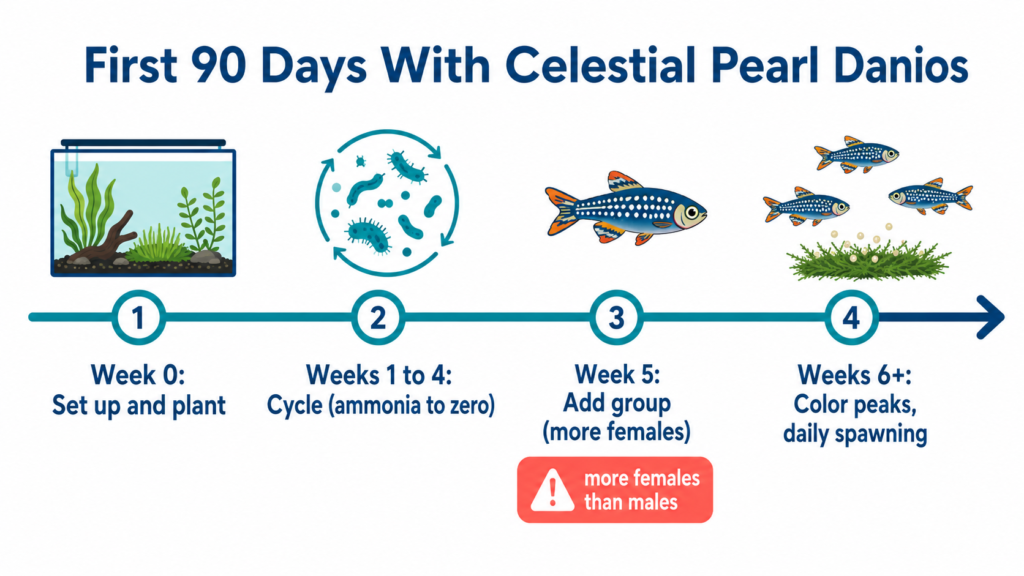
Breeding is famously easy — it is the whole reason the species is so widely tank-bred. Once mature at three to four months, a well-fed group spawns almost daily, scattering eggs into fine-leaved plants and moss. Adults eat the eggs, so in a community tank survival is low; to raise fry deliberately, use a separate tank with java moss or a spawning mop. Eggs hatch in about two to four days, and the fry need infusoria-grade food before graduating to baby brine shrimp. The table below sums up the journey.
| Stage / week | Action | Target or amount | Rough cost (mid-2026) |
|---|---|---|---|
| Week 0 (shopping) | 10–20 gal tank, sponge filter, light, dechlorinator (heater optional) | Buy captive-bred fish | $80–$150 |
| Weeks 1–4 | Fishless cycle; plant heavily with sightline breaks | Ammonia & nitrite to 0 ppm | $20–$40 (plants) |
| Week 4–5 | Add a group, more females than males | 6+ fish; drip-acclimate ~45–60 min | $30–$70 (fish) |
| Weekly, ongoing | Water change + small feeds | 10–20% change; feed 1–2x/day | ~$4/mo (food + conditioner) |
| Optional | Separate moss tank to raise fry | Eggs hatch in 2–4 days | $0–$30 |
For the species itself, the Wikipedia entry on the celestial pearl danio covers its 2006 discovery and conservation history in more detail.
Common Beginner Mistakes to Skip
Three errors account for most disappointing celestial pearl danio tanks, and all are free to avoid. First, keeping them too warm because they were sold as “tropical,” when they prefer cooler water. Second, a male-heavy group in a bare tank, which turns sparring into bullying. Third, adding them to an uncycled tank.
- Overheating — aim for the low-to-mid 70s; a heater is often optional.
- Too many males, too few plants — skew female and break up sightlines.
- Skipping the cycle — fix with patience and a test kit, not chemicals.
- Buying wild-caught — choose hardier, more ethical captive-bred stock.
For the broader patterns that sink first tanks, our 9 beginner aquarium mistakes article is worth a read. Results always vary with your tap water and room temperature, so treat every number here as a target band, not a guarantee.
Keep Exploring NanoTank Lab
- Best Nano Tank Fish for Beginners — where celestial pearl danios rank among easy nano species.
- Coldwater vs Tropical Nano Tank — why these fish may not need a heater.
- How to Cycle a New Aquarium (fishless cycling) — the non-negotiable first step.
- Chili Rasbora Care Guide — a compatible, peaceful schooling tankmate.
- Java Moss Care & Uses — ideal cover for sightline breaks and raising fry.
Frequently Asked Questions
Do celestial pearl danios need a heater?
Often not. Celestial pearl danios come from cool highland ponds and thrive in the low-to-mid 70s Fahrenheit, so in a normal heated room they frequently do well with no heater at all. They tolerate up to about 78°F, but sustained warmth stresses them. If your room runs cold or swings a lot, a small adjustable heater set low keeps the temperature stable.
Are celestial pearl danios aggressive?
Not toward other species, but males display and chase each other constantly. This sparring is mostly harmless posturing, but it becomes real bullying in a bare tank or a male-heavy group. Keep more females than males and plant heavily to break up sightlines, and the chasing turns into a beautiful display rather than a source of stress.
How many celestial pearl danios should I keep?
Keep at least six, with more females than males. A small group of five to seven suits a 10-gallon, while a larger, more impressive school of 10 to 15 is happiest in a 20-gallon. Larger groups with extra females spread out male sparring, reduce stress, and let these shy fish feel secure enough to show their full color.
Should I buy wild-caught or captive-bred?
Always choose captive-bred. After the species was discovered in 2006, heavy wild collection crashed the population, but it breeds so readily that the trade is now supplied almost entirely by tank-raised fish. Captive-bred danios are hardier, already eat prepared foods, adapt to your water more easily, and keep pressure off the wild population.
Are celestial pearl danios easy to breed?
Yes — they are among the easiest egg-scattering fish to breed. Once mature at three to four months, a well-fed group spawns almost daily into fine plants and moss. The challenge is survival, since adults eat the eggs. To raise fry, use a separate tank with java moss or a spawning mop; eggs hatch in two to four days and fry need very small foods at first.
What tank size do celestial pearl danios need?
A 10-gallon is the practical minimum for a small group of five to seven, and a 20-gallon is better for a larger school of 10 to 15. More floor space matters here because it lets subordinate males escape dominant ones, which keeps sparring from becoming bullying. Combine adequate size with heavy planting and a female-skewed ratio for the calmest, most colorful group.