
Choosing the best nano tank size is the one decision that makes fishkeeping easy or frustrating for a beginner. Go too small and the water chemistry swings fast and punishes every mistake; go a little bigger and the same tank quietly forgives you while you learn.
This guide compares the three most common nano sizes — 3, 5, and 10 gallons — on stability, stocking, cost, and space, then helps you pick the right one for your situation.
First, what counts as a “nano” tank?
A nano aquarium is any small freshwater tank, roughly 1–10 gallons (about 4–38 liters). If you haven’t built one yet, start with our step-by-step nano aquarium setup guide — this article is about choosing the size before you buy.
The one rule that decides everything: water volume = stability
More water is more stable water. Temperature, pH, and waste are all diluted across the volume, so the bigger the tank, the slower anything changes. A heater glitch or one extra pinch of food barely moves a 10-gallon tank — but it can spike ammonia or temperature in a 3-gallon overnight.
💡 Beginner takeaway: stability buys forgiveness. The “cute tiny tank” is actually the hardest to keep alive. Bigger is easier.
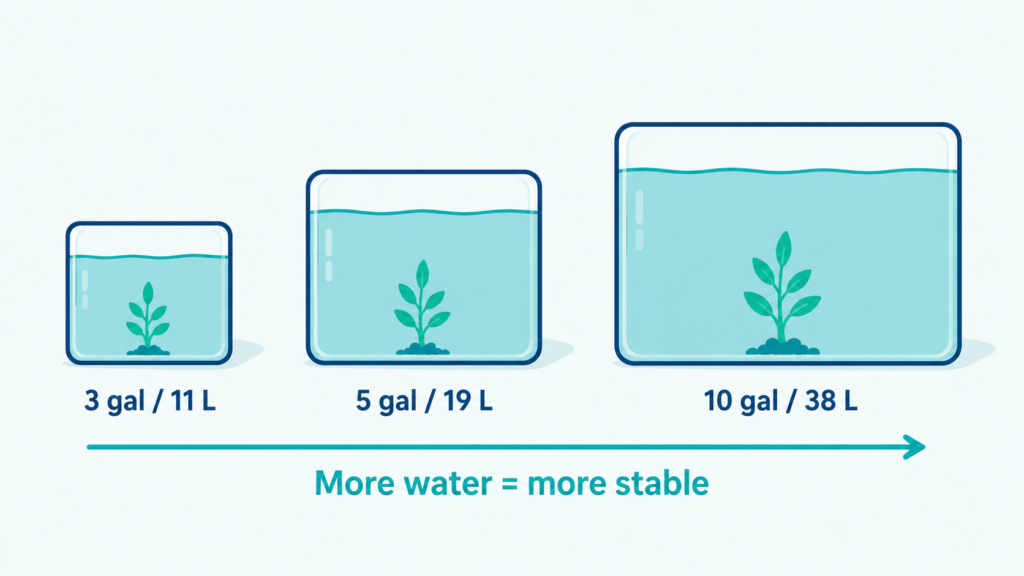
3 vs 5 vs 10 gallon: the honest comparison
| Size | Volume | Stability | Realistic stocking | Best for | Watch-outs |
|---|---|---|---|---|---|
| 3 gallon | ~11 L | Hard | 1 betta or a shrimp colony | Desks, tight spaces, shrimp keepers | Swings fast; no margin for error |
| 5 gallon | ~19 L | Manageable | 1 betta + snails, or shrimp + a few nano fish (carefully) | Most beginners | Still easy to overstock |
| 10 gallon | ~38 L | Easiest | Small school of nano fish + shrimp | Anyone with the space | Needs a slightly bigger spot & budget |
3 gallons (11 L) — the minimalist
The smallest size most people can realistically keep. It fits anywhere and looks great as a single-species showpiece, but it gives you almost no margin for error. Best treated as a shrimp tank or a carefully maintained home for one betta — not a community tank. Recommended only if you’re patient and willing to test the water often.
5 gallons (19 L) — the beginner sweet spot
This is the size we recommend for most first-timers. It’s still small and affordable, but the extra water forgives the early mistakes everyone makes. A 5-gallon happily houses a single betta with snails, or a small shrimp colony, and gives plants room to grow. If you want one tank that’s both manageable and rewarding, start here.
10 gallons (38 L) — the easiest to keep
Technically “nano-plus,” but the most forgiving of the three. The larger volume stays stable almost on its own, and it finally opens the door to a small school of nano fish plus shrimp — which is what makes a planted tank feel alive. If you have the space and a little more budget, this is the easiest path to success.
Quick stocking reference
| Tank | A safe beginner stocking |
|---|---|
| 3 gal | 1 betta + 1 nerite snail, OR ~6–10 cherry shrimp |
| 5 gal | 1 betta + snails, OR a small shrimp colony |
| 10 gal | ~6–8 nano fish (e.g. chili rasboras) + shrimp + snails |
These are conservative on purpose. Overstocking is the most common beginner mistake — it overloads the tank’s biological filtration and spikes ammonia. When in doubt, keep fewer animals.
Cost and space
Bigger tanks cost a little more up front (tank, heater, light, more substrate and plants) and need a sturdier spot, but the running cost difference between these sizes is small. Don’t let a few dollars push you into a 3-gallon if a 5- or 10-gallon would make the hobby easier — the cheaper-to-buy tank is often the harder (and more disappointing) one to keep.
So which nano tank size should you pick?
- Limited space / one centerpiece pet → 5 gallon
- Want a small school and the easiest experience → 10 gallon
- Shrimp-only, or experienced and space-limited → 3 gallon
Still unsure? Get the 5-gallon. It’s the best balance of size, stability, and cost for a beginner — small enough to fit a desk, big enough to forgive you. Once it’s chosen, head back to the full setup guide to put it together, then learn how to cycle it and which nano fish suit your tank size.
Keep Exploring NanoTank Lab
Picked a size? Here’s what to read next:
- Putting it together: How to set up a nano aquarium, step by step
- What to buy: Nano aquarium starter kit checklist
- The crucial wait: How to cycle a new aquarium
- Stocking it: Best nano tank fish for beginners
Frequently Asked Questions
What is the best nano tank size for a beginner?
A 5-gallon (19 L) tank. It’s small and affordable but holds enough water to stay stable while you learn, which makes it far more forgiving than a 3-gallon.
Is a 3-gallon tank too small for fish?
For most community fish, yes. A 3-gallon is best as a shrimp tank or a carefully maintained home for a single betta — not a group of fish.
Can a beginner start with a 10-gallon?
Absolutely — it’s the easiest of the three to keep stable. It’s a touch larger than a strict “nano,” but the forgiveness is worth it if you have the space.
How many fish can I keep in a 5-gallon nano tank?
Keep it light: a single betta with snails, or a small shrimp colony. Resist the urge to add “just one more” — overstocking a small tank is the fastest way to crash it.
Does a bigger nano tank cost much more to run?
Barely. The up-front difference between a 3-, 5-, and 10-gallon is small — a slightly bigger tank, heater, and a bit more substrate. Running costs (electricity, food, dechlorinator) are nearly identical. Don’t let a few dollars push you into the harder-to-keep tank; the extra stability of a 5- or 10-gallon is well worth it.