
A good aquarium starter kit checklist saves a beginner from the two classic traps: buying junk you’ll replace in a month, or forgetting a cheap item that turns out to be essential. This guide is the exact list of what a new nano tank actually needs — and, just as important, what you can skip.
We’ll split everything into must-haves, nice-to-haves, and skip-its, give honest 2026 price ranges, and show you three budget builds so you can shop in one trip.
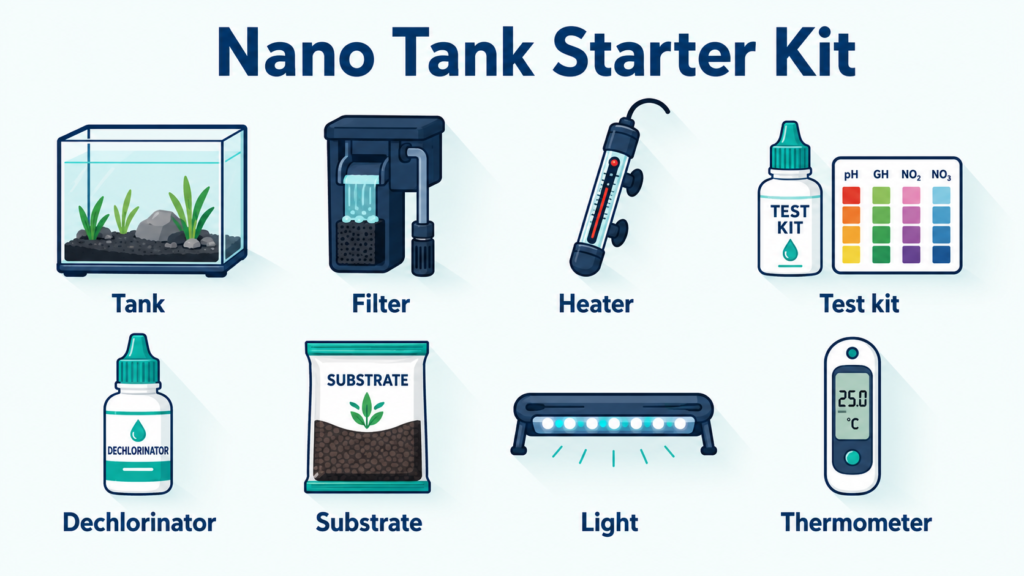
What’s on the aquarium starter kit checklist: the essentials
These are non-negotiable. Skip one of these and you’re setting up to fail — usually with dead fish or green water within weeks.
| Item | What it does | 2026 price (USD) | Skip it? |
|---|---|---|---|
| Tank (3–10 gal) | The home itself; bigger = more stable | $20–60 | No |
| Filter | Houses the bacteria that process waste | $15–50 | No |
| Heater (nano-rated) | Tropical fish need stable 76–80 °F | $15–35 | No* |
| Liquid test kit | The only way to see your cycle & water | $25–35 | No |
| Dechlorinator | Removes tap-water chlorine that kills bacteria | $6–10 | No |
| Substrate | Gravel/sand or plant soil base | $10–25 | No |
| Light | For plants & viewing (often in kits) | $15–40 | No |
| Thermometer | Confirms the heater is actually working | $3–6 | No |
*Skip the heater only for a true coldwater setup. Most beginner fish are tropical, so plan on one.
💡 The one item beginners cheap out on and regret: the heater. Bargain nano heaters are notoriously inconsistent and can cook or chill a small tank fast. Buy a known brand here even if you save elsewhere.
Nice-to-haves: helpful, not urgent
- Bottled beneficial bacteria — can shorten your first cycle.
- Live plants — absorb some waste, fight algae, look great (start with low-light species).
- Algae scraper & a small siphon — makes weekly maintenance painless.
- A second sponge/media — pre-seeded backup for emergencies.
- Timer or smart plug — keeps your light on a consistent schedule.
Skip these (for now)
- CO2 systems — unnecessary for low-light beginner plants.
- UV sterilizers & fancy media reactors — overkill for a nano.
- Plastic decorations with sharp edges — can tear delicate fins (bettas especially).
- Paper test strips — too vague to cycle a tank by; get the liquid kit instead.
- Live fish on day one — the tank isn’t ready (more on that below).
Three starter builds by budget
Prices are ballpark 2026 ranges for a 5-gallon setup, before fish and plants. An all-in-one kit can bundle tank, filter, and light cheaply — just budget extra for a quality heater and a test kit, which kits often skimp on.
| Build | What you get | Rough total |
|---|---|---|
| Budget | All-in-one kit + cheap-but-decent heater + liquid test kit + dechlorinator + substrate | ~$90–130 |
| Balanced | Separate quality tank/filter/light + reliable heater + test kit + plant-friendly substrate + a few low-light plants | ~$150–220 |
| Premium | Rimless tank + quiet filter + good LED + brand heater + full test kit + aquasoil + plants + tools | ~$250–350 |
For most beginners the Balanced build is the sweet spot: it forgives mistakes and you won’t be re-buying gear in three months. If money is tight, the Budget build is fine — just don’t cut the heater or test kit.
All-in-one kit or buy separately?
This is the question that trips up most first-timers at the store. An all-in-one kit bundles the tank, filter, and usually a light into one box at a lower price than buying each piece alone — a genuinely good deal for a beginner who just wants to get started. The catch is what kits leave out or cheap out on: the heater and the test kit. Many kits ship with no heater at all, or a flimsy fixed-temperature one, and almost none include a liquid test kit.
Buying separately costs a little more and takes research, but you choose a quieter filter, a better light for plants, and a reliable heater — gear you won’t be replacing in three months. Our honest middle path: start with a decent all-in-one kit to save money on the tank-filter-light core, then buy a quality heater and a liquid test kit on the side. You get the savings without the two weak points that actually cost beginners their fish.
What to do once you’ve bought everything
Having the gear is step one. Next comes assembly and the most-skipped step of all — growing your filter bacteria before any fish arrive. Follow our step-by-step nano aquarium setup guide to put it together, then run a full fishless cycle so the tank can safely handle waste. The science behind why is the nitrogen cycle.
Keep Exploring NanoTank Lab
Gear sorted? Here’s where to go next:
- Pick the right size: Nano tank size guide — 3 vs 5 vs 10 gallon
- Assemble it: How to set up a nano aquarium
- The crucial wait: How long before you can add fish to a new tank
- What it all costs: How much does a nano aquarium cost?
Frequently Asked Questions
What do I need to start a nano aquarium?
At minimum: a tank, filter, heater, liquid test kit, dechlorinator, substrate, light, and a thermometer. Everything else — CO2, UV, fancy media — is optional and can wait.
Are all-in-one aquarium kits worth it?
Often yes — they bundle the tank, filter, and light affordably. Just budget separately for a quality heater and a liquid test kit, the two items kits most commonly skimp on or omit.
Do I really need a liquid test kit?
Yes. It’s the only reliable way to see ammonia, nitrite, and nitrate while your tank cycles. Paper strips are too imprecise — guessing usually ends in dead fish.
Can I skip the heater?
Only for a true coldwater setup. Most popular beginner fish are tropical and need a stable 76–80 °F, so plan on a nano-rated heater from a reputable brand.
How much should a complete nano starter kit cost?
For a 5-gallon setup before fish and plants, budget roughly $90–130 for a no-frills build, $150–220 for a balanced one that won’t need replacing, and $250–350 for a premium rimless setup. The biggest mistake is shaving money off the heater or test kit — those two are where a cheap-out actually costs you fish. See our full nano aquarium cost breakdown for line-by-line pricing.