
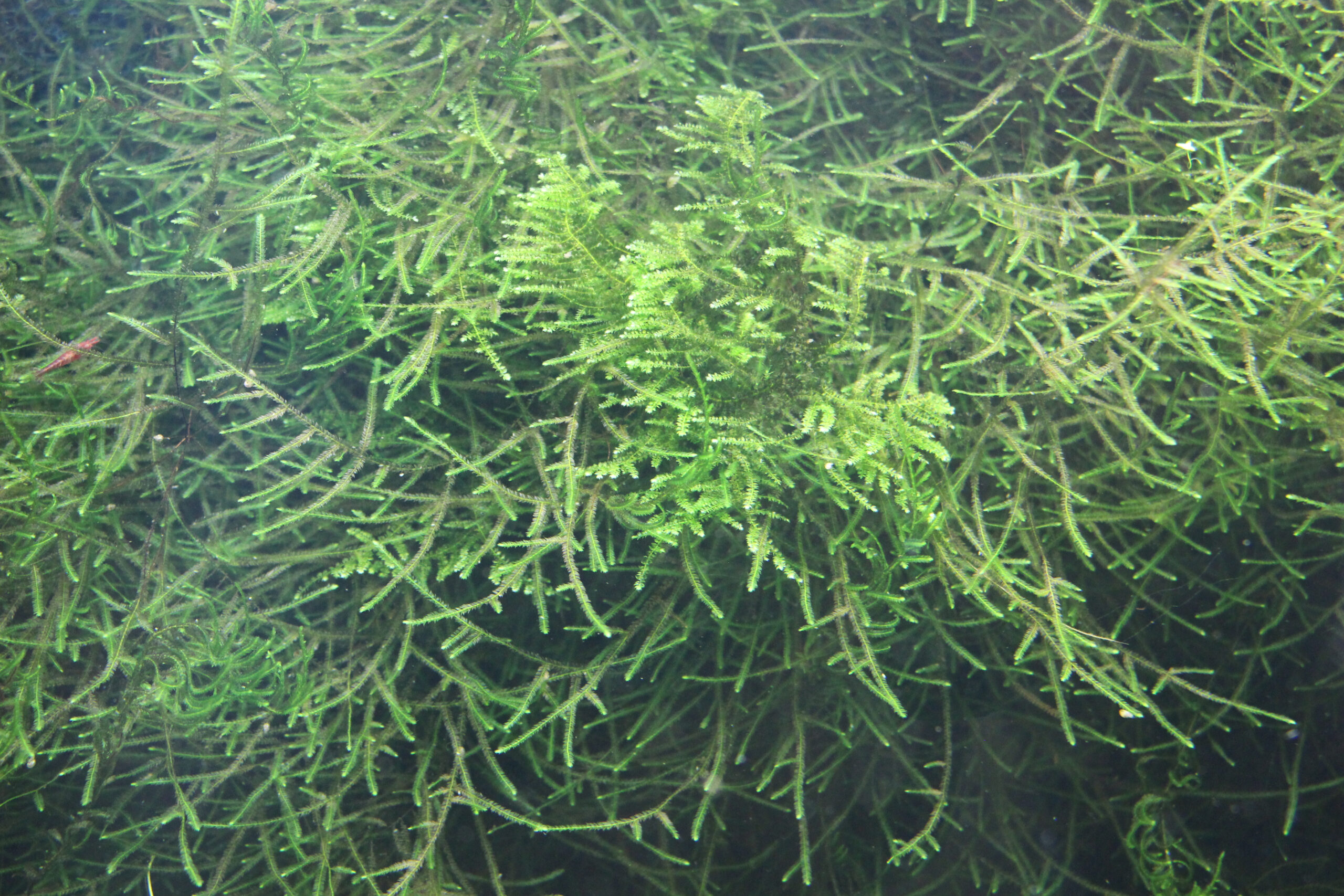
If you have spent five minutes researching java moss care, you have probably read that this plant is “impossible to kill” — and that single myth is why so many beginners end up with a brown, stringy mess instead of a lush green carpet. Java moss (Taxiphyllum barbieri) is genuinely one of the most forgiving plants in the hobby, but “forgiving” is not the same as “thrives on neglect.” It tolerates abuse; it does not enjoy it.
Most articles stop at “low light, no CO2, attach to rock, done.” The gap they leave out is the practical stuff: exactly how warm is too warm, why your moss turns brown even when it is technically alive, how to prevent it from smothering itself, and the seven specific jobs it actually does well in a nano tank. This post fills those gaps with honest numbers, a parameter table you can act on, and a real maintenance checklist — no hand-waving.
Why Java Moss Is the Default Nano Plant
In a small tank, every plant has to earn its footprint, and java moss earns it several times over. It needs no substrate, no fertilizer dosing to survive, no carbon injection, and no special light. You can grow it in a 3-gallon bowl on a desk lamp or in a high-tech 10-gallon under a premium planted LED, and it will adapt to both. That flexibility is exactly why it shows up in almost every beginner shrimp tank and betta setup. If you are still choosing a tank, our Nano Tank Size Guide (3 vs 5 vs 10 gallon) pairs nicely with moss because the plant scales down to the smallest volumes without complaint.
The catch — and the part that separates good java moss care from “it’s just surviving” — is flow and trimming. Moss does not have roots that pull nutrients from soil; every strand absorbs water and light directly. That means stagnant pockets brown out, and untrimmed clumps shade their own interiors until the middle dies and rots. Manage those two variables and the plant is close to bulletproof.
Java Moss Care Parameters (Honest Numbers)
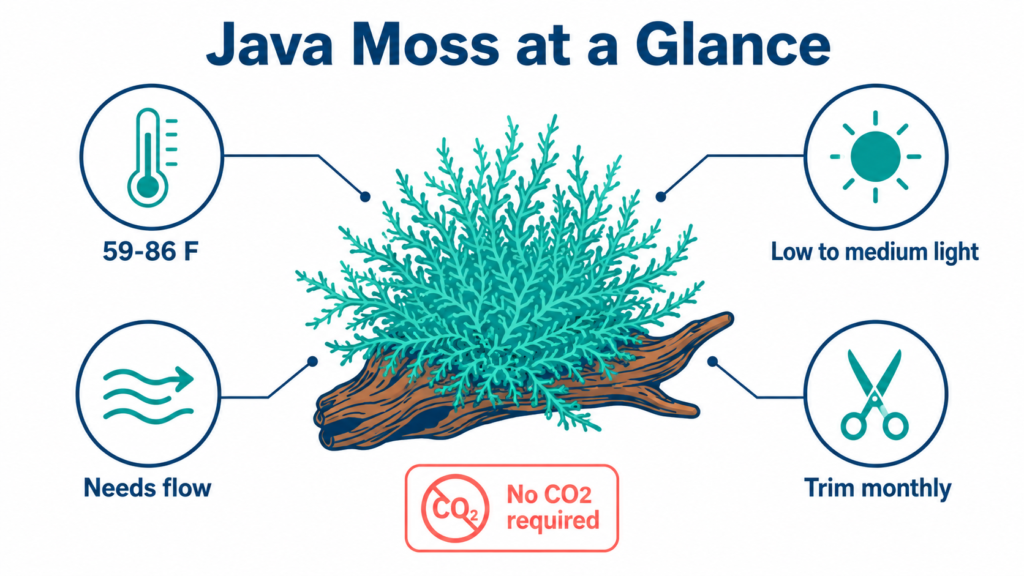
Below is the range java moss tolerates versus the range where it looks its best. The plant survives well outside the “ideal” column — that is its whole reputation — but if your moss is pale, leggy, or browning, the gap is almost always temperature or flow, not light.
| Parameter | Survival range | Ideal (best growth & color) | Notes |
|---|---|---|---|
| Temperature | 59-86°F (15-30°C) | 68-77°F (20-25°C) | Above ~82°F (28°C) growth thins and browning risk rises |
| Lighting | Very low to bright | Low to medium, ~6-8 hrs/day | Bright light = denser growth but feeds algae if nutrients lag |
| pH | 5.5-8.0 | 6.0-7.5 | Adapts to most tap water without buffering |
| Hardness (GH) | 3-15 dGH | 4-10 dGH | Soft or moderately hard water both work |
| CO2 | None needed | Optional | Injection roughly 2-3x growth speed; not required |
| Flow | Gentle to moderate | Light, steady current | Stagnant spots trap detritus and brown out |
Tip: If your java moss is browning but the strands still feel firm and green when you part the clump, you have a flow or trimming problem — not a dead plant. Thin it out, redirect a little current across it, and the surface greens up within two to three weeks. Results vary with temperature.
One honest caveat: the “temperature” guidance is where hobbyists disagree most. Plenty of keepers run moss in warm 80°F (27°C) betta tanks for years with fine results. What is not debated is that sustained heat above the low 80s°F slows the plant and makes brown patches more likely, so if you keep a tropical setup, lean on flow and trimming to compensate. Our Coldwater vs Tropical Nano Tank breakdown is worth a read if you have not locked in your temperature yet.
7 Uses for Java Moss in a Nano Tank
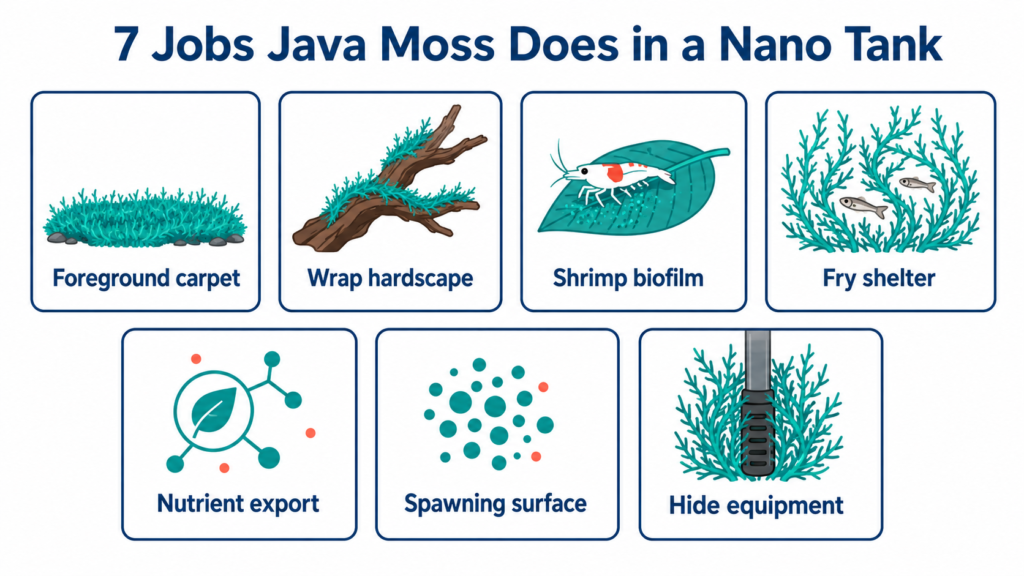
This is the part most care guides skip. Java moss is not just decoration — in a small ecosystem it pulls real weight. Here are the seven jobs it does best, with a realistic difficulty rating for each.
1. Carpeting the foreground
Tied flat to a mesh pad and trimmed regularly, java moss forms a low green carpet without the CO2 demands of true carpeting plants. It is slower and shaggier than a dwarf hairgrass lawn, but for a no-CO2 nano it is the most reliable green floor you can get.
2. Wrapping driftwood and rock
This is the classic look. Wrap a piece of spiderwood or seiryu stone in thread or fishing line, and within roughly three to ten weeks — faster in bright, fertilized tanks, slower in dim ones — the moss anchors itself with rhizoids and the line can be removed. The result is a mature, “aged” hardscape that makes a brand-new tank look established.
3. Shrimp grazing and biofilm
The dense structure traps microscopic biofilm, which is a primary natural food for cherry and crystal shrimp. A well-established moss clump can support a colony almost on its own between feedings.
4. Fry and shrimplet shelter
Baby shrimp and small fish fry hide deep inside the tangle where adults and currents cannot reach them. In a breeding nano, a fist-sized moss clump dramatically raises survival rates compared to a bare tank.
5. Supplemental nutrient export
Like any fast-ish plant, moss takes up nitrogen compounds such as ammonia and nitrate as it grows. It will not replace your filter or your water changes, but in a lightly stocked nano it meaningfully buffers nutrient spikes. This complements — never substitutes for — a properly cycled tank, which you can set up with our guide on how to cycle a new aquarium (fishless cycling).
6. A natural spawning surface
Many egg-scattering fish and even some bettas use moss as a spawning site. The fine texture catches eggs and shields them, and the attached biofilm gives the first free-swimming fry something to graze immediately.
7. Hiding equipment
Intake tubes, heater cords, and suction cups disappear behind a moss curtain. It is the cheapest, most natural way to clean up the look of a small tank without adding bulky decor that steals swimming space.
| Use | Difficulty | Time to result | Best for |
|---|---|---|---|
| Foreground carpet | Moderate | 8-12 weeks | No-CO2 aquascapes |
| Driftwood / rock wrap | Easy | 3-10 weeks | Instant “aged” hardscape |
| Shrimp biofilm | Easy | 3-4 weeks | Cherry / crystal shrimp |
| Fry shelter | Easy | Immediate | Breeding tanks |
| Nutrient export | Easy | Ongoing | Lightly stocked nanos |
| Spawning surface | Easy | Immediate | Egg-scatterers |
| Hiding equipment | Easy | 4-8 weeks | Any visible-gear tank |
How to Attach and Plant Java Moss
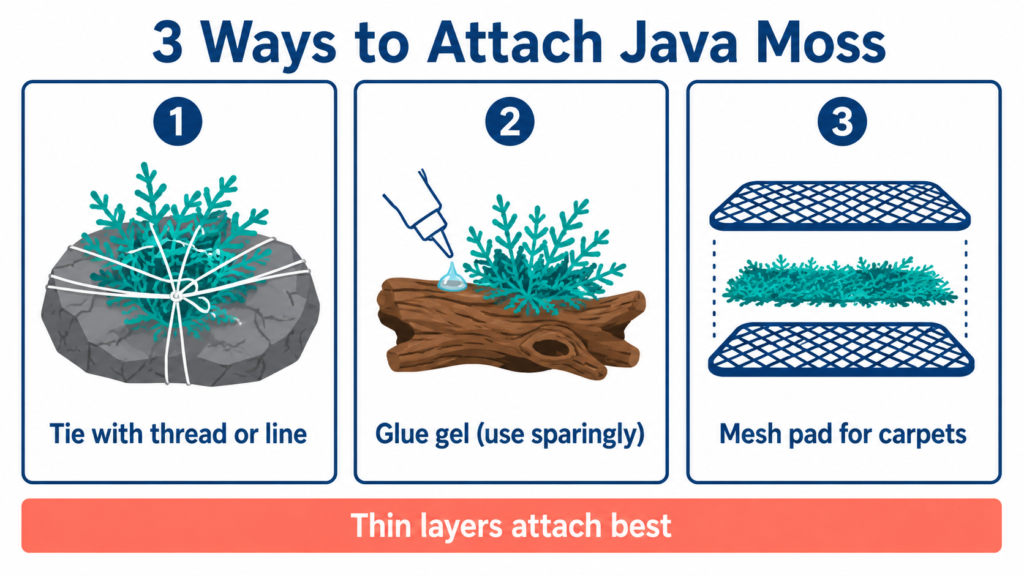
Java moss does not root into substrate the way stem plants do — it grips surfaces with thread-like rhizoids. So you do not “plant” it; you anchor it and wait. There are three reliable methods, and none of them require special tools.
- Tie method: Spread a thin layer over wood or rock and wind cotton thread or fishing line around it. Thin layers attach faster and greener than thick clumps. Cotton thread dissolves on its own in a few weeks; fishing line you remove once it has gripped.
- Glue method: A few dabs of cyanoacrylate (super glue) gel bond small portions to hardscape in seconds. Use sparingly — glued spots can brown if buried too deep in the clump.
- Mesh method: Sandwich a thin layer between two plastic mesh pads and zip-tie the edges. This is the go-to for flat carpets and moss walls because it forces an even, low profile.
Whichever method you choose, the golden rule is thin. A wispy layer photosynthesizes and attaches across its whole surface; a thick wad shades and rots from the inside. Rhizoids also grip porous surfaces — driftwood, lava rock, unglazed stone — far better than smooth glass. For more on what to buy before you start, our Nano Aquarium Starter Checklist covers the scissors, line, and tools that make this painless.
Maintenance Checklist & Troubleshooting
This is where good java moss care becomes routine instead of guesswork. The plant asks very little, but the little it asks is non-negotiable: trim before it shades itself, and keep detritus out of the clump. Use the schedule below, with rough costs stamped mid-2026 so you can budget.
| Task | How often | Why it matters | Cost (mid-2026) |
|---|---|---|---|
| Trim with sharp scissors | Every 3-5 weeks | Prevents inner shading and rot | $8-15 (one-time, scissors) |
| Turkey-baster blast detritus | Weekly at water change | Clears trapped waste, keeps it green | $5-8 (one-time, baster) |
| Check flow across the clump | Weekly (visual) | Stagnation causes browning | $0 |
| Remove brown/dead patches | As needed | Stops rot from spreading | $0 |
| Starter portion of moss | Once | A golf-ball clump fills a nano in ~2-3 months | $5-12 |
| Optional liquid fertilizer | Weekly (high light only) | Denser growth, better color | $10-18 per bottle |
Two of the most common moss failures are also the most common beginner mistakes overall — overstocking that fouls the water and skipping flow planning. If that sounds familiar, our roundup of 9 beginner aquarium mistakes will save you a few brown clumps. And if you are building the tank from scratch, start with how to set up a nano aquarium so the moss lands in a stable environment from day one.
Java moss is so easygoing that it is sometimes confused with other Taxiphyllum species sold under different trade names; for the botanical background, the Wikipedia entry on Taxiphyllum barbieri is a solid neutral reference.
Frequently Asked Questions
Does java moss need CO2 or fertilizer?
No — java moss needs neither CO2 nor fertilizer to survive and grow. Both will speed it up and improve density and color, but they are pure optional upgrades. In a typical low-tech nano, the waste from your livestock supplies enough nutrients to keep it healthy.
Why is my java moss turning brown?
Browning is almost always caused by stagnant flow, trapped detritus, or a clump grown so thick the inside is shaded out. Part the moss — if the strands underneath are still green and firm, the plant is alive; thin it, blast out the waste, and improve circulation. Sustained heat above the low 80s°F can also contribute, and results vary by tank.
How fast does java moss grow?
In a low-tech nano it grows slowly but steadily — expect a golf-ball-sized portion to fill out a small tank in roughly two to three months. With strong light and CO2, growth can roughly double or triple, but it also demands more frequent trimming to stay tidy.
Can java moss grow floating, without attaching?
Yes, java moss will keep growing as a loose floating clump without ever being anchored. It just looks messier and tends to drift into filter intakes, so most keepers attach it for both appearance and tidiness. Floating moss is perfectly fine as a temporary fry refuge or grow-out.
Is java moss safe for shrimp and betta nano tanks?
Yes — it is one of the safest and most recommended plants for both. Shrimp graze the biofilm it grows, and bettas appreciate the cover and resting spots. For stocking specifics, see our guides on betta fish care in a nano tank and the best nano tank fish for beginners.
How much java moss do I need to start?
A single golf-ball-sized portion, typically $5-12 in mid-2026, is plenty for most nano tanks. Because it propagates from nearly every fragment, that starter portion multiplies over a couple of months and you will likely be trimming and giving the excess away.
Keep Exploring NanoTank Lab
- How to Set Up a Nano Aquarium
- Nano Tank Size Guide (3 vs 5 vs 10 gallon)
- How to Cycle a New Aquarium (fishless cycling)
- Betta Fish Care in a Nano Tank
- 9 Beginner Aquarium Mistakes