
The best substrate for kuhli loaches is fine sand — that part is not controversial, and every guide agrees. What those guides do not agree on is why, and the reason nearly all of them give is the weakest one available: that gravel shreds their barbels.
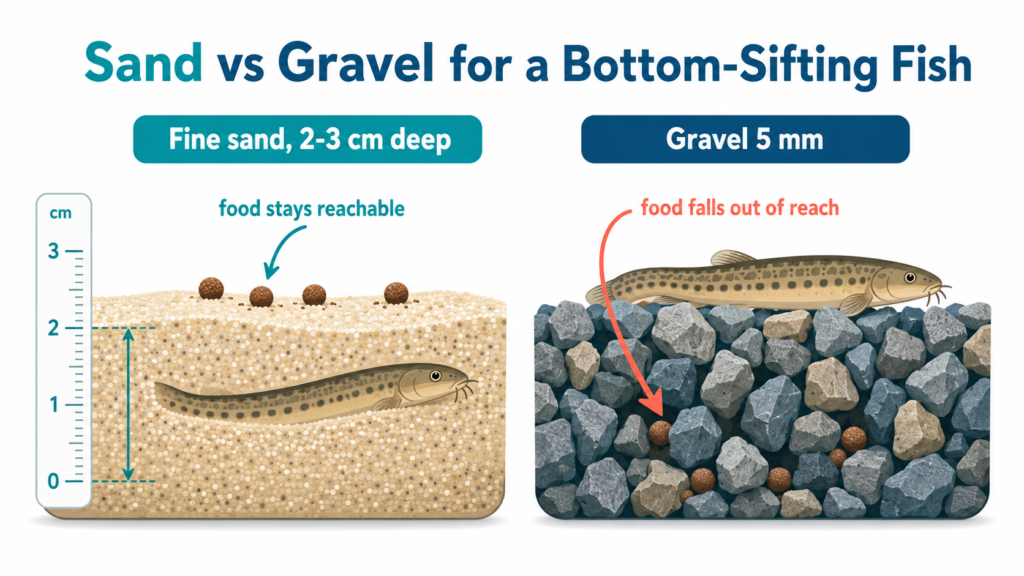
That claim gets repeated because it is dramatic, not because keepers can show it happening. The stronger case for sand is behavioural, and it happens to be the thing you actually care about: on sand, kuhli loaches burrow, sift, feed properly and are visible more often. On gravel they lose food between the grains and spend more of their lives out of sight. This guide covers which sand to buy, how deep to lay it, what to do in a planted tank, and which parts of the standard advice hold up.
Do kuhli loaches need sand?
They do not need it to survive — plenty live for years on smooth gravel. They need it to behave like kuhli loaches. These are Pangio species from soft-bottomed, leaf-littered streams, built to push into loose substrate and to sift mouthfuls of it for food particles. A fine bed lets them do both. Gravel makes the first impossible and the second inefficient.
That matters more than it sounds, because the most common complaint about this species is that owners never see them. The variables that move that needle are lighting, tankmates and substrate — we ranked all six in our guide to kuhli loaches that hide all day. Substrate came third, and it is the cheapest of the three to change.
| Substrate | Burrowing | Food access | Planting | Verdict |
|---|---|---|---|---|
| Pool filter sand | Excellent — grains roll and part easily | Food stays on the surface where they find it | Fine for rooted plants; no nutrients of its own | ✅ Best all-round choice |
| Play sand | Good, but grains are very fine and compact | Good | Compacts more; needs stirring | ⚠️ Cheapest, needs rinsing and stirring |
| Blasting / black diamond sand | Good, and dark colour keeps fish visible | Good | Fine | ✅ Good, but rinse thoroughly first |
| Fine smooth gravel (2–3 mm) | None — they can only wedge between grains | Food falls out of reach | Easy | ⚠️ Survivable, not suitable |
| Standard gravel (5 mm+) | None | Poor — most sinking food disappears below | Easy | ❌ Avoid |
| Aquasoil | They will dig into it and break down the granules | Adequate | Best for plants | ⚠️ Works, but expect a mess — cap or use pots |
| Bare bottom | None | Excellent | None | ❌ Poor for a burrowing species |
The barbel claim, checked honestly
Search this topic and every page-one result tells you gravel damages barbels — the sensory whiskers around the mouth. It is presented as established fact and never sourced. Here is a fairer reading of what is actually known, because getting the reason right changes what you do about it.
| Common claim | How well it holds up | Practical takeaway |
|---|---|---|
| “Gravel shreds their barbels” | Weak as stated. Barbel erosion in bottom-dwellers is more consistently associated with poor substrate hygiene — bacteria in trapped detritus — than with grain sharpness alone. | Clean substrate matters as much as grain size. Gravel traps more waste, which is the mechanism worth worrying about. |
| “They must be able to burrow” | Partly. Reports are genuinely split — many keepers watch them bury and sift, others never see it in years. | Provide the option. Do not treat burrowing as guaranteed behaviour. |
| “Sand causes deadly anaerobic pockets” | Overstated at nano depths. Pockets form in deep, undisturbed beds — and a group of loaches is itself a stirring mechanism. | Keep it under about 1 inch (2.5 cm) and it is a non-issue. |
| “Don’t mix sand and gravel” | Reasonable. Mixed beds settle into layers, trap waste at the boundary and clean badly. | Pick one. If you want both looks, separate them with a barrier. |
| “Dark substrate keeps them visible” | Supported by keeper reports, and consistent with a scaleless prey species avoiding high-contrast ground. | Choose a dark sand if visibility is your goal. |
💡 Sand is the right answer whichever mechanism you believe. But if you switch to sand and keep vacuuming the surface conscientiously, you have addressed the hygiene case as well — and that one is better evidenced.
How to lay it: depth, grain and rinsing
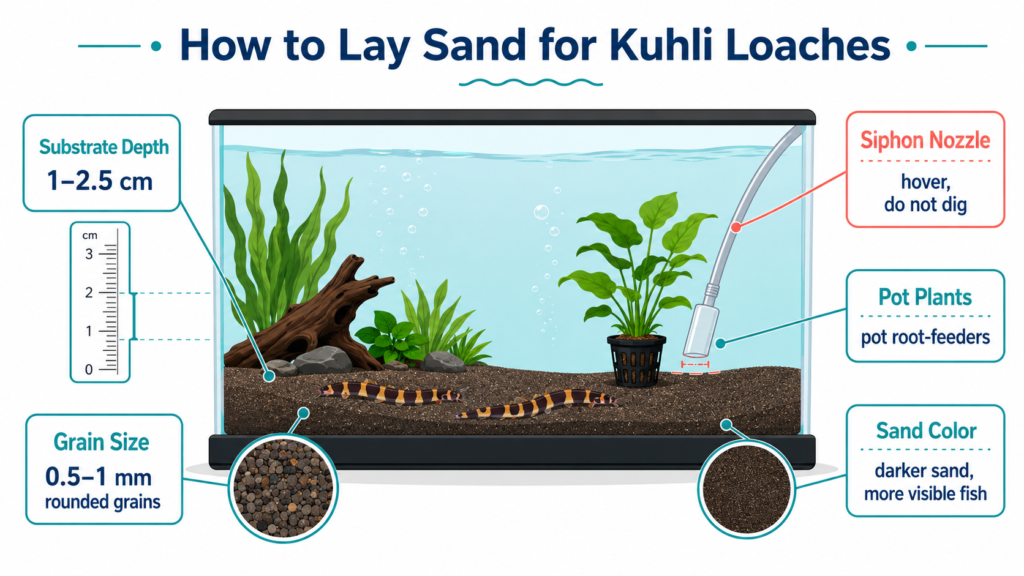
- Depth: 1–2.5 cm (roughly half an inch to an inch). Deep enough to bury in, shallow enough that gas pockets never become a topic.
- Grain size: around 0.5–1 mm. Pool filter sand sits in this range and stays loose; very fine play sand compacts into a slab.
- Shape: rounded rather than angular. Blasting grit is fine visually but rinse it exhaustively — it arrives dusty.
- Rinsing: in a bucket, stirring and pouring off the cloudy water, repeatedly, until the water runs nearly clear. Ten minutes here saves a week of haze.
- Adding water: pour onto a plate or a bag so you do not blast the bed across the tank. If it clouds anyway, see cloudy water after a water change — sand fines are a classic cause.
Maintenance is simpler than with gravel, not harder. You hover the siphon just above the surface rather than digging into it; waste sits on top of sand instead of sinking into it, which is exactly why it stays cleaner. Once a month, run your fingers through any area the loaches do not visit — under hardscape, mostly — and you are done.
Sand and plants in the same tank
This is the real friction point, because the aquascaping answer (nutrient soil) and the loach answer (loose sand) pull in opposite directions. A soil substrate capped with sand is the standard planted-tank solution — but a burrowing fish digs through caps, brings soil to the surface and clouds the tank doing it.
Three approaches that work, in order of how well they hold up:
- Sand plus plants that do not root in it. Anubias and java fern attach to wood and stone, and moss grows on anything — no substrate nutrients required. This is the cleanest fit for a loach tank.
- Sand plus root-tabs, or potted root-feeders. Amazon swords and crypts do fine in inert sand fed with tabs, and a pot keeps the roots and the fish separated.
- Capped soil, accepting the mess. Workable in larger tanks with a thick cap, but expect the loaches to eventually find the boundary.
Our low-light plant list is mostly attaching species, which is why it pairs so well with a sand-bottomed tank, and anubias care covers the single easiest plant to run this way.
Switching from gravel to sand without crashing the tank
- Rinse the sand first, outside the tank, until the runoff is nearly clear.
- Move the fish to a holding container of tank water — kuhlis wedge into gravel and are easy to injure while you dig it out.
- Remove gravel in sections rather than all at once, and keep your filter running throughout. Most of your bacteria live in the filter, not the substrate, so a staged change is low-risk.
- Add the sand, then refill gently onto a plate.
- Expect a few days of haze, and possibly a small bacterial bloom. Test ammonia and nitrite for the first week rather than assuming.
- Return the fish once the temperature matches — and give them a week before judging whether behaviour changed.
If ammonia does appear, treat it as a disturbed cycle rather than a substrate problem; our cycling guide covers the recovery.
Keep Exploring
- Kuhli loach care guide — tank size, group size, feeding and lifespan.
- Kuhli loach hiding all day? — the six variables that decide whether you ever see them.
- Nano aquascaping ideas — layouts that work with a sand-bottomed tank.
- Best low-light aquarium plants — attaching species that need no nutrient substrate.
- Nano tank maintenance schedule — how to vacuum sand without hoovering it up.
Frequently Asked Questions
Can kuhli loaches live on gravel?
They can live on smooth, small gravel, but they cannot burrow in it and they lose sinking food into the gaps. Expect a fish you see less often and one that competes badly at feeding time. If gravel is what you have, feed sinking food after lights-out and keep the substrate scrupulously clean.
How deep should sand be for kuhli loaches?
About 1–2.5 cm. That is deep enough for a slim-bodied fish to bury itself and shallow enough that anaerobic pockets never become a concern, particularly with loaches turning it over as they sift.
Is pool filter sand safe for kuhli loaches?
Yes, and it is the most-recommended option. The grains are rounded, sized around 0.5–1 mm, and it stays loose rather than compacting the way very fine play sand can. Rinse it thoroughly before it goes in.
Do kuhli loaches actually burrow in sand?
Some do it constantly and some never do, and keeper reports are genuinely split on this. Sand is still the right substrate because of feeding and hygiene, but do not buy it expecting guaranteed burrowing behaviour — individuals and species within the group differ.
Will sand hurt my plants?
Only in the sense that sand carries no nutrients of its own. Attaching plants like anubias, java fern and moss do not care, and root-feeders such as crypts and swords do well with root tabs or in pots. That combination keeps both the plants and a burrowing fish happy.
Does dark sand really make kuhli loaches more visible?
Keeper reports consistently say so, and it fits the biology: a scaleless prey fish is more exposed against a bright, high-contrast floor. Pairing dark sand with dimmer lighting is the combination most often credited with turning invisible loaches into ones you actually see.