
The most common beginner aquarium mistakes almost all trace back to the same root cause: moving too fast. The good news is that the nine errors below are predictable, well understood, and easy to avoid once you know them. Dodge these and you’ll skip the frustration that makes so many first-timers quit.
Here are the nine most common new-tank mistakes, why each one hurts, and the simple fix for every one. They’re listed roughly in the order they tend to bite a beginner — from the day-one rush to add fish, through stocking and feeding errors, to the maintenance habits that quietly decide whether your tank thrives or crashes a month in. None of them require expensive gear to avoid; they just require knowing they exist.
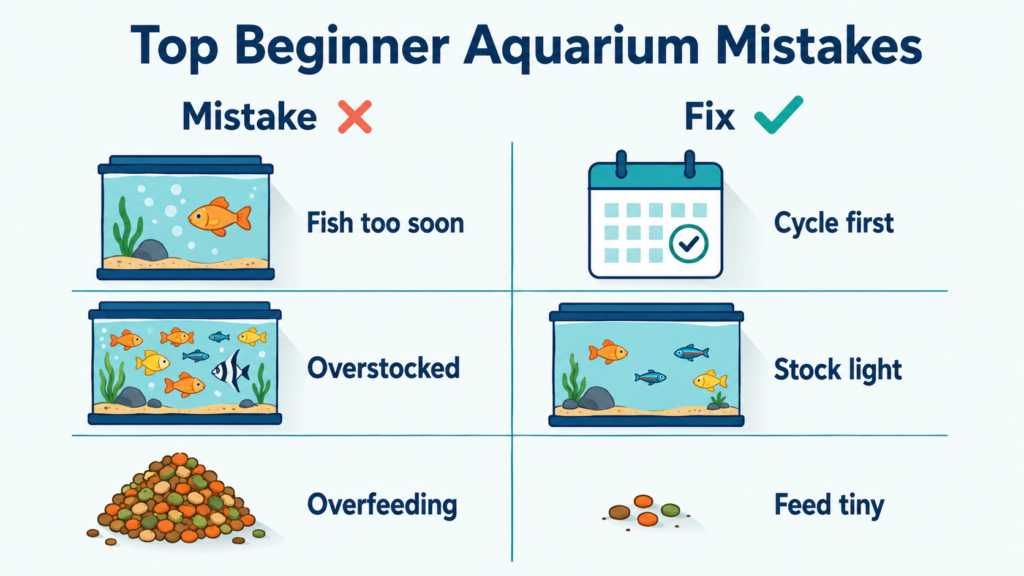
The 9 beginner aquarium mistakes at a glance
| # | Mistake | Quick fix |
|---|---|---|
| 1 | Adding fish before cycling | Cycle the tank first (3–6 weeks) |
| 2 | Buying too small a tank | Go 5 gallons or larger |
| 3 | Overstocking | Fewer fish; research adult sizes |
| 4 | Overfeeding | Tiny amounts, once or twice a day |
| 5 | No water test kit | Buy a liquid kit |
| 6 | Skipping water changes | ~25% weekly |
| 7 | Cleaning the filter with tap water | Rinse in old tank water only |
| 8 | No dechlorinator | Treat every drop of tap water |
| 9 | Impulse-buying fish | Research before you buy |
1. Adding fish before the tank is cycled
The big one. A new tank has no bacteria to process waste, so fish added on day one are poisoned by their own ammonia. Fix: run a fishless cycle first, and check exactly how long to wait before adding fish.
2. Buying the smallest tank you can find
Tiny tanks swing in temperature and chemistry fast, punishing every mistake. Fix: start at 5 gallons or more — see our nano tank size guide for why bigger is easier.
3. Overstocking
“Just one more fish” overloads the filter and spikes ammonia. Fix: stock conservatively, and always research a fish’s adult size before buying — that cute juvenile may triple in length.
4. Overfeeding
Uneaten food rots into ammonia and fuels algae. Fix: feed only what your fish finish in about a minute, once or twice a day. A skipped day won’t hurt them; overfeeding will.
5. Not owning a test kit
Without testing, you’re blind to the very problems that kill fish. Fix: buy a liquid test kit — it’s on our starter checklist as a true essential.
6. Skipping water changes
Nitrate and other dissolved waste build up invisibly between changes. Fix: do a small partial water change — around 25% — every week. Consistency beats the occasional big scrub.
7. Cleaning the filter under the tap
Most of your good bacteria live in the filter media — and tap-water chlorine kills them, effectively un-cycling your tank. Fix: gently rinse media in a bucket of old tank water, never under a running tap, and never replace all media at once.
8. Forgetting dechlorinator
Tap water contains chlorine or chloramine that harms fish and bacteria. Fix: treat every drop of tap water with dechlorinator before it touches the tank, including top-ups.
9. Impulse-buying fish at the store
That gorgeous fish may need a heater you don’t have, a 30-gallon tank, or peaceful tankmates yours will bully. Fix: research compatibility and care needs before you buy — never decide at the counter.
Symptom-to-mistake quick diagnostic
When something looks off in a new tank, the symptom usually points straight back to one of the nine mistakes. Use this table to jump from “what you’re seeing” to “what to fix” without guessing:
| What you see | Most likely mistake | The fix |
|---|---|---|
| Fish gasping at the surface | Added fish before cycling / overstocked | Test water, big water change, stop adding fish |
| Cloudy white water in week 1–2 | Normal bacterial bloom (not a mistake) | Wait it out; keep testing |
| Green water or algae film | Overfeeding / too much light | Feed less, shorten light to 6–8 hrs |
| Fish died days after a “deep clean” | Rinsed filter media in tap water | Only rinse media in old tank water |
| Nitrate keeps climbing | Skipping water changes | ~25% weekly, on a schedule |
Related reading
Avoid all nine by starting right: read the nano aquarium setup guide, gather gear with the starter checklist, and be patient through the cycling process.
Frequently Asked Questions
What is the most common beginner aquarium mistake?
Adding fish before the tank is cycled. With no beneficial bacteria, fish waste poisons the water — the leading cause of early fish loss in new tanks.
How often should a beginner change the water?
About 25% once a week for a nano tank. Regular small changes keep nitrate low and the water stable far better than rare large ones.
Why did my new tank get cloudy?
A cloudy new tank is usually a harmless bacterial bloom during cycling. Don’t panic-clean — keep up testing and small water changes, and it clears as the tank matures.
Can I fix these mistakes after they happen?
Almost always, yes. Most are reversible with patience: cycle properly, cut feeding, do regular water changes, and stop adding fish until the water tests clean.
What’s the single best habit to avoid most beginner mistakes?
Slow down and test the water. Most of the nine mistakes come from rushing — adding fish too soon, overstocking, overfeeding. A weekly five-minute test-and-water-change routine catches problems while they’re still fixable and builds the patience the hobby rewards. If you only change one thing, make it this.