
“How long before adding fish to a new tank?” is the question every excited beginner asks on day one — and the honest answer is the hardest to hear: usually 3 to 6 weeks, not a few days. Rushing this single step is the number-one reason new tanks crash and fish die in their first month.
Here’s exactly why the wait exists, how long each method really takes, the signs your tank is finally ready, and what happens if you add fish too soon.
Why you can’t just add fish to fresh water
A brand-new tank has no beneficial bacteria yet — the colonies that convert toxic fish waste (ammonia) into something harmless. Until those colonies grow, every bit of waste a fish produces poisons the water it’s swimming in. Growing that bacteria is called cycling, and it can’t be rushed past a certain point because you’re waiting on living organisms to multiply. For the full how-to, see our fishless cycling guide; this article is about the timing.
💡 “Crystal clear water” does not mean “ready for fish.” Clear water and a cycled tank are completely different things — only a test kit can tell you the truth.
How long before adding fish to a new tank, by method
| Method | Typical time to fish | Notes |
|---|---|---|
| Fishless cycle (plain) | 3–6 weeks | Safest; you dose ammonia, no animals at risk |
| Fishless + seeded media | 1–2 weeks | Borrow filter media from an established tank |
| Fishless + bottled bacteria | 2–4 weeks | Quality starter products can speed things up |
| Fish-in cycle | 4–8 weeks | Slow & stressful for fish; emergencies only |
| “Just add fish day one” | ❌ Don’t | New Tank Syndrome — likely fish loss |
The 4 signs your tank is ready for fish
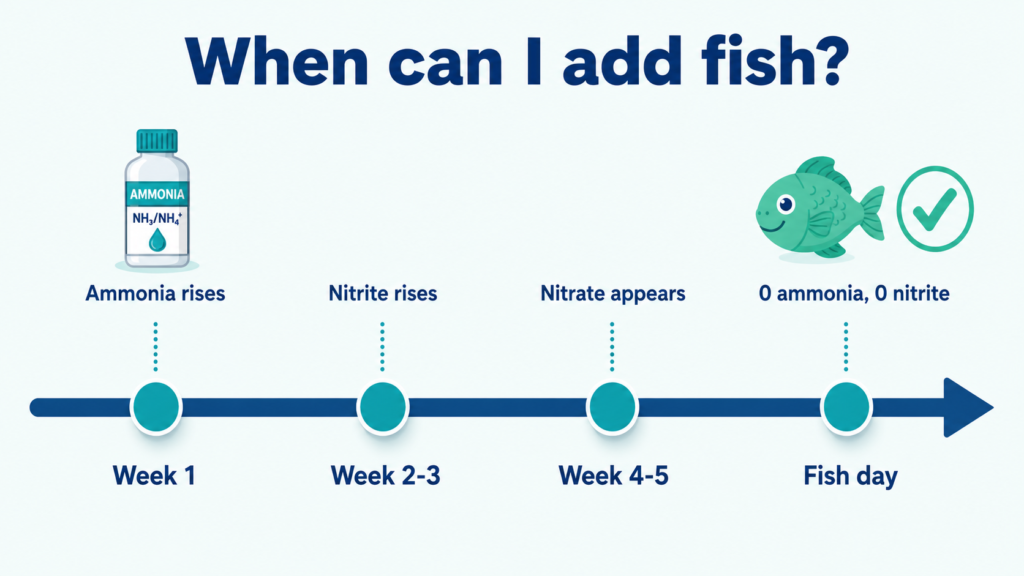
Don’t go by the calendar — go by your test kit. Your tank is cycled and ready when all four of these are true:
- You dose ammonia to ~2 ppm and 24 hours later it reads 0.
- Nitrite also reads 0 in that same 24-hour window.
- Nitrate is present (the harmless end product — proof the chain works).
- You’ve done a large water change to drop nitrate back to a safe level.
Hit all four and you can finally add your first fish — a small number at first, so the bacteria can scale up to the real, ongoing load.
What happens if you add fish too soon
This is called New Tank Syndrome. With no bacteria to process waste, ammonia and then nitrite spike to toxic levels — the same toxic nitrogen cycle chemistry that cycling is meant to tame. Fish suffer burned gills, clamped fins, gasping at the surface, and often die within days to weeks. The survivors are stressed and prone to disease. It’s heartbreaking, expensive, and completely avoidable — which is the whole reason cycling exists.
The warning signs show up fast, and knowing them helps you act before it’s too late if you ever inherit an uncycled tank:
| Warning sign | What’s happening | What to do now |
|---|---|---|
| Fish gasping at the surface | Ammonia or nitrite is burning their gills | Test the water; do a 25–50% change immediately |
| Clamped fins, hiding, no appetite | Toxin stress | Reduce feeding to near zero; daily partial changes |
| Cloudy “new tank” water | Bacterial bloom — cycle is still in progress | Keep testing; don’t add more fish |
| Red or inflamed gills | Ammonia poisoning | Large water change; add no livestock until 0/0 |
If you see these, stop adding fish, feed almost nothing, and do daily partial water changes with dechlorinated water until the tank finishes cycling. Treating the symptoms is damage control — the real fix is always letting the cycle complete before livestock goes in.
How to wait less (safely)
- Seed your filter with media or substrate from a healthy established tank — the single biggest time-saver.
- Add a quality bottled-bacteria starter.
- Keep the water warm (78–82 °F) and well-oxygenated with an air stone.
- Plant heavily — live plants absorb some ammonia and ease the load.
- Keep dosing ammonia so the growing colony never starves mid-cycle.
Related reading
New here? Start with the full nano aquarium setup guide and the fishless cycling walkthrough. If you’re still gathering gear, our nano aquarium starter checklist covers everything you need — including the test kit that tells you when it’s time.
Frequently Asked Questions
How long before you can add fish to a new tank?
Usually 3–6 weeks for a standard fishless cycle. Seeding the filter with established media can cut it to 1–2 weeks. Go by your test results, not the calendar.
Can I add fish after 24 hours if I use water conditioner?
No. Dechlorinator makes tap water safe from chlorine, but it does not create the bacteria that process fish waste. You still need to cycle the tank first.
How do I know the tank is cycled?
Dose ammonia to ~2 ppm; if both ammonia and nitrite read 0 within 24 hours and nitrate is present, it’s cycled. Do a big water change, then add fish.
How many fish can I add at first?
Just a few. Adding your whole stocking list at once can overwhelm a young bacteria colony. Add a small group, wait a couple of weeks, test, then add more.
Does clear water mean my tank is ready for fish?
No — this is the most common false signal. Crystal-clear water only means there’s nothing visibly floating in it; it says nothing about ammonia or nitrite, which are completely invisible. A tank can look pristine and still be deadly to fish. The only proof a tank is cycled is a test kit reading 0 ammonia and 0 nitrite 24 hours after dosing ammonia.