Ember Tetra Care: The Perfect Nano Schooling Fish
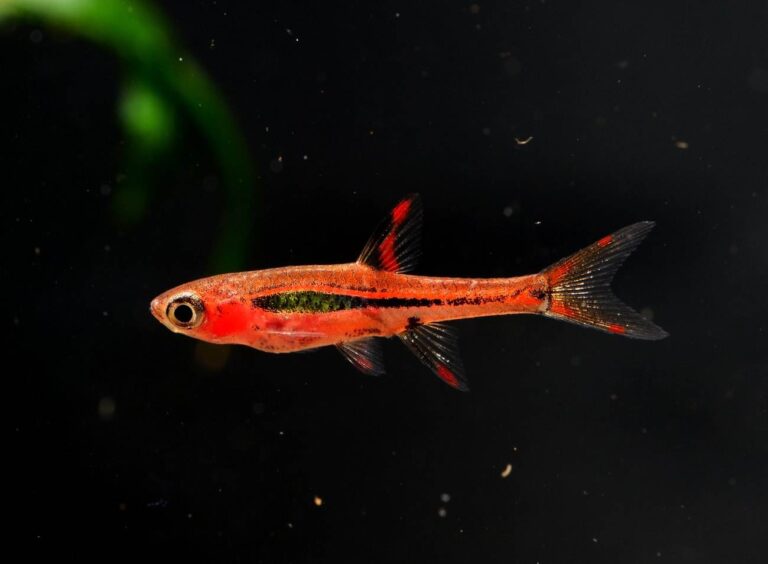
Ember tetra care is one of the friendliest starting points in the whole hobby: these tiny glowing-orange fish are hardy, peaceful, and inexpensive, and a full school looks like a swarm of drifting embers. At just about two centimeters long, Hyphessobrycon amandae packs an astonishing amount of color into a body barely bigger than a grain of rice. Get a few simple things right and you will have one of the most rewarding nano displays you can build, whether it is your first tank or your fifth.
Most care sheets stop at “small, orange, peaceful” and skip the two things that actually decide whether your embers glow or hide. The first is group size — these are loose shoaling fish, and in small numbers they turn pale and skittish. The second is contrast — their color is dramatically brighter over dark substrate and in tannin-stained blackwater. This guide fills both gaps with honest numbers, two original reference tables, a realistic stocking and tankmate plan, and a first-month timeline so your school stays bold and confident.
Why Ember Tetra Care Is So Beginner-Friendly
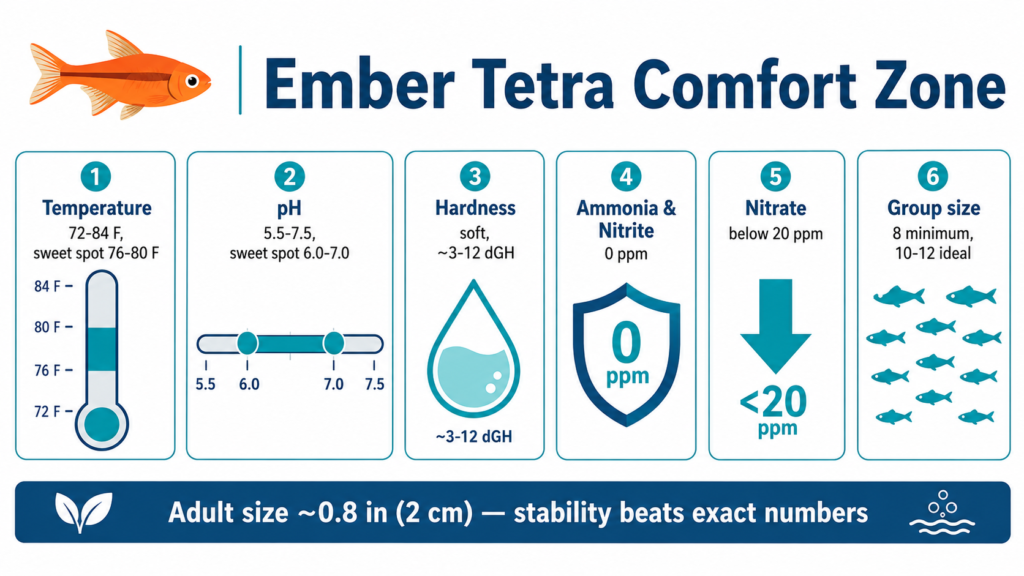
Embers earn their easy reputation honestly. They are small, so they produce little waste; they are peaceful, so they rarely bother anything; and they are adaptable, tolerating a wide band of water chemistry as long as it is stable. Native to slow, warm, tannin-rich waters of the Araguaia basin in Brazil, they are built for soft, slightly acidic conditions but happily settle into typical community tank water. The comfort-zone table below lays out the ranges that matter, with the “sweet spot” that brings out their best color and behavior.
| Parameter | Workable range | Sweet spot | What actually matters |
|---|---|---|---|
| Temperature | 72–84°F (22–29°C) | ~76–80°F | Wide tolerance; steady beats chasing a number |
| pH | 5.5–7.5 | ~6.0–7.0 | Adaptable; stability matters more than the target |
| Hardness (GH) | Soft to moderately hard | Soft (~3–12 dGH) | Soft water suits them but they cope with most tap water |
| Ammonia / Nitrite | 0 ppm | 0 ppm | Non-negotiable; only a cycled tank passes |
| Nitrate | Below 20 ppm | As low as possible | Keep low with plants and weekly changes |
| Adult size | ~0.8 in (2 cm) | — | A micro-mouth needs micro foods |
| Group size | 8 minimum | 10–12 | The single biggest factor in color and confidence |
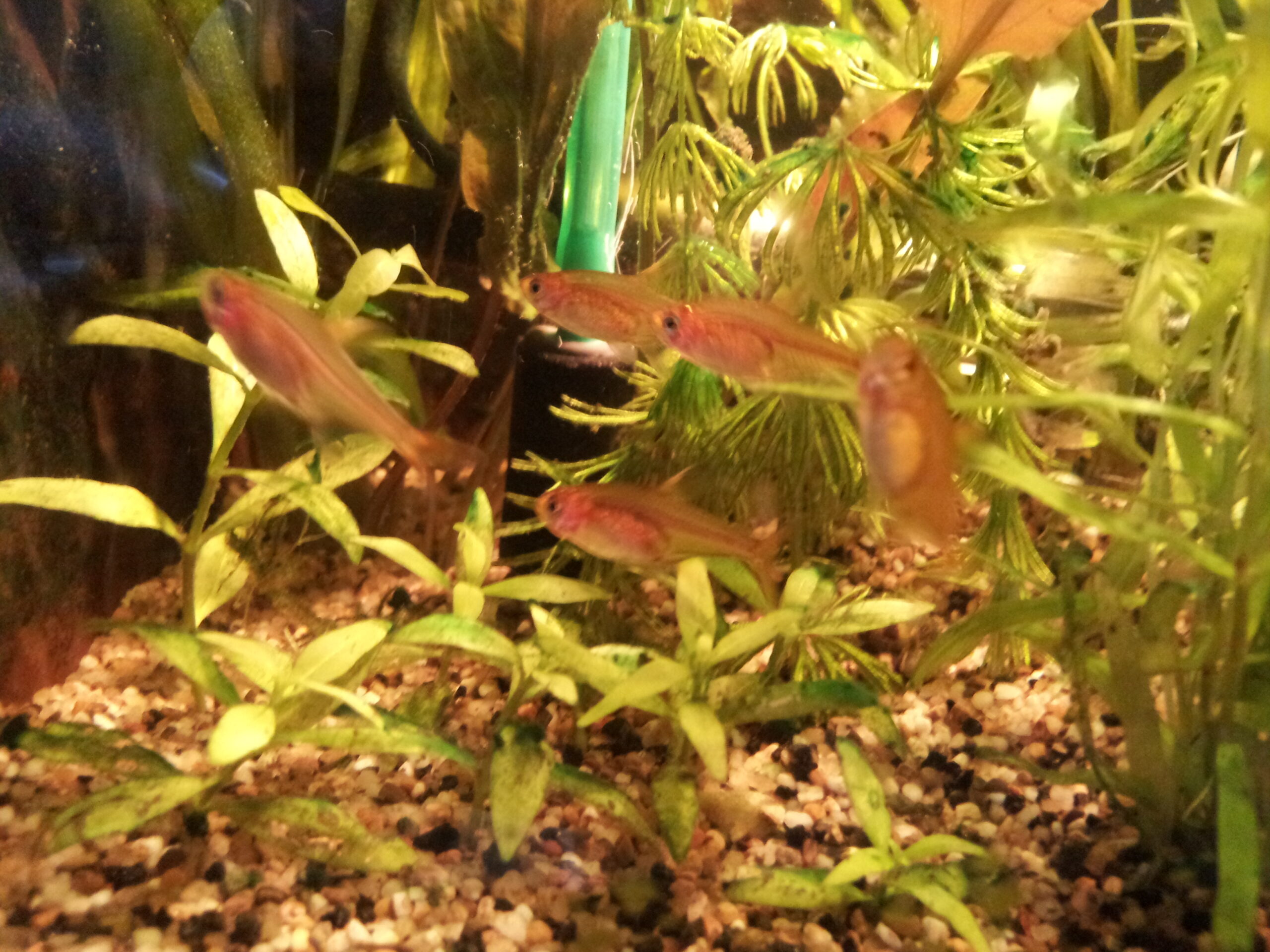
The row worth re-reading is group size. Ember tetras are loose shoalers rather than tight synchronized schoolers, but they still need numbers to feel safe. In a group of three or four they hide in the plants, wash out to a dull peach, and rarely venture into the open. In a group of ten or twelve they spread across the mid-water, hold their deep orange, and behave like the confident little fireballs they are meant to be. For a wider shortlist of easy nano species, see our best nano tank fish for beginners roundup.
Tank Size and the Cycle That Comes First
Because they are so tiny, ember tetras can technically live in a 5-gallon tank — but only if you commit to diligent, frequent water changes, since small volumes swing fast in temperature and chemistry. For most keepers a 10-gallon is the recommended minimum, and it is the smarter choice: the extra water is far more stable, and the longer footprint lets a proper school of ten to twelve stretch out and show natural shoaling behavior. If you are still choosing a tank, our nano tank size guide comparing 3, 5, and 10 gallon setups walks through the trade-offs.
Whatever size you land on, the non-negotiable first step is cycling. A brand-new tank has no bacteria to process the ammonia fish produce, and even hardy embers cannot survive an uncycled tank. Run a fishless cycle until ammonia and nitrite both read zero and nitrate begins to climb — only then is the tank ready for its first school. Rushing this stage is the single most common reason beginner tanks fail, and it is entirely avoidable with a test kit and a little patience.
Design tip: dark substrate plus a few tannin-releasing botanicals (like dried leaves) does more for ember color than any expensive light. Contrast is what makes the orange glow.
Aquascaping is where you turn a decent ember tank into a stunning one. These fish evolved against dark, leaf-littered substrate under a canopy of plants, so recreating that contrast makes their orange practically luminous. Use a dark sand or fine gravel, plant densely with tall stems and floating cover to diffuse the light, and consider a blackwater look with botanicals that stain the water a gentle tea color. The shade and cover also make the school bolder, because a shoaling fish that feels hidden is paradoxically more willing to swim in the open.
Feeding a Micro-Mouth
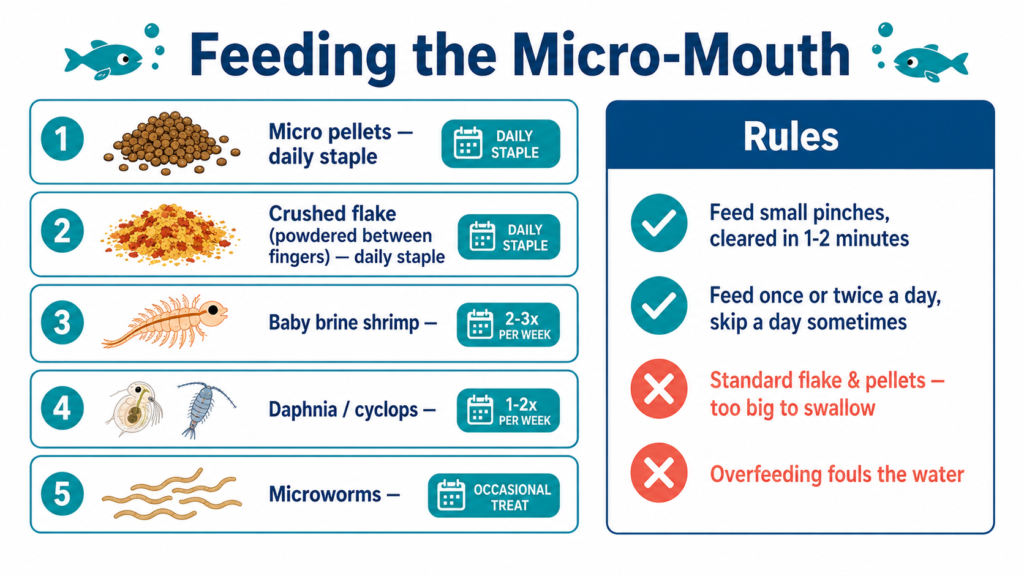
The one genuine catch in ember tetra care is the size of their mouths. An adult ember is about two centimeters long, and its mouth is proportionally tiny, so standard flake and pellets are simply too big to swallow whole. Feed foods sized for a micro-mouth: high-quality micro pellets, flake crushed to a fine powder between your fingers, and small live or frozen foods. As mid-level swimmers, embers prefer to eat food drifting through the water column rather than picking it off the bottom, so feed small pinches that stay suspended.
Variety brings out both color and condition. Baby brine shrimp, daphnia, cyclops, and microworms are all excellent, and rotating them alongside a quality dry staple keeps the fish vivid and active. Feed small amounts once or twice a day — only what the school clears in a minute or two — and skip a day now and then. Overfeeding a tiny-bodied fish is far more dangerous than a light appetite, because uneaten food fouls the water your embers depend on.
| Food type | How to serve it | How often | Why it helps |
|---|---|---|---|
| Micro pellets | Sinking-slow, tiny size | Daily staple | Convenient, balanced base diet |
| Crushed flake | Powdered between fingers | Daily staple | Cheap; must be crushed for the micro-mouth |
| Baby brine shrimp | Live or frozen, thawed | 2–3x per week | Boosts color and conditions for spawning |
| Daphnia / cyclops | Frozen, thawed | 1–2x per week | Adds variety and gentle roughage |
| Microworms | Cultured, rinsed | Occasional treat | Ideal tiny live food, great for fry too |
Tankmates: Building a Peaceful Nano Community
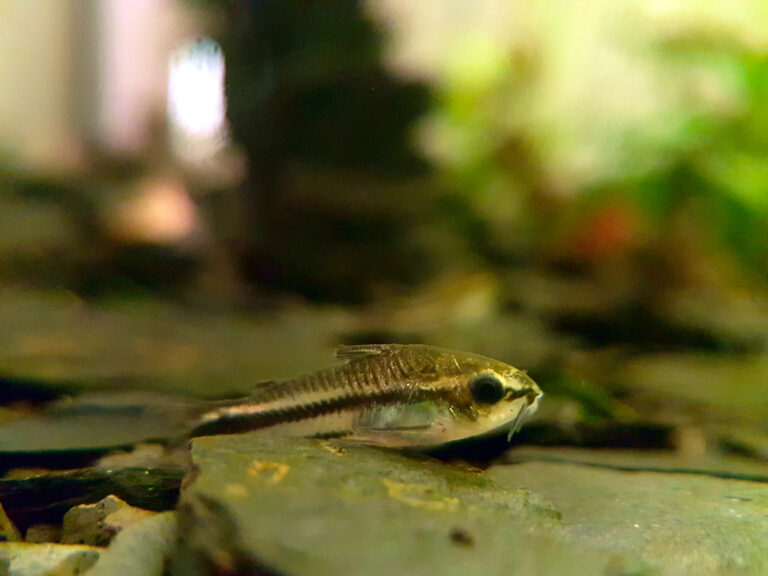
Ember tetras are model community citizens — peaceful, small, and content to stay in their own mid-water lane. The golden rule is to pair them only with other calm, small species that will not outcompete or intimidate them. They are a natural match for chili rasboras, whose deep red plays beautifully against ember orange, and for the jewel-toned celestial pearl danio. Pygmy corydoras are a great bottom-dwelling companion, working the substrate while the embers hold the middle of the tank.
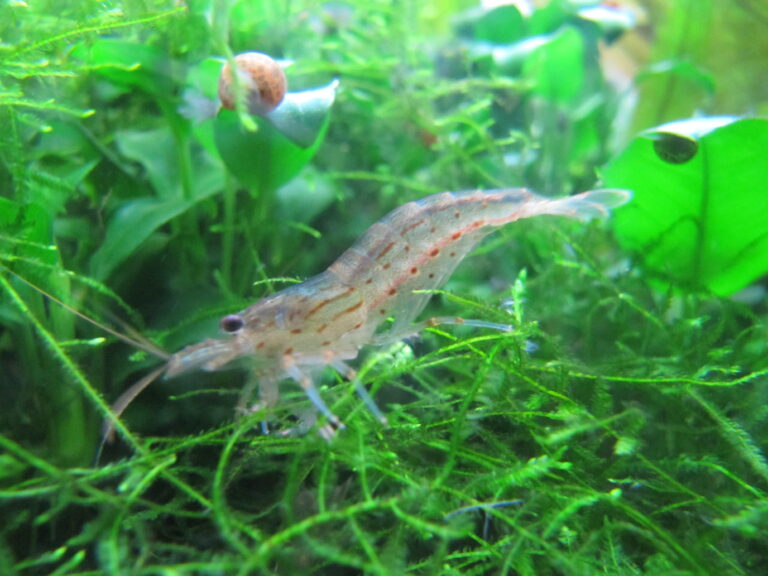
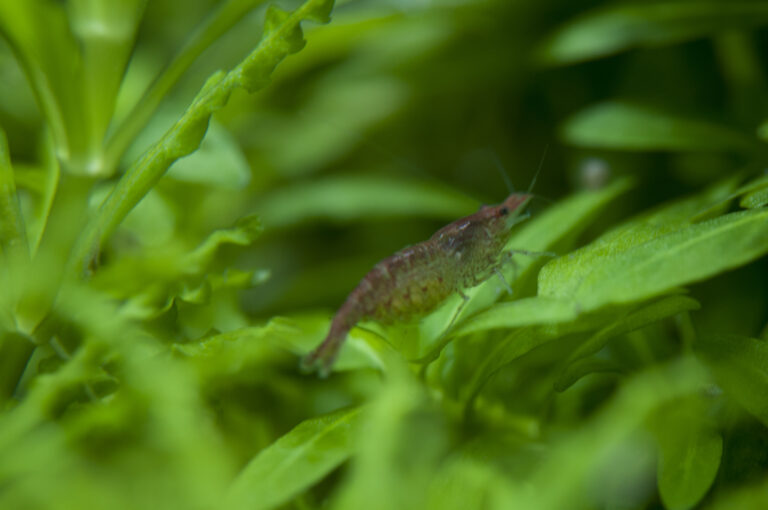
Dwarf shrimp are a popular addition, with one honest caveat. Adult ember tetras are safe with adult shrimp and will not harass them, but their instinct is opportunistic — they will happily eat any baby shrimp small enough to fit in that tiny mouth. In a shrimp-breeding tank, dense moss and cover let some shrimplets survive, but if your goal is a booming shrimp colony, a species-only setup is the surer bet. Avoid anything large, boisterous, or fin-nippy; a peaceful fish this small is easily stressed by pushy tankmates.
For the taxonomy and natural range behind all of this, the Ember tetra (Hyphessobrycon amandae) entry covers the species’ description and Brazilian origins in more detail.
Your First Month: A Realistic Timeline
Ember tetras reward patience more than money. The setup is cheap, but the payoff — a bold, glowing, well-adjusted school — arrives over weeks, not hours. Here is a realistic arc from empty glass to a settled display. Set the tank up and plant it, cycle it fully, add the school all at once so no single fish is stranded alone, and then let color build as the group settles and learns the tank is safe.
- Week 0 — set up a 10-gallon with dark substrate, plant densely, add a gentle filter and heater, and add botanicals for a blackwater tint.
- Weeks 1–4 — run a fishless cycle; wait until ammonia and nitrite both read zero.
- Week 4–5 — drip-acclimate and add the whole school of 10–12 at once; expect pale, shy fish for a few days.
- Weeks 6+ — color deepens and confidence grows; the embers spread into open water and glow their brightest.
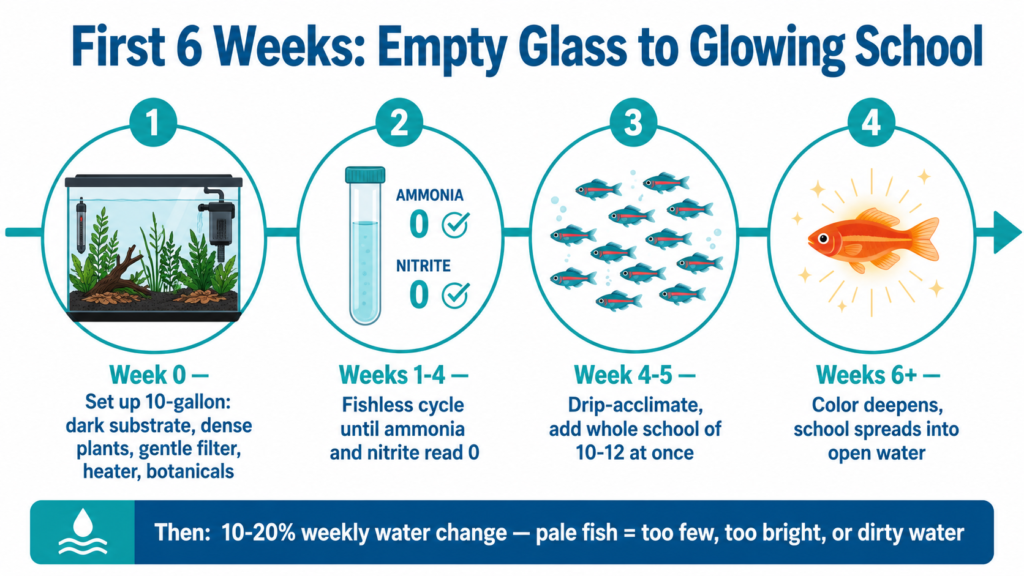
Ongoing care is light: a weekly water change of 10 to 20 percent, always temperature-matched and dechlorinated, keeps nitrate low and the water stable. Watch color as your daily health gauge — a settled, well-fed ember school glows deep orange, while pale, washed-out fish are usually telling you the group is too small, the tank too bright, or the water in need of a change. Every number here is a target band, not a guarantee; your tap water and room temperature will always shape the details.
Keep Exploring NanoTank Lab
- Best Nano Tank Fish for Beginners — where ember tetras rank among the easiest nano species.
- Nano Tank Size Guide (3 vs 5 vs 10 gallon) — why a 10-gallon is the smarter minimum for a school.
- Chili Rasbora Care Guide — a red-and-orange color pairing made for embers.
- Celestial Pearl Danio Care — another jewel-toned, peaceful mid-water tankmate.
Frequently Asked Questions
How many ember tetras should I keep together?
Keep at least eight, and ideally ten to twelve. Ember tetras are loose shoaling fish that rely on numbers to feel secure, and in small groups of three or four they hide, stay skittish, and lose their color. A larger school spreads confidently across the mid-water and holds a deep, vivid orange, which is exactly the look that makes these fish so striking.
Can ember tetras live in a 5-gallon tank?
They can, but a 10-gallon is the recommended minimum. Their tiny size means a 5-gallon is physically possible if you commit to diligent, frequent water changes, since such a small volume swings quickly in temperature and chemistry. A 10-gallon gives you more stable water and enough room for a proper school of ten to twelve to show natural shoaling behavior, which is why it is the better choice for most keepers.
What water temperature and pH do ember tetras need?
Aim for about 76 to 80°F and a pH near neutral to slightly acidic. Ember tetras tolerate a wide band — roughly 72 to 84°F and pH 5.5 to 7.5, in soft to moderately hard water — but they look and behave best in that warmer, gently acidic sweet spot. As with most nano fish, steady, stable parameters matter far more than hitting an exact target number.
Are ember tetras safe with shrimp?
Adult ember tetras are safe with adult dwarf shrimp and will not harass them. The one caveat is baby shrimp: an ember’s opportunistic instinct means it will eat any shrimplet small enough to fit in its mouth. Dense moss and cover let some survive in a mixed tank, but if you want a thriving shrimp colony, a shrimp-only setup is the more reliable option.
What do ember tetras eat?
Feed foods small enough for their micro-mouth. Standard flake and pellets are too large to swallow whole, so use micro pellets, finely crushed flake, and small live or frozen foods like baby brine shrimp, daphnia, and microworms. As mid-level swimmers they prefer food drifting through the water column, so offer small pinches once or twice a day and avoid overfeeding, which quickly fouls a small tank.