Amano Shrimp Care: Nano Tank Size, Algae & Molting
Amano shrimp care comes down to three things most guides gloss over: giving them enough algae to actually eat, a tight-fitting lid so they never climb out, and a little patience through their molt cycle. The amano shrimp (Caridina multidentata) is widely considered the hobby’s single best algae eater, an inch-and-a-half cleanup machine that mows through hair and thread algae faster than any other invertebrate you can buy. But the reputation gets oversold, and the mismatch between “put one in and it fixes everything” and reality is exactly where new keepers get frustrated.
Most amano shrimp care articles stop at “they eat algae” and a generic parameter chart — this one also covers exactly which algae they will and won’t touch (spoiler: not black beard algae), how many you actually need per tank size for real algae control versus token cleanup, and what to do during the vulnerable day or two right after a molt. You get three original reference tables to keep open while you shop and stock, plus honest numbers on why you almost certainly cannot breed them at home.
Amano Shrimp at a Glance
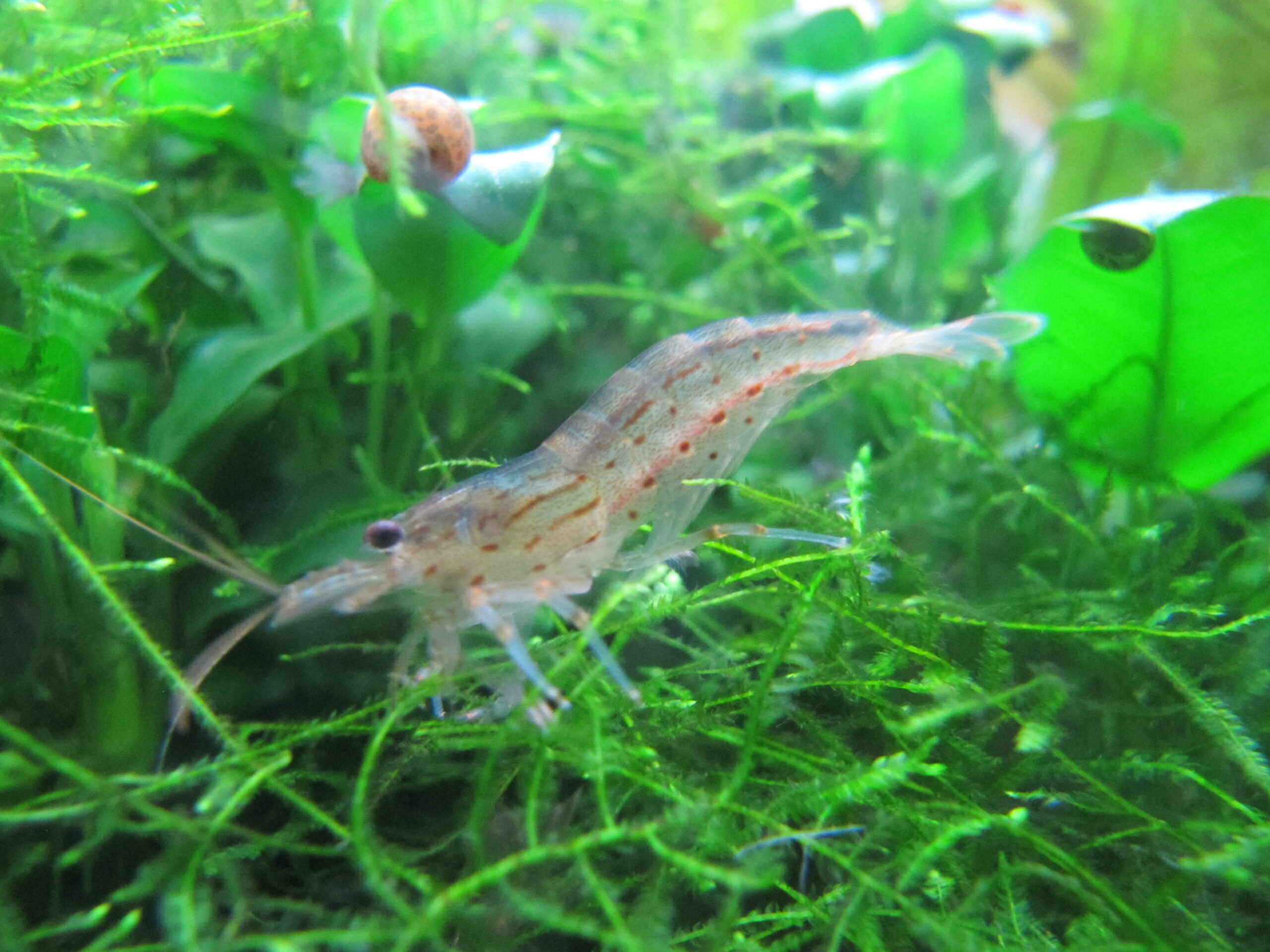
Amanos are peaceful, hardy, and almost entirely occupied with foraging. They are larger and longer-lived than the more colorful Neocaridina in our cherry shrimp care guide, which makes them a better fit for tanks that also house small fish, since they are too big to be an easy snack. Their translucent grey-green body with a dotted lateral stripe is subtle rather than showy, so people keep them as workers, not display animals. The quick-stats table below is the fast reference version of everything that follows.
| Trait | Amano shrimp detail |
|---|---|
| Scientific name | Caridina multidentata (formerly Caridina japonica) |
| Adult size | ~1.5–2 in (4–5 cm); females larger |
| Lifespan | 2–3 years, sometimes longer |
| Minimum tank | 5 gallons for a trio |
| Temperature | 68–78°F (20–26°C) |
| pH | 6.5–7.8 |
| GH / KH | 6–12 dGH / 1–8 dKH |
| Bioload | Very low |
| Temperament | Peaceful; safe with dwarf shrimp & nano fish |
| Care level | Easy to keep, nearly impossible to breed |
The two rows that trip people up are bioload and care level. Because amanos add almost nothing to the waste load, keepers assume they are indestructible — but they are genuinely sensitive to copper and to ammonia or nitrite spikes, so a fully cycled tank is non-negotiable. And “easy to keep” sits right next to “nearly impossible to breed,” which surprises anyone expecting the self-replenishing colonies that cherry shrimp produce.
The Amano Shrimp Care Basics: Tank, Water, and a Tight Lid
Sound amano shrimp care starts with a cycled, stable tank. Amanos tolerate a wide comfort band — roughly 68 to 78°F, pH 6.5 to 7.8, and a moderately hard GH so they have the minerals to build each new shell — but they do not tolerate swings or toxins. Never add them to a tank that has not finished its nitrogen cycle, and keep ammonia and nitrite at a flat zero. If those terms are new to you, our primer on aquarium water parameters for beginners breaks down what each number means and why stability beats chasing a perfect reading.
The one piece of hardware amano keepers forget, then regret, is a lid. Amanos are determined climbers and escape artists, especially in a new tank or when water quality dips. They will walk up airline tubing, filter cords, and even a thin film on the glass, and a shrimp on the carpet dries out fast. A tight-fitting glass lid or a mesh cover with cutouts sealed around cords is essential, not optional. Beyond that, a sponge filter or a foam-guarded intake keeps them from being pulled in, and stable water does the rest.
💡 The most common way to lose an amano shrimp is not disease or bad water — it is finding it on the floor. If you buy nothing else, buy a lid that actually seals.
Copper is the other silent hazard. Many general fish medications, some plant fertilizers, and certain tap-water sources contain copper that is harmless to fish but toxic to invertebrates. Read labels, use a shrimp-safe dechlorinator, and quarantine any medicating away from your amanos. Do all of this in a tank sized for stability — a larger water volume resists the temperature and chemistry swings that stress shrimp, which is why the nano tank size guide comparing 5, 10, and 20 gallon setups is worth a look before you stock heavily.
How Many Amano Shrimp for Real Algae Control
This is where expectations and reality collide. A single amano in a 20-gallon tank is a rounding error against an algae bloom; effective cleanup is a numbers game. As a rough stocking rule, a 5-gallon tank comfortably holds a trio, and you can add about one more shrimp per additional gallon. For genuine algae control — the “why did I buy these” level of results — aim for roughly one shrimp per 2 to 3 gallons. The table below turns that into concrete counts.
| Tank size | Light cleanup crew | Serious algae control (~1 per 2–3 gal) |
|---|---|---|
| 5 gallon | 2–3 shrimp | 2–3 shrimp |
| 10 gallon | 3–5 shrimp | 4–5 shrimp |
| 20 gallon (long) | 5–6 shrimp | 6–10 shrimp |
| 29–40 gallon | 8–10 shrimp | 12–20 shrimp |
Amanos have such a low bioload that stocking on the higher end rarely fouls the water, which is why they are a rare “add more of them” recommendation. They do not need to be kept in groups the way schooling fish do, but they are more active and confident with company, so a small squad both cleans better and behaves more naturally. If you are stocking a brand-new nano and weighing amanos against other options, our roundup of the best shrimp for a nano tank compares them side by side with cherries and other dwarf species.
What Amano Shrimp Actually Eat (and What They Ignore)
The amano’s whole reputation rests on appetite, and it is mostly deserved. They devour hair algae, thread algae, and soft green film algae with a speed no other cleanup invertebrate matches, and they pick at leftover food and biofilm all day. But the myth that they eat every algae is where tanks go wrong. The one every keeper wants gone — black beard algae, that dark fuzz on driftwood and leaf edges — amanos will not reliably touch, despite countless forum claims. BBA is a water-flow and CO2 problem to fix at the source, not a shrimp problem.
| Algae / food type | Do amanos eat it? | Notes |
|---|---|---|
| Hair & thread algae | Yes — eagerly | Their specialty; cleared fast in a group |
| Soft green film algae | Yes | Grazed off glass, plants, and hardscape |
| Leftover food & biofilm | Yes | General janitors; reduce waste buildup |
| Black beard algae (BBA) | No (not reliably) | Fix flow/CO2; do not count on shrimp |
| Green spot & hard algae | Rarely | Too tough; a nerite snail does better |
| Blue-green “algae” (cyano) | No | A bacteria, not algae — needs its own fix |
One practical consequence: in a very clean, algae-free tank, amanos can go hungry and will strip new plant growth or beg constantly. If they have cleaned house, supplement lightly with a sinking algae wafer, blanched zucchini, or a shrimp pellet every couple of days — enough to be gone within a few hours, never so much it fouls the water. A hungry amano is an active amano, but a starving one in a spotless tank is a common oversight.
Molting: The Vulnerable Days You Should Not Panic Over
Amanos grow by molting — shedding their old exoskeleton roughly every five to six weeks and expanding into a soft new shell that then hardens over the next day or two. During those hours the shrimp is defenseless, so a freshly molted amano typically hides in moss or under hardscape for one to three days while the new shell firms up. New keepers panic at two sights: a shrimp that has vanished (it is hiding, not dead) and a translucent, perfectly shrimp-shaped shell on the substrate (that is the molt, not a corpse).
Leave the shed exoskeleton in the tank. Shrimp re-consume it to reclaim calcium and minerals for the next shell, so scooping it out throws away free shell-building material. If you see repeated failed or incomplete molts — a shrimp stuck half-in its old shell, or the dreaded “white ring of death” gap — the usual culprit is water that is too soft or an unstable GH, not disease. The fix is mineral balance and stability, which is a husbandry adjustment, not a medication. The checklist below keeps molt time uneventful.
| Molt-time checklist | Why it matters |
|---|---|
| Keep GH in the 6–12 dGH band | Minerals build the new shell; too soft causes failed molts |
| Leave the shed shell in the tank | Re-eaten as a calcium source |
| Provide dense cover (moss, wood) | Hiding spots protect the soft, newly molted shrimp |
| Make water changes small & matched | A big TDS or temp swing can trigger a stressful mass molt |
| Do not disturb a hiding shrimp | It is hardening its shell, not sick — give it 1–3 days |
Breeding and Tankmates: Manage Your Expectations
Here is the honest part almost no store mentions: you will almost certainly not breed amano shrimp at home. Unlike cherry shrimp, which hatch as miniature adults in plain freshwater, amano larvae require brackish (salt) water to survive their first weeks, then must transition back. A berried female will hatch her eggs, but in a standard freshwater tank the larvae die within days. Success requires a dedicated brackish larval setup, which is why nearly every amano sold is commercially raised. Treat the ones you buy as a stable, non-multiplying crew.
On tankmates, amanos are model citizens. They are peaceful, ignore other invertebrates, and are perfectly safe alongside dwarf shrimp and small, non-aggressive nano fish. Their larger size even protects them from fish that would eat a baby cherry shrimp. The only pairings to avoid are the obvious predators — cichlids, larger gouramis, crayfish, or anything big enough to view a two-inch shrimp as food. For a neutral scientific overview of the species, its native range, and its larval biology, the Caridina multidentata reference entry is a solid, non-commercial source.
Keep Exploring NanoTank Lab
- Best Shrimp for a Nano Tank — how amanos compare to cherries and other dwarf species.
- Cherry Shrimp Care Guide — the colorful, easy-to-breed alternative crew.
- Aquarium Water Parameters for Beginners — what every number on your test kit means.
- Nano Tank Size Guide (5 vs 10 vs 20 gallon) — pick a footprint that stays stable.
Frequently Asked Questions
Do amano shrimp really eat black beard algae?
No — amano shrimp do not reliably eat black beard algae (BBA), despite very common claims online. They excel at hair, thread, and soft green algae, but the tough, dark tufts of BBA are one they mostly ignore. BBA is best solved by improving water flow and CO2 stability, or spot-treating the source, rather than relying on any shrimp.
How many amano shrimp do I need per gallon?
For serious algae control, aim for about one amano shrimp per 2 to 3 gallons. A 5-gallon tank holds a trio comfortably, and you can add roughly one more shrimp per extra gallon. So a 20-gallon long can support around 6 to 10 for real cleanup — their very low bioload makes stocking on the higher end safe.
Why is my amano shrimp hiding and not moving?
It is almost always molting, not dying. After shedding its shell, an amano hides for one to three days while the soft new exoskeleton hardens, staying tucked in moss or under hardscape. Leave it undisturbed, and leave the shed shell in the tank so it can be re-eaten as a calcium source.
Can amano shrimp live with other shrimp and nano fish?
Yes — amano shrimp are peaceful and safe with dwarf shrimp like cherries and with small, non-aggressive nano fish. Their larger size even keeps them off the menu for fish that might eat tiny shrimplets. Just avoid pairing them with known predators such as cichlids, large gouramis, or crayfish.
Can you breed amano shrimp in a freshwater tank?
Not in a standard freshwater tank — amano larvae need brackish (saltwater) conditions to survive their first weeks before transitioning back to freshwater. A female will carry and hatch eggs, but the larvae die within days in plain freshwater. Home breeding requires a dedicated brackish larval setup, so nearly all amanos are commercially raised or wild-caught.