Guppy Care: Are Guppies Right for a Nano Tank?
Guppy care is the first search almost every new fishkeeper runs, and the honest headline is that guppies are wonderfully easy to keep alive but surprisingly hard to keep in a true nano tank. Poecilia reticulata is peaceful, brilliantly colored, forgiving of ordinary tap water, and cheap — which is exactly why it gets recommended for tiny 3 to 5 gallon setups. The catch nobody mentions on the store label is that guppies are livebearers that breed explosively, so a “perfect beginner nano fish” can quietly turn a small tank into an overstocked one within a couple of months.
Most guppy articles bury this. They repeat the same generic lines — “keep in a 5-gallon, feed flakes, very hardy” — and never address the two decisions that actually determine whether a nano keeper succeeds: how big the tank realistically needs to be once reproduction starts, and how to stock the sexes so the population does not run away from you. This guide fills both gaps with honest size numbers, the smallest setup that genuinely works long-term, and a realistic look at the population math.
Are Guppies Actually a Good Nano Tank Fish?
Guppies earn their beginner reputation for real reasons. They are genuinely hardy, they stay small (males around 1.2 to 1.5 inches), they are peaceful and constantly on display near the surface, and they are inexpensive. On paper, that reads like the ideal first nano fish.
The honest answer is more nuanced: guppies are a fantastic small aquarium fish but a mediocre true nano fish. The problem is not difficulty — it is volume. A mixed-sex group breeds continuously with no trigger, and a 3 to 5 gallon tank simply cannot absorb the resulting bioload and population growth for long. You can start a trio in 5 gallons, but reproduction quickly overwhelms it, which is why 10 to 20 gallons is the realistic long-term home. If your heart is set on a 3-gallon, guppies are the wrong pick; if you can stretch to 10, they are excellent. The comfort-zone table below sorts out which numbers guppies actually care about.
| Parameter | Comfortable range | How fussy? | What actually matters |
|---|---|---|---|
| Temperature | 72–82°F (22–28°C) | Forgiving | Stable is better than exact; avoid daily swings |
| pH | 7.0–8.0 | Prefers neutral to alkaline | Unlike tetras, guppies like harder, slightly basic water |
| GH (general hardness) | ~8–30 dGH | Likes it moderate to hard | Soft tap water is the one thing to correct — add minerals |
| Ammonia / Nitrite | 0 ppm | Zero tolerance | Non-negotiable; only an uncycled tank fails this |
| Nitrate | Below 30 ppm | Moderate | Rising nitrate is the hidden cost of an overstocked breeding tank |
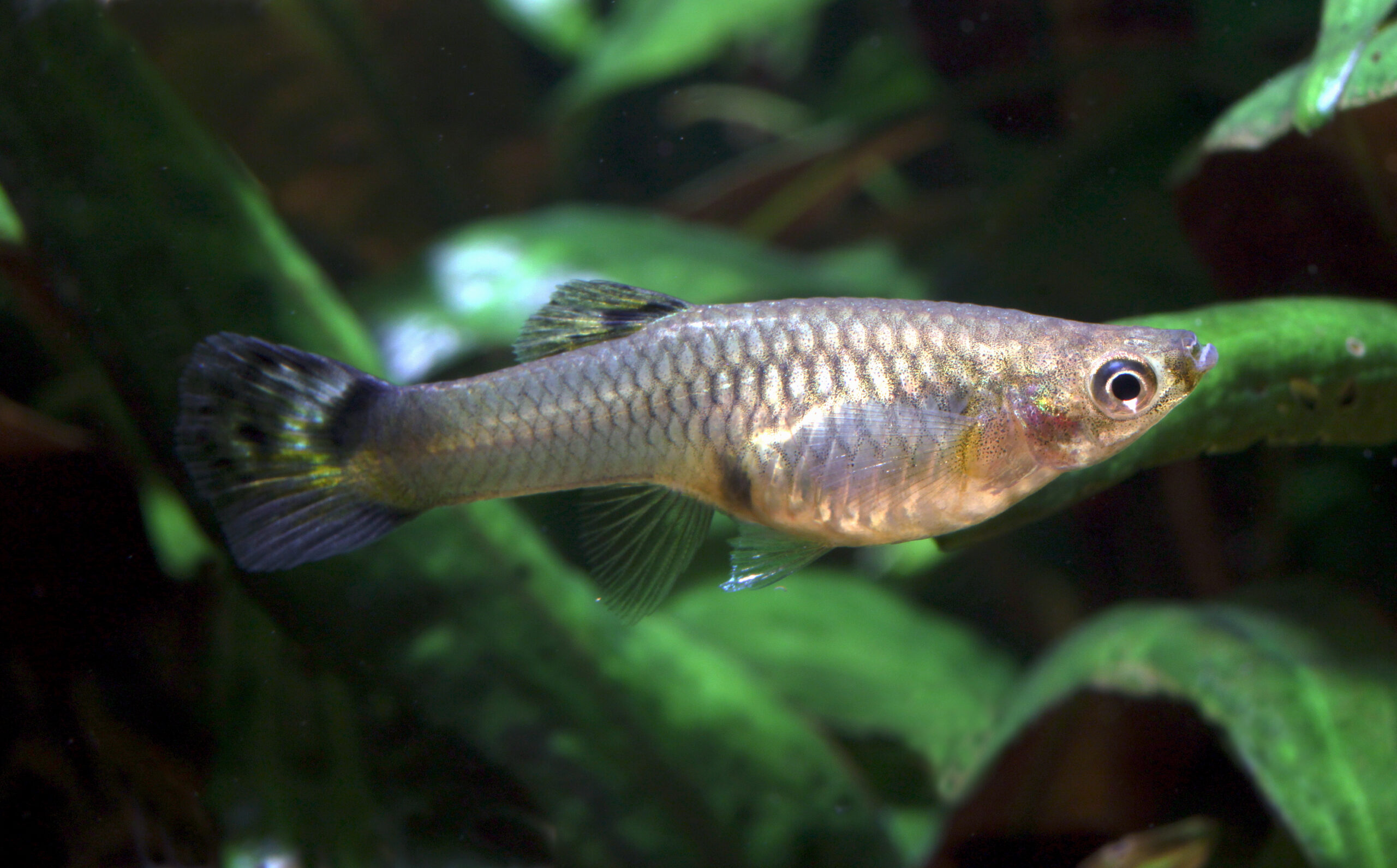
| Adult size | Males ~1.2–1.5 in, females ~1.5–2.5 in | — | Females are larger and plainer than the flashy males |
| Minimum realistic tank | ~10 gallons | Important | A trio starts in 5 gal, but breeding pushes you to 10–20 |
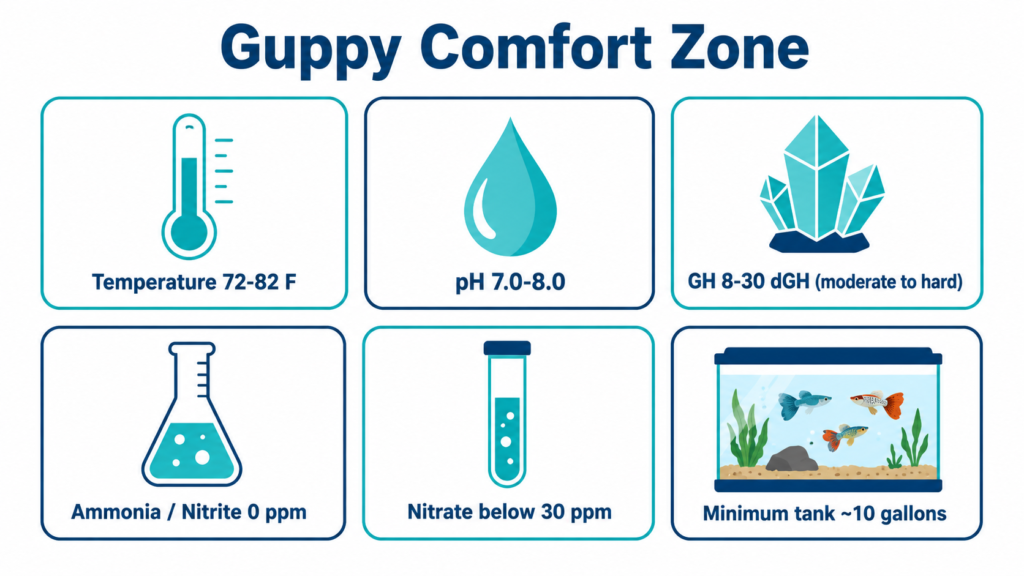
The row beginners misread most is GH. Guppies come from hard-water habitats, so the soft, acidic water that suits many popular schoolers is actually wrong for them. If your tap water is naturally moderate to hard, you are already set up to keep guppies with no adjustment. If it is soft, that is the one parameter worth correcting before you buy fish. If you are still choosing a tank, our nano tank size guide comparing 3, 5, and 10 gallon setups walks through why the extra volume changes everything for a breeding livebearer.
Guppy Care Basics: Water, Diet, and Daily Routine
Day-to-day guppy care is mostly steady, undramatic maintenance — which is a big part of why it suits beginners. The non-negotiable first step comes before any fish: cycling. A new tank has no bacteria to convert toxic ammonia into safer nitrate, and even a hardy guppy cannot survive that gap. Run a fishless cycle first, and see how long before you can safely add fish to a new tank so your timing is realistic rather than rushed.
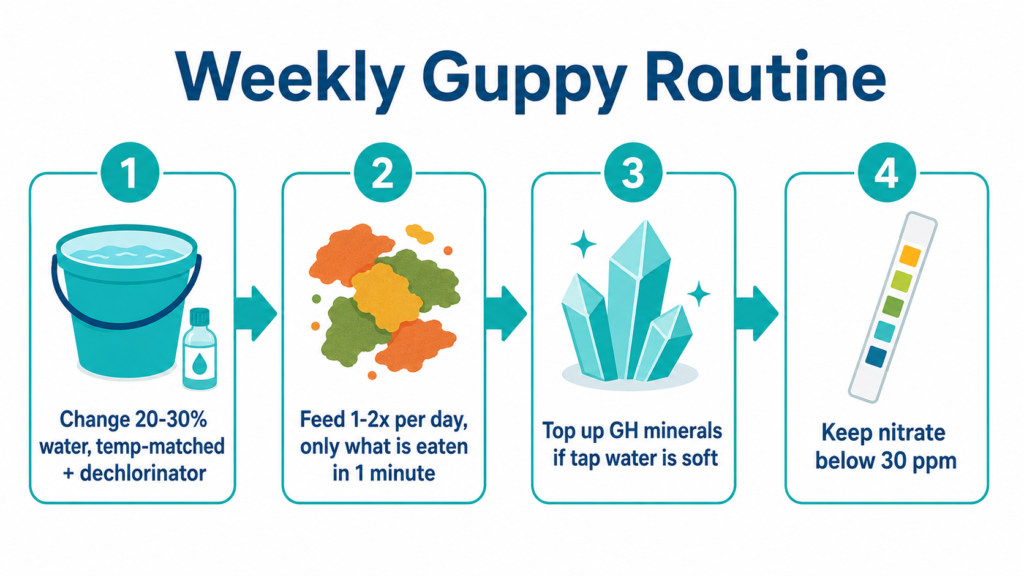
Once the tank is cycled and stocked, the weekly routine is simple. Small, regular water changes — roughly 20 to 30 percent, temperature-matched and dechlorinated — keep nitrate in check, and that matters more with guppies than with most nano fish because a breeding group adds bioload fast. A water conditioner is mandatory at every change, and if your water is soft, this is when you top up minerals with a remineralizer or a mineral block to hold GH in the band guppies prefer.
Feeding is where good intentions cause the most trouble. Guppies have tiny mouths, so a quality micro-pellet or finely crushed flake is the staple, rounded out with variety: frozen or live baby brine shrimp, daphnia, and the occasional bit of blanched vegetable. Feed small amounts once or twice a day, only what they finish in about a minute. Overfeeding fouls a small tank quickly and spikes the ammonia that an uncycled or overstocked tank cannot handle. Guppies are tropical, so most rooms need a small adjustable heater; if you are weighing a heated versus unheated build, our coldwater versus tropical aquarium comparison shows exactly where guppies fall on that spectrum.
💡 The single biggest guppy myth is that they are a “bowl fish.” They are hardy, not indestructible — they need a filtered, cycled, heated tank with stable hard water. Give them that and they are close to bulletproof.
Tank Size and Stocking: The Honest Smallest Setup
Here is where this guide breaks from the generic advice. Most articles flatly say “5 gallons is fine,” which is only true for a very short window or a carefully managed all-male tank. The moment you keep both sexes, you are running a breeding colony whether you planned to or not, and that needs volume to stay stable. The table below lays out the realistic trade-offs so you can match the tank to your actual goal.
| Tank size | Best guppy setup | Breeding? | Honest verdict |
|---|---|---|---|
| 3 gallon | Not recommended | No | Too small to buffer water chemistry or bioload — skip guppies here |
| 5 gallon | A trio (starter) or 3–4 males only | Short-term / no | Works briefly; a mixed trio outgrows it fast as fry arrive |
| 10 gallon | 1 male + 2–3 females, or 5–6 males | Yes | The realistic long-term minimum for a mixed group |
| 20 gallon+ | Mixed colony + peaceful tankmates | Yes | Room to absorb broods, plant heavily, and add companions |
Notice the two clean escape hatches from the population problem. The first is an all-male tank: male guppies are the flashy ones anyway, so a group of 3 to 4 males in a 5-gallon stays brilliantly colored and never reproduces. The second is simply sizing up to a 10 or 20-gallon before you add females, so the tank can actually hold the offspring. Either choice sidesteps the single most common guppy mistake — accidental overstocking — before it ever happens.
Hardware is simple and cheap. A gentle sponge or low-flow filter is ideal because guppies dislike strong current and a sponge also protects fry. A basic light and an adjustable heater finish the essentials. For a compatible community, or if you would rather choose a fish that thrives in a true nano footprint, our roundup of the best nano tank fish for beginners vets species that stay stable in the smallest tanks.
The Population Trap: Guppy Breeding Math
Breeding requires essentially no effort, which is the whole appeal and the whole problem. Guppies are livebearers: there is no egg-laying, no larval stage, and no special trigger. A single female typically drops 20 to 60 fully-formed, free-swimming fry roughly every four to six weeks, and she can store sperm to keep producing broods long after any male is removed. Do that math across two or three females and a 5-gallon fills up shockingly fast.
The sex ratio matters more than most guides admit, and not only for population control. Male guppies court females relentlessly, so keeping a lone female with a male can stress and exhaust her. The standard fix is to keep more females than males — a ratio of about two to three females per male — which spreads the male’s attention out and keeps everyone calmer. That same ratio, of course, maximizes fry, so it only makes sense in a tank sized to hold them.
Adult guppies, including the mother, readily eat fry, so survival hinges on cover. Dense planting — floating plants, fine-leaved stems, and moss — gives fry places to hide and is the difference between a slow trickle and a full-blown boom. If you want to control numbers, lean the other way: fewer plants and a species-only tank naturally thin each brood. The action table below turns the whole thing into a buy-and-do checklist.
| Stage / week | Action | Target or amount | Rough cost (mid-2026) |
|---|---|---|---|
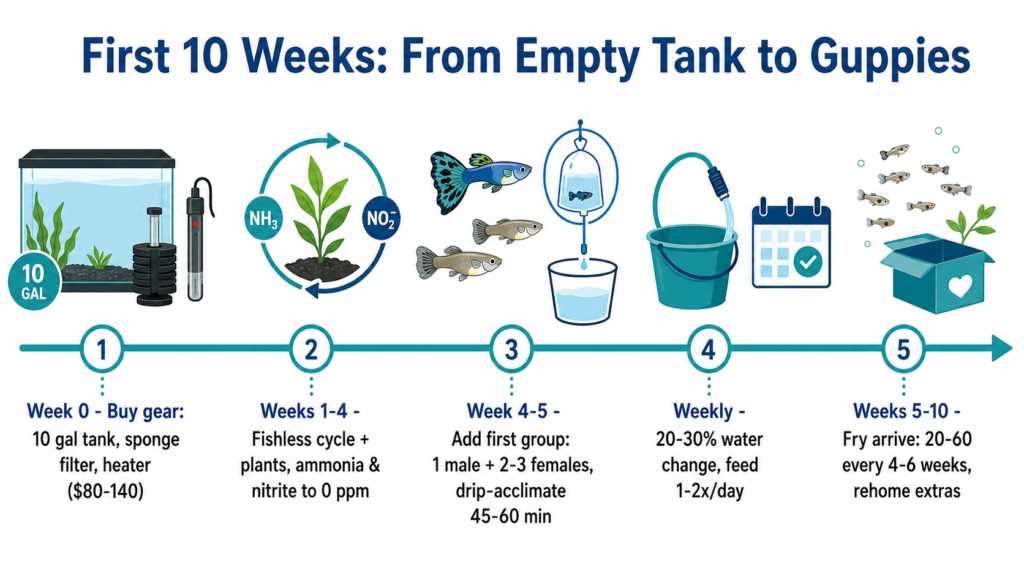
| Week 0 (shopping) | 10 gal tank, sponge filter, heater, light, dechlorinator, GH test | Correct soft water with minerals | $80–$140 |
| Weeks 1–4 | Fishless cycle; add live plants & floating cover early | Ammonia & nitrite must reach 0 ppm | $15–$30 (plants) |
| Week 4–5 | Acclimate first group (all-male, or 1 male + 2–3 females) | Drip-acclimate ~45–60 min | $15–$35 (fish) |
| Weekly, ongoing | Water change + small feeds | 20–30% change; feed 1–2x/day | ~$5/mo (food + conditioner + minerals) |
| Weeks 5–10 (if mixed) | Watch for fry; plan to rehome extras | 20–60 fry every ~4–6 weeks | $0 |
For the species itself, the Wikipedia entry on the guppy (Poecilia reticulata) is a solid neutral reference on its biology, native range, and remarkable reproductive strategy.
Common Beginner Mistakes to Skip
Three errors account for most disappointing guppy tanks, and all of them are free to avoid. First, accidental overstocking — dropping mixed sexes into a tiny tank and being blindsided by the population boom. Second, keeping them in water that is too soft and acidic, when guppies actually want it moderate to hard and slightly alkaline. Third, adding fish to an uncycled tank, the silent killer that no amount of hardiness survives.
- Mixed sexes in a 5-gallon — go all-male, or size up to a 10-gallon breeding tank.
- Soft, acidic water — guppies like it harder and neutral-to-alkaline; add minerals if your tap is soft.
- Skipping the cycle — fix with patience and a test kit, not chemicals.
- One female per male — keep 2–3 females per male so males do not harass a lone female.
Results always vary with your tap water and room temperature, so treat every number here as a target band, not a guarantee. Get the tank size, the water hardness, and the sex ratio right up front, and guppy care becomes just about the most rewarding low-effort hobby in the aquarium world.
Keep Exploring NanoTank Lab
- Nano Tank Size Guide (3 vs 5 vs 10 gallon) — why volume decides whether guppies work long-term.
- Best Nano Tank Fish for Beginners — species that stay stable in a true nano footprint.
- How Long Before Adding Fish to a New Tank — the cycling step even hardy guppies cannot skip.
- Coldwater vs Tropical Aquarium — where guppies fall on the heated-versus-unheated question.
Frequently Asked Questions
Can guppies live in a 5-gallon nano tank?
Only in a limited way, so a 5-gallon is not the ideal long-term guppy home. A small all-male group of 3 to 4 fish can live in a well-filtered 5-gallon because it never breeds, and a mixed trio can start there. But a mixed-sex group reproduces so fast that it outgrows 5 gallons within a couple of months, which is why 10 to 20 gallons is the realistic minimum for a breeding tank.
How many guppies should I keep together?
Keep guppies in a small group and mind the sex ratio. For a mixed group, use about two to three females per male so the males do not relentlessly harass a single female; a common 10-gallon stocking is one male with two or three females. If you want color without the breeding, keep an all-male group instead, since the males are the flashy ones and will never reproduce.
What water conditions do guppies need?
Guppies prefer warm, moderately hard water. Aim for a temperature of about 72 to 82°F (22 to 28°C), a pH around 7.0 to 8.0, and a general hardness of roughly 8 to 30 dGH. If your tap water is soft, add minerals with a remineralizer or mineral block to raise hardness. As always, ammonia and nitrite must read 0 ppm in a fully cycled tank.
How fast do guppies breed?
Very fast. Guppies are livebearers, and a single female typically drops 20 to 60 free-swimming fry roughly every four to six weeks with no special effort. Females can also store sperm and keep producing broods after the male is removed. Adults eat fry, so dense plants raise survival rates — but plan to rehome extras or keep males only if you do not want a population boom.
Are guppies good fish for absolute beginners?
Yes, with one caveat. Guppies are hardy, peaceful, colorful, and forgiving of typical tap water, which makes them one of the easiest fish to keep alive. The only thing beginners consistently get wrong is stocking: choose an all-male group for a small tank, or a properly sized 10-gallon-plus tank if you want to breed, and you avoid the single most common guppy mistake.