Otocinclus Care: The Nano Algae Eater That Needs a Mature Tank
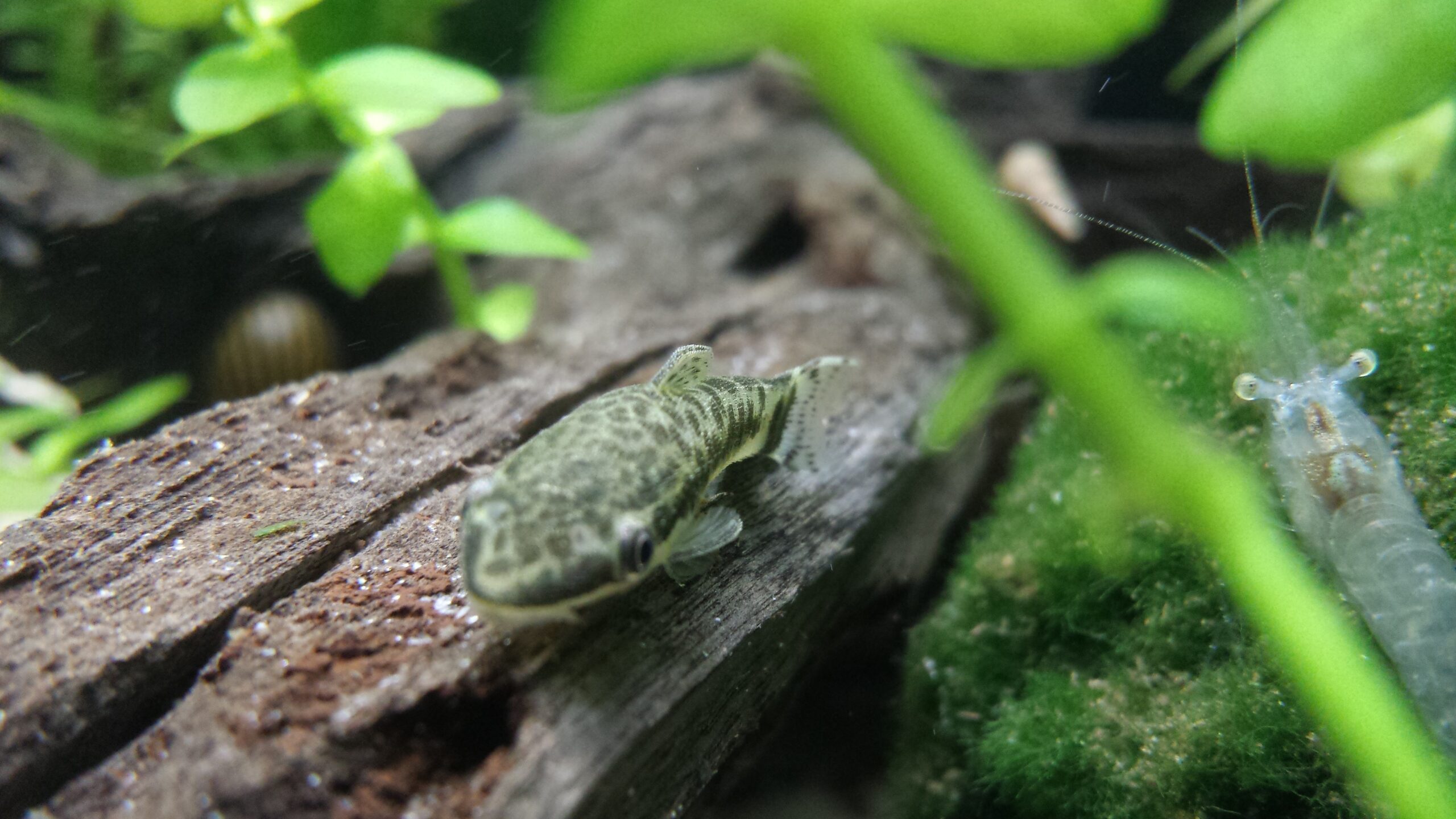
Otocinclus care hinges on a single rule that most people learn the hard way: these tiny sucker-mouth catfish must go into a mature, algae-covered tank, never a shiny new one. The otocinclus — often called the dwarf oto or dwarf sucker catfish — is a strict herbivore that grazes soft green algae and the brown diatom film that coats glass and leaves. It is peaceful, endlessly busy, and one of the best natural algae eaters small enough for a nano. But it is also one of the easiest nano fish to accidentally starve, and that is entirely a husbandry problem you can plan around.
Most oto guides skip the two facts that actually decide whether your fish thrive or fade: tank maturity and group size. They hand you a generic parameter chart and never mention that an oto dropped into a freshly cycled tank has nothing to eat, or that a single oto kept alone hides and wastes away. This guide puts those two facts front and center, backs them with three original reference tables and honest numbers, and gives you a realistic timeline so your little grazers stay round-bellied, bold, and out in the open.
Why Otocinclus Care Starts With a Mature Tank
The most important thing to understand about otocinclus care is timing. Otos are specialist grazers: their whole diet is the soft green algae and brown diatom film that grows on established surfaces. A brand-new or newly cycled tank simply has not grown that food yet. Drop otos in too early and they run out of grazing within days, thin out, and slowly starve — a fate that has nothing to do with disease and everything to do with an empty pantry.
So the golden rule is simple: only add otos to a stable, mature tank with an established biofilm and a visible algae crop. In practice that means a tank that has been running smoothly for a couple of months, with a light dusting of green algae on the glass and brown diatoms on older leaves and hardscape. Otos are also sensitive to unstable or poor water quality, so they belong in a tank that has already proven it can hold rock-steady parameters. If your tank is still cycling, that step comes first — our step-by-step guide to cycling an aquarium walks through it, and the numbers you are aiming for live in our aquarium water parameters guide.
| Parameter | Comfortable range | How fussy? | What actually matters |
|---|---|---|---|
| Temperature | 72–79°F (22–26°C) | Forgiving | Stable, moderate tropical; avoid sudden swings |
| pH | 6.5–7.5 | Adaptable | Neutral-ish is ideal; stability beats hitting a number |
| GH (hardness) | Soft to medium | Adaptable | Tolerates a range if changes are gradual |
| Ammonia / Nitrite | 0 ppm | Zero tolerance | Non-negotiable; only a fully cycled tank passes |
| Nitrate | Below 20 ppm | Sensitive | Keep low with plants and weekly changes |
| Tank maturity | Established, algae present | Critical | The #1 avoidable failure — no algae means no food |
| Group size | 3 minimum, 6+ ideal | Critical | Lone otos hide; groups graze calmly in the open |
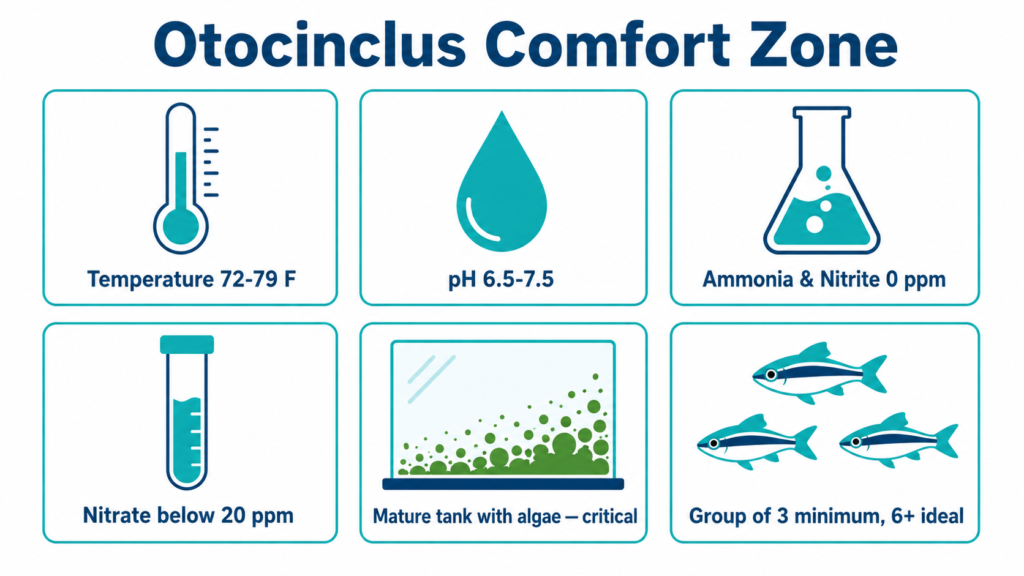
The two rows people skim past — tank maturity and group size — are exactly the two that decide whether otocinclus care goes smoothly. Everything else on this chart is forgiving by comparison.
Tank Size, Setup, and Group Numbers
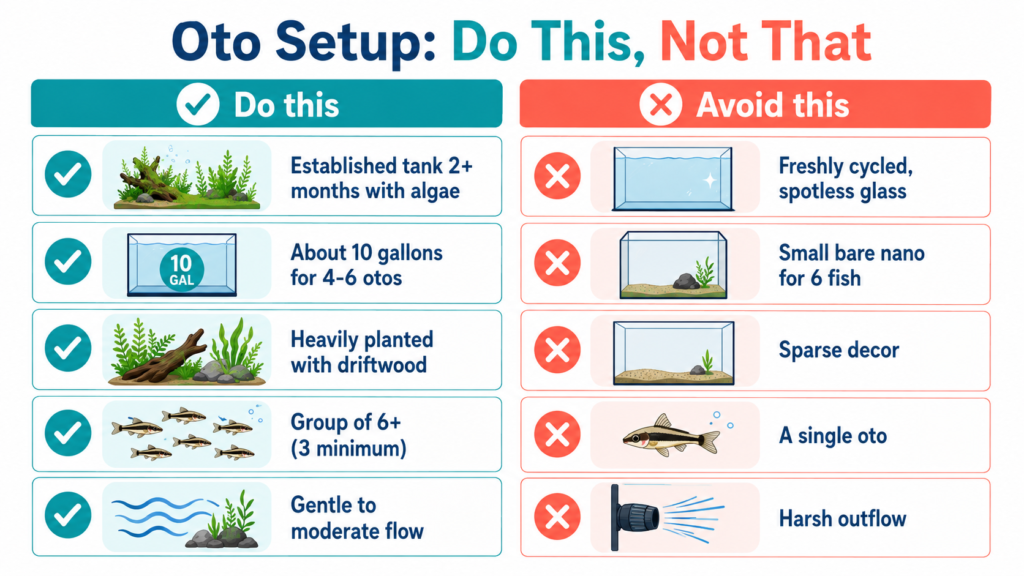
Otos stay small — typically around 1.5 to 2 inches — but they are active grazers that need surface area to feed on, not just water to swim in. A group of four to six is comfortable in roughly a 10-gallon tank. A true nano is feasible only if it is heavily planted and very stable, because plant leaves, driftwood, and glass all multiply the grazing surface and the biofilm that feeds them. Bare, sparsely planted nanos rarely grow enough algae to sustain a group, which is why setup matters as much as gallons.
Group size is not optional. Otos are social fish that feel secure in numbers. Keep a minimum of three, and six or more is genuinely better: larger groups are calmer, less skittish, and far more likely to graze out in the open during the day instead of hiding behind the filter. A single oto tends to sulk, hide, and eat poorly. Think of them as a small shoal you are stocking, not a cleanup gadget you are adding.
| Setup choice | Do this | Avoid this | Why |
|---|---|---|---|
| Tank maturity | Established 2+ months, algae present | Freshly cycled, spotless glass | No algae crop means the group slowly starves |
| Tank size | ~10 gal for a group of 4–6 | Small bare nano for 6 | Grazing surface, not just volume, feeds otos |
| Planting | Heavily planted, driftwood, leaves | Sparse decor | Plants and wood grow biofilm and diatoms |
| Group size | 6+ (3 absolute minimum) | A single oto | Bigger groups are calmer and graze in the open |
| Flow | Gentle to moderate | Harsh outflow | Otos like clean, oxygenated but not turbulent water |
Because they graze on plants and hardscape all day, otos pair beautifully with a planted layout. If you are still choosing greenery, a leafy, established scape not only looks good, it is the buffet your otos depend on. A well-planted tank also helps hold the stable water otos need, so the effort does double duty.
Feeding: Don’t Let Your Otos Starve
Here is the part nobody plans for. Otos are strict herbivores that specialize in soft green algae and brown diatoms, and a hungry group will clear the algae in a mature tank faster than you expect. Once the natural film runs low, you have to supplement — otherwise the very fish you bought to eat algae will run out of it. A healthy oto has a gently rounded belly; a sunken, pinched belly is the warning sign that grazing has run dry and it is time to feed.
Supplementing is easy and cheap. Blanched vegetables are the staple backup: drop a slice of zucchini or cucumber (briefly softened in hot water and weighed down or skewered) into the tank and let the otos rasp at it. Remove the leftovers after a day so they do not foul the water. Algae wafers designed for grazing herbivores round out the menu. The goal is continuous access to food, since otos graze more or less constantly rather than eating big meals.
| Food source | Role in the diet | How to offer it | Notes |
|---|---|---|---|
| Soft green algae | Primary natural food | Grown on glass, plants, hardscape | Only a mature tank supplies enough |
| Brown diatoms | Primary natural food | The brown film on new-ish surfaces | Otos love it; often their first target |
| Blanched zucchini | Main supplement | Softened slice, weighted, 1–2 days | Remove leftovers to keep water clean |
| Blanched cucumber | Supplement / variety | Softened slice, weighted | Rotate with zucchini for variety |
| Algae wafers | Backup staple | Sinking wafer, small amounts | Choose herbivore/algae-based formulas |
A quick belly check is the whole game: keep an eye on your otos and if bellies look flat, add more vegetables and wafers. Getting feeding right is the single biggest factor in long-term otocinclus care once the tank is established.
Tankmates and the Slow Acclimation They Need
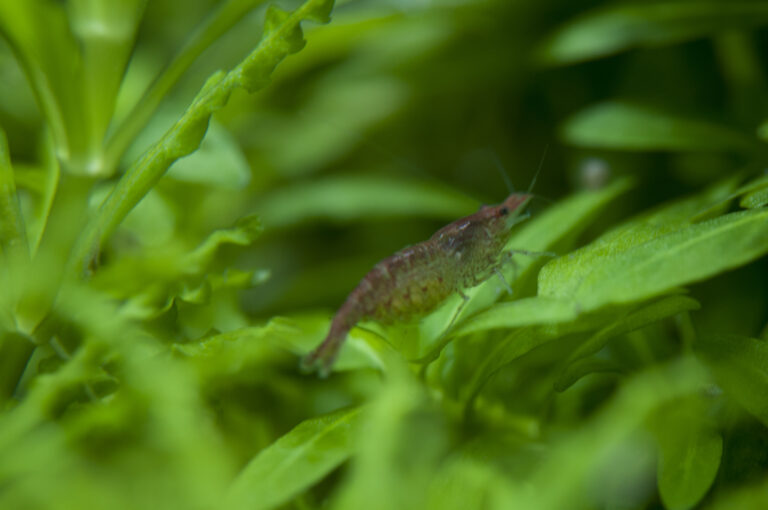
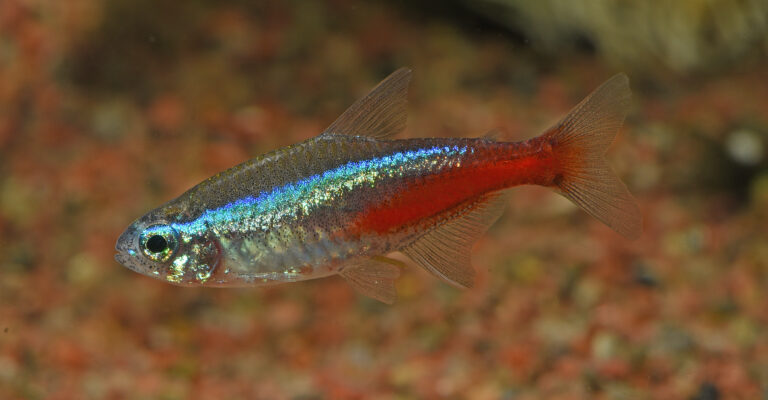
Otos are gentle, non-aggressive community fish and one of the most tankmate-friendly species you can keep. They are effectively reef-safe for a freshwater community: completely peaceful with dwarf shrimp and with small, calm nano fish. They pair naturally with the same species you would stock in any peaceful nano — see our roundup of the best nano tank fish for beginners for good companions, and our guide to the best shrimp for a nano tank for invertebrates that share space with otos without a hint of conflict. Avoid large or boisterous fish that could bully or outcompete them at feeding time.
One more piece of otocinclus care deserves its own paragraph: acclimation. Otos are frequently shipped stressed and already hungry, having been moved through the supply chain with little to graze on, which is part of why they have a fragile reputation. Give them the gentlest possible arrival. Float the bag to match temperature, then drip-acclimate slowly over roughly 45 to 60 minutes so they adjust gradually to your water. A calm, slow introduction into a mature, algae-rich tank is exactly the soft landing a hungry, travel-worn oto needs.
For a neutral overview of the genus, its species, and its native range across South American streams, the Otocinclus entry on Wikipedia is a solid reference.
Common Otocinclus Mistakes to Skip
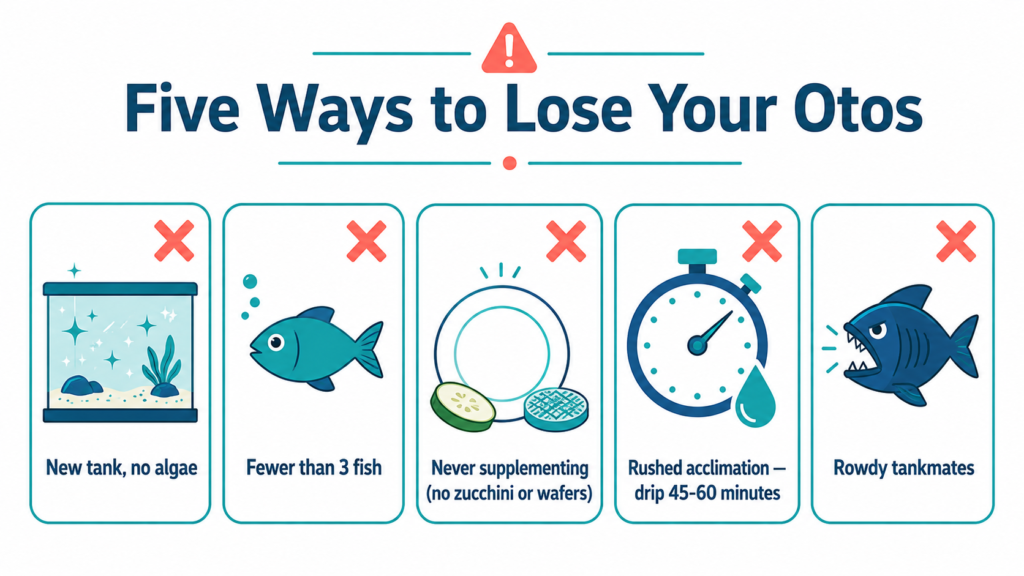
Three errors account for most disappointing oto tanks, and all three are free to avoid. First, adding otos to a new or unstable tank with no algae. Second, keeping too few — a lone oto or a pair. Third, assuming a natural algae supply will feed them forever and never supplementing when the film runs low.
- New tank, no algae — wait for a mature, established tank before adding otos.
- Too few fish — keep at least three, ideally six or more, for calm open grazing.
- Never supplementing — offer blanched zucchini, cucumber, and algae wafers so they don’t starve.
- Rushed acclimation — drip slowly; they arrive stressed and hungry.
- Rowdy tankmates — keep companions small, peaceful, and shrimp-friendly.
Results always vary with your tap water, planting, and how much algae your particular tank grows, so treat every number here as a target band, not a guarantee. Watch the fish, watch the bellies, and adjust.
Keep Exploring NanoTank Lab
- Best Nano Tank Fish for Beginners — peaceful companions that suit an oto community.
- Best Shrimp for a Nano Tank — invertebrates that live safely alongside otos.
- How to Cycle a New Aquarium — the step that must finish long before otos arrive.
- Aquarium Water Parameters Explained — the stable numbers sensitive otos depend on.
Frequently Asked Questions
Can otocinclus go in a new tank?
No, and this is the most important rule of otocinclus care. Otos are specialist grazers that eat soft green algae and brown diatoms, and a new or freshly cycled tank has not grown that food yet. Added too early, they run out of grazing and slowly starve. Only add otos to a stable, mature tank that has been running for a couple of months with a visible algae crop.
How many otocinclus should I keep together?
Keep at least three, and six or more is better. Otos are social fish that feel secure in a group, and larger groups are noticeably calmer and graze out in the open during the day. A single oto tends to hide, sulk, and eat poorly. For a group of four to six, aim for roughly a 10-gallon tank so there is enough grazing surface to go around.
What do I feed otocinclus when the algae runs out?
Supplement with blanched vegetables and algae wafers. Otos will clear a tank’s natural algae faster than you expect, so once the film runs low, offer softened slices of zucchini or cucumber, weighted down, plus sinking algae wafers made for herbivores. Remove uneaten vegetables after a day. A rounded belly means they are well fed; a sunken belly means it is time to add food.
Are otocinclus safe with shrimp and nano fish?
Yes. Otos are completely peaceful and are one of the most community-friendly nano species available. They ignore dwarf shrimp entirely and coexist calmly with small, gentle nano fish, making them effectively reef-safe for a freshwater community. Just avoid large or aggressive tankmates that could bully them or outcompete them for food.
Why are otocinclus considered hard to keep?
Their reputation comes down to two things: they arrive stressed and hungry from shipping, and they are often added to tanks too new to feed them. Both are fixable. Acclimate slowly with a 45 to 60 minute drip, add them only to a mature tank with an established algae crop, and supplement food when grazing runs low. Do those and otos are hardy, long-lived little grazers.