
Endler’s livebearer care gets sold as “easier than guppies, breeds itself, perfect for beginners,” and most of that is true — which is exactly how a peaceful 5-gallon nano tank turns into an overstocked fish factory by month three. Poecilia wingei is a tiny, dazzling, genuinely hardy livebearer that thrives in the small tanks bettas and tetras call home. But “breeds itself” is a feature and a trap at the same time, and almost no care guide tells you which one you are signing up for.
Most Endler articles just repeat the same generic numbers (10 to 20 gallons, keep in groups, feed flakes) and never address the two things that actually decide whether a nano keeper succeeds: how to stock them so they do not explode in population, and how to tell a pure Endler from a guppy hybrid before you buy. This guide fills both gaps, with honest size and stocking numbers, three original reference tables, and a realistic first-90-days timeline so you end up with a stable, colorful tank instead of a crowded one.
Why Endlers Are a Great (but Sneaky) Nano Fish
Endlers earn their beginner reputation for three concrete reasons. They stay genuinely tiny — males reach only about 1 inch — so a small footprint holds a real group. They tolerate a wide range of water conditions, including the hard, slightly alkaline tap water that frustrates soft-water fish keepers. And they are peaceful, active, and constantly on display near the top of the tank, which makes them feel like a much bigger fish than they are.
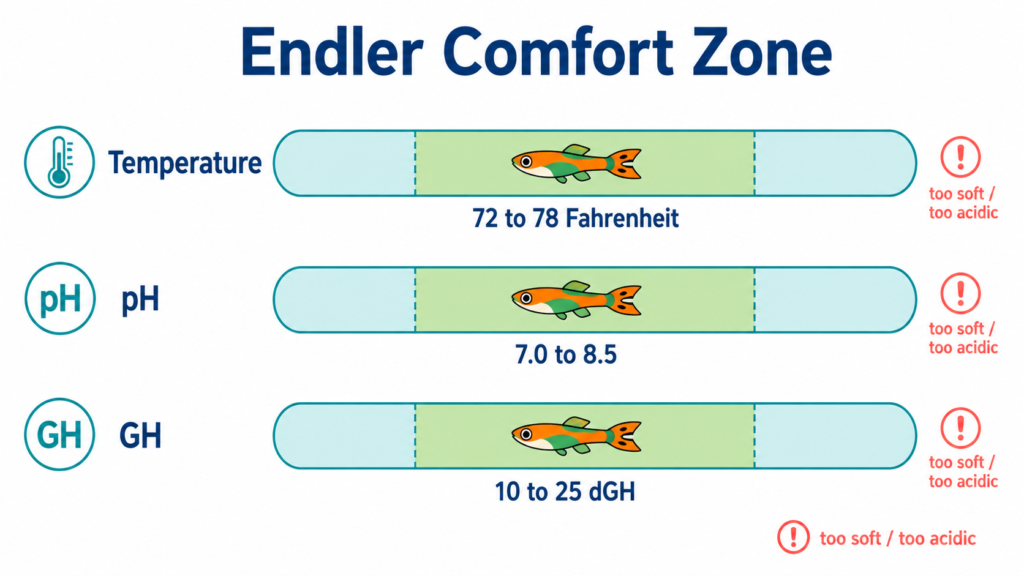
The catch is that all of that hardiness includes their breeding. Drop a mixed-sex group into a healthy tank and they will reproduce non-stop, with no special trigger needed. In a 20-gallon that is delightful; in a 5-gallon nano it is a slow-motion overstocking problem. The fix is not more gear — it is choosing your stocking strategy up front. The comfort-zone table below sorts out which numbers Endlers actually care about.
| Parameter | Comfortable range | How fussy? | What actually matters |
|---|---|---|---|
| Temperature | 72–78°F (22–26°C) | Forgiving | Tolerates 68–82°F; stability beats chasing an exact number |
| pH | 7.0–8.5 | Prefers alkaline | Unlike tetras, Endlers like hard, slightly basic water — do not chase soft/acidic |
| GH (general hardness) | 10–25 dGH (~180–450 ppm) | Likes it hard | Hard tap water is a feature here, not a problem |
| Ammonia / Nitrite | 0 ppm | Zero tolerance | Non-negotiable; only an uncycled tank fails this |
| Nitrate | Below 30 ppm | Moderate | Rising nitrate is the hidden cost of an overstocked breeding tank |
| Adult size | Males ~1 in, females ~1.4–1.8 in | — | Females are noticeably larger and plainer than the flashy males |
| Group size | 6+ minimum | Important | Males-only avoids the population boom; mixed sexes will breed |
The row beginners misread most is pH. Endlers descend from hard-water habitats in Venezuela, so the soft, acidic water that suits a neon tetra is wrong for them. If your tap water is hard and alkaline, you are already set up to keep Endlers with no adjustment at all — which is a big part of why they are so beginner-friendly.
Endler vs Guppy: What You’re Actually Buying
The single most confusing part of Endler’s livebearer care happens at the store, not the tank. Endlers (Poecilia wingei) and common guppies (Poecilia reticulata) are close enough relatives that they interbreed freely, and a lot of “Endlers” sold in chain stores are actually guppy hybrids. That matters because hybrids grow larger, lose the crisp wild patterns, and muddy any line you try to breed. If keeping a pure strain matters to you, buy from a hobbyist or specialist and avoid mixing them with guppies entirely.
| Trait | Pure Endler (P. wingei) | Common guppy (P. reticulata) | Why it matters for a nano tank |
|---|---|---|---|
| Adult male size | ~1 inch | 1.2–1.5 inches | Endlers fit a smaller footprint |
| Pattern | Crisp metallic blocks, “peacock” spots | Larger, flowing, varied fins | Hybrids look “in between” and blurry |
| Tail | Smaller, often clear or lyre | Large, fancy, colorful | Big guppy tails get nipped easier |
| Breeding behavior | Prolific | Prolific | Both will overrun a small tank |
| Interbreeds? | Yes, readily with guppies | Yes | Keep separate to preserve a pure line |
None of this means a hybrid is a bad pet — they are still hardy and colorful. It only matters if you care about a true Endler strain or plan to sell offspring. For a casual display tank, just pick the healthiest, most active fish in the group and do not worry about the Latin name on the label.
Tank Size, Stocking, and the Cycle That Comes First
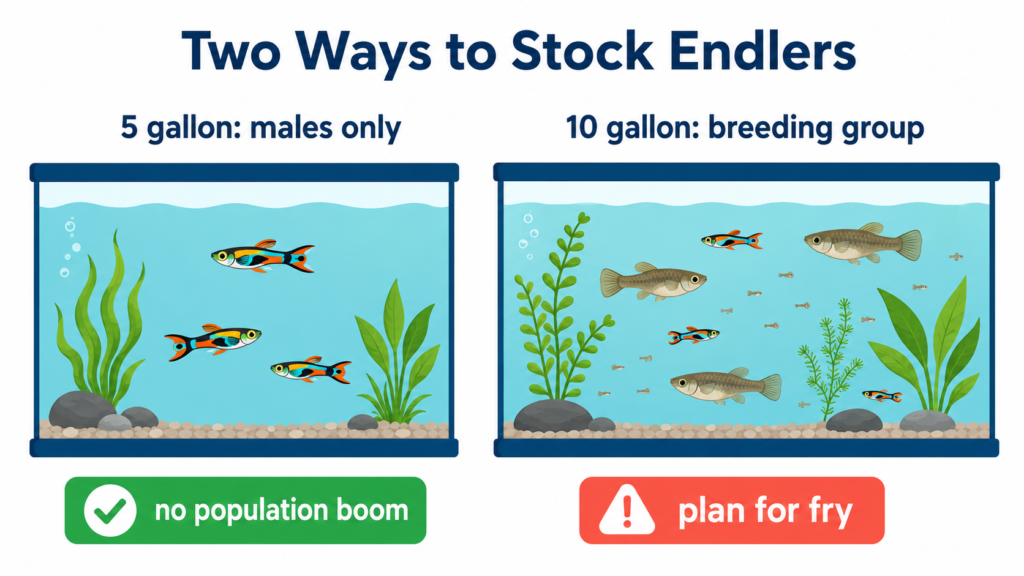
Here is where this guide breaks from the generic advice. Most articles flatly say “10 to 20 gallons,” which is correct for a breeding group but ignores the most common nano reality: a small, male-only display. A group of 3 to 5 male Endlers lives happily in a well-filtered 5-gallon, stays brilliantly colored, and — critically — never reproduces, so it never overstocks. The moment you add females, you need more water volume to absorb the population growth. The matching table below makes the trade-off concrete.
| Tank size | Best Endler setup | Breeding? | Notes |
|---|---|---|---|
| 5 gallon | 3–5 males only | No | Stable, colorful, zero population risk — the easy nano win |
| 10 gallon | 6–9, mixed (2–3 females per male) | Yes | Smallest size that absorbs a breeding colony; plant heavily |
| 20 gallon+ | Mixed colony + tankmates | Yes | Room for fry, plants, and peaceful companions |
If you are still choosing a tank, our nano tank size guide comparing 3, 5, and 10 gallon setups walks through the stability trade-offs in detail. Whatever size you land on, the non-negotiable first step is cycling. A new tank has no bacteria to convert toxic ammonia into safer nitrate, and even hardy Endlers cannot survive that gap. Run a fishless cycle first — our step-by-step guide to fishless cycling covers it, and how long before you can safely add fish sets realistic timing.
Tip: If you want color without the breeding math, buy all males. Male Endlers are the flashy ones anyway, and an all-male group sidesteps the single biggest nano-tank mistake — accidental overstocking.
Hardware is simple and cheap. A gentle sponge or low-flow filter is ideal because Endlers are weak swimmers that dislike strong current, and a sponge filter also protects fry. A basic plant light and an adjustable heater (only if your room drops below the comfort band) finish the list. The full inventory lives in our nano aquarium starter checklist.
Water, Food, and Daily Endler Care
Day-to-day Endler care is mostly steady maintenance. Small, regular water changes — roughly 10 to 25 percent weekly, temperature-matched and dechlorinated — keep nitrate in check, which matters more here than with most nano fish because a breeding group adds bioload fast. Chlorine and chloramine from tap water are harmful, so a water conditioner is mandatory at every change.
Feeding is where good intentions cause trouble. Endlers have tiny mouths, so a high-quality micro-pellet or finely crushed flake is the staple, rounded out with variety: frozen or live microworms, baby brine shrimp, and the occasional bit of blanched vegetable. Feed small amounts two to three times a day, only what they finish in two to three minutes. Overfeeding fouls a small tank quickly and spikes the ammonia that an uncycled or overstocked tank cannot handle.
Endlers are tropical enough to prefer a heater in most rooms, but they are more cold-tolerant than many nano fish and handle the low 70s without complaint. If you are weighing a heated versus unheated setup, our coldwater versus tropical nano tank comparison covers where they fall on that spectrum.
Tankmates, Color, and Breeding (the Population Trap)
Endlers are peaceful and make good community fish, but in a nano tank the safest stocking is a species-only group. If you do add tankmates, choose small, non-aggressive, non-fin-nipping species and avoid anything large enough to eat an adult Endler. They generally coexist with cherry shrimp, though adult Endlers will pick off newborn shrimplets, and they share water preferences poorly with soft-water schoolers. For a vetted shortlist of compatible nano species, see our roundup of the best nano tank fish for beginners.
Breeding requires essentially no effort, which is the whole point and the whole problem. Endlers are livebearers: a female carries fertilized eggs internally for about 23 to 28 days, then releases 10 to 30 fully-formed, free-swimming fry (large mature females can drop 40 or more). There is no larval stage and no special trigger. The catch is that adults, including the mother, readily eat fry, so survival depends on cover. Dense planting — especially java moss and floating plants — gives fry hiding spots and is the difference between a slow trickle and a population explosion.
That brings us back to the trap. With both sexes present and good plant cover, a starting group can double within a couple of months and keep going. Plan ahead: keep males only, rehome extras to a local fish store or hobbyist, or run a larger tank from the start. The action table below turns the whole process into a buy-and-do checklist.
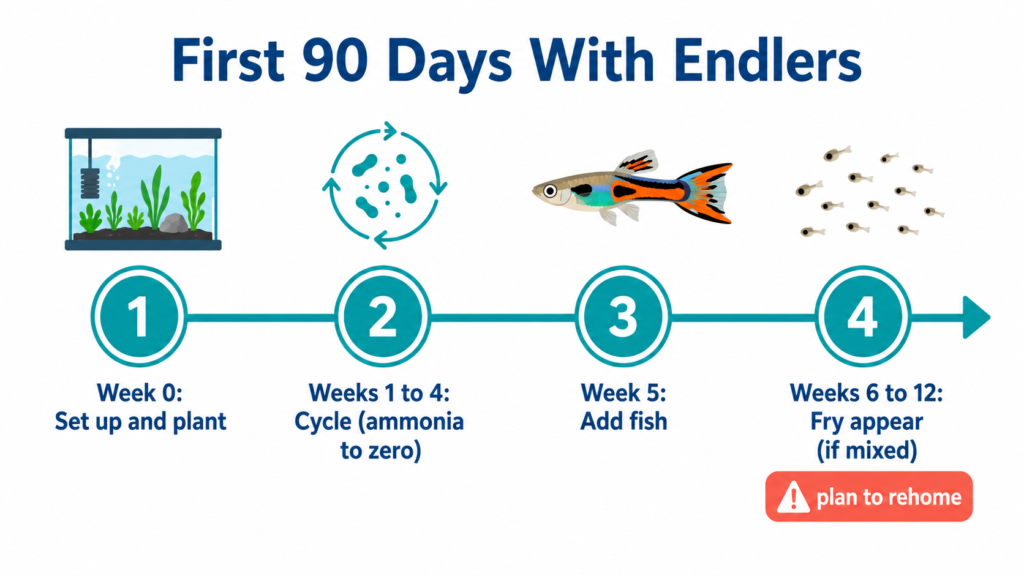
| Stage / week | Action | Target or amount | Rough cost (mid-2026) |
|---|---|---|---|
| Week 0 (shopping) | 5–10 gal tank, sponge filter, heater, light, dechlorinator, GH test | Hard/alkaline tap water is fine | $70–$130 |
| Weeks 1–4 | Fishless cycle; add live plants & floating cover early | Ammonia & nitrite must reach 0 ppm | $15–$30 (plants) |
| Week 4–5 | Acclimate first group (3–5 males, or 6+ mixed) | Drip-acclimate ~45–60 min | $20–$45 (fish) |
| Weekly, ongoing | Water change + small feeds | 10–25% change; feed 2–3x/day | ~$4/mo (food + conditioner) |
| Weeks 6–12 (if mixed) | Watch for fry; plan to rehome extras | Broods every ~4 weeks | $0 |
For the species itself, the Wikipedia entry on Poecilia wingei is a solid neutral reference on its biology, range, and conservation status.
Common Beginner Mistakes to Skip
Three errors account for most disappointing Endler tanks, and all of them are free to avoid. First, accidental overstocking — adding mixed sexes to a tiny tank and being surprised by a population boom. Second, treating them like tetras and chasing soft, acidic water when they actually want it hard and alkaline. Third, adding fish to an uncycled tank, the silent killer that no amount of hardiness survives.
- Mixed sexes in a 5-gallon — go males-only, or size up to a 10-gallon.
- Softening the water — Endlers like hard, alkaline water; leave good tap water alone.
- Skipping the cycle — fix with patience and a test kit, not chemicals.
- Strong filter flow — Endlers are weak swimmers; use a gentle sponge filter.
For the broader patterns that sink first tanks, our 9 beginner aquarium mistakes article is worth a read. Results always vary with your tap water and room temperature, so treat every number here as a target band, not a guarantee.
Keep Exploring NanoTank Lab
- Best Nano Tank Fish for Beginners — where Endlers rank among the easiest nano species.
- How to Set Up a Nano Aquarium — the full build before you add fish.
- How to Cycle a New Aquarium (fishless cycling) — the step even hardy fish cannot skip.
- Nano Tank Size Guide (3 vs 5 vs 10 gallon) — pick the footprint that fits your stocking plan.
- Cherry Shrimp Care Guide — a popular (but fry-risky) Endler tankmate.
Frequently Asked Questions
How many Endlers should I keep in a 5-gallon tank?
For a 5-gallon, keep a group of 3 to 5 male Endlers only. Males are the colorful ones, and an all-male group never breeds, so it stays stable in a small tank. If you want a breeding colony, move up to at least a 10-gallon, because mixed-sex Endlers multiply quickly and will overstock a nano tank within a few months.
Do Endler’s livebearers need a heater?
Usually yes, but they are flexible. Endlers do best between about 72 and 78°F (22 and 26°C) and will tolerate a few degrees either side. If your room stays warm and stable in that band you can sometimes skip a heater, but an inexpensive adjustable heater removes the risk of a cold snap and keeps the temperature steady.
Are Endlers and guppies the same fish?
No, but they are close relatives that interbreed easily. Endlers (Poecilia wingei) are smaller with crisper, more metallic patterns, while common guppies (Poecilia reticulata) are larger with fancier tails. Many store “Endlers” are actually hybrids. If you want a pure strain, buy from a specialist and never house Endlers with guppies.
What water parameters do Endlers prefer?
Endlers prefer hard, slightly alkaline water: a pH around 7.0 to 8.5 and a general hardness of roughly 10 to 25 dGH. This is the opposite of soft-water fish like tetras, so hard tap water is an advantage here. As always, ammonia and nitrite must read 0 ppm in a fully cycled tank, and stability matters more than hitting an exact number.
How fast do Endlers breed?
Very fast. Endlers are livebearers with a gestation of about 23 to 28 days, and a female can produce 10 to 30 fry per brood — sometimes 40 or more — roughly every month with no special effort. Adults eat fry, so dense plants like java moss raise survival rates. Plan to rehome extras or keep males only if you do not want a population boom.
Are Endlers good for absolute beginners?
Yes, with one caveat. They are hardy, peaceful, colorful, and forgiving of typical hard tap water, which makes them one of the easiest nano fish to keep alive. The only thing beginners get wrong is stocking: choose a male-only group for a small tank, or a larger tank if you want to breed, and you avoid the single most common Endler mistake.