How to Carpet a Nano Tank with Dwarf Hairgrass
Most beginners think aquarium carpet plants are an “advanced-only” project that demands pressurized CO2, a $300 light, and the patience of a saint. That is the misconception worth breaking today: a dense, emerald lawn of dwarf hairgrass (Eleocharis sp.) is one of the most achievable carpets in a nano tank, and you can get there in a 5-gallon with modest gear. The trick is not buying more equipment — it is understanding how the plant actually spreads.
One quick naming note before the how-to: “dwarf hairgrass” is sold as two closely related, frequently mislabeled species — Eleocharis acicularis (taller, a bit more upright, and notably forgiving of varied light) and Eleocharis parvula (shorter, the tighter horizontal carpeter). Stores often swap the labels, and both will carpet a nano tank, so do not stress about which one you ended up with. The care below applies to either.
Here is the gap most guides leave out: they tell you to “plant it and wait,” then skip the two variables that actually decide success — runner propagation mechanics and the early-weeks algae window. This post fills that gap. You will get a week-by-week timeline with honest numbers, a substrate and lighting comparison built for small tanks, and a troubleshooting table for when growth stalls. Among aquarium carpet plants, dwarf hairgrass is the best place to start, and below is exactly why and how.
Why Dwarf Hairgrass Is the Beginner’s Best Carpet
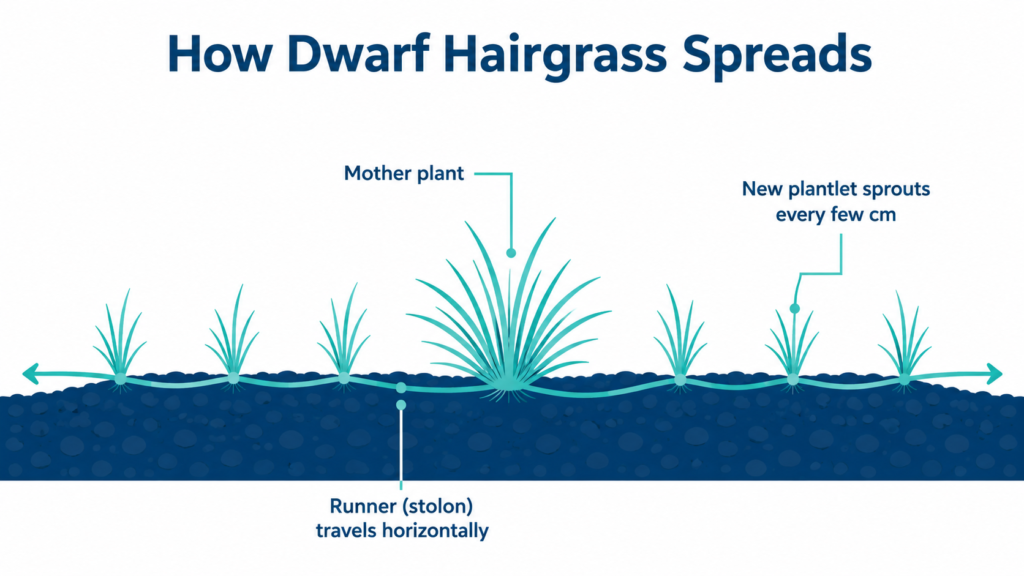
Dwarf hairgrass spreads by sending out horizontal runners (stolons) just below the substrate surface. Each runner pushes up new vertical blades every few centimeters, and those new plantlets send out their own runners. This is geometric, not linear, growth — which is why the first few weeks feel painfully slow and then the tank seems to “fill in overnight.” Understanding that curve is the single most important thing for keeping your sanity.
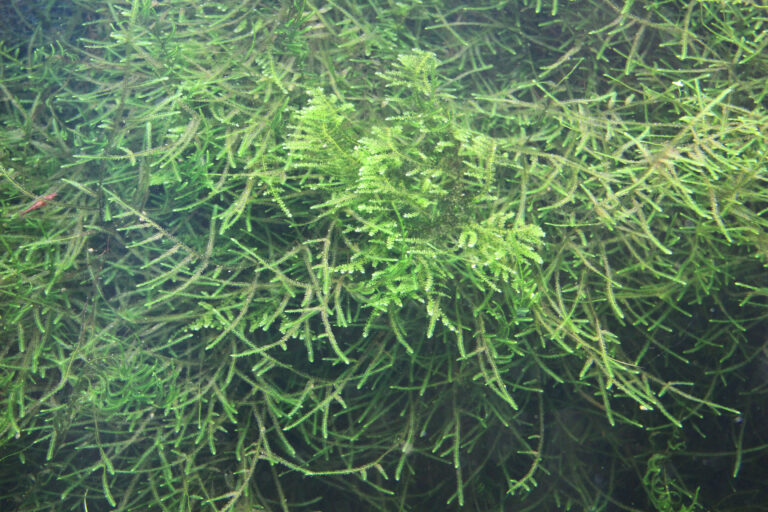
Compared with other popular carpets, it sits in a sweet spot: easier than Monte Carlo or Dwarf Baby Tears (which genuinely want CO2 to thrive), and tidier than Java moss (which carpets but never looks like a manicured lawn). The table below is an honest side-by-side for a nano-scale tank.
| Carpet plant | Difficulty | CO2 needed? | Min. light (PAR at substrate) | Fill-in time (no CO2) |
|---|---|---|---|---|
| Dwarf hairgrass (Eleocharis sp.) | Beginner-friendly | Optional (faster with) | ~30-50 PAR | 8-14 weeks |
| Monte Carlo (Micranthemum sp.) | Intermediate | Recommended, not required | ~40-60 PAR | 6-10 weeks (with CO2) |
| Dwarf Baby Tears (HC Cuba, Micranthemum callitrichoides) | Advanced | Effectively required | ~50-80 PAR | Usually fails without CO2 |
| Java moss (Taxiphyllum sp.) | Very easy | No | ~15-30 PAR | 4-8 weeks (shaggy look) |
What These Aquarium Carpet Plants Actually Need (Tank, Light, Substrate)
You do not need a high-tech rig, but you do need the right foundation. A carpet is a substrate game first and a lighting game second. If you are still choosing a tank, the Nano Tank Size Guide (3 vs 5 vs 10 gallon) will help you pick a footprint with enough floor space — and floor space, not water volume, is what a carpet cares about.
Substrate: the part most people get wrong
Hairgrass roots are short and fine. They anchor and feed best in a fine-grained, nutrient-rich aquasoil rather than large inert gravel, where thin roots simply cannot grip. Aim for a substrate depth of roughly 1.5-2.5 inches (4-6 cm) at the front so runners have room to travel. Active aquasoils also gently lower pH and release nutrients, which suits this plant well. If you are on inert sand or gravel and do not want to rescape, root tabs tucked under the planting zone are a workable compromise — just expect slower fill-in.
Light: enough, not blinding
Carpets fail in the shade. Because light has to reach all the way down to the substrate, a low fixture that looks fine for stem plants may starve a lawn. A modest, full-spectrum LED running a consistent 6-8 hour photoperiod beats a blazing light left on 12+ hours — long photoperiods mostly feed algae, not grass. The setup table below stamps real mid-2026 ballpark costs so you can budget honestly.
| Component | Beginner spec for a 5-gallon carpet | Why it matters | Typical cost (mid-2026, USD) |
|---|---|---|---|
| Substrate | Fine aquasoil, 1.5-2.5 in (4-6 cm) front depth | Anchors fine roots, feeds runners | $18-30 |
| Light | Full-spectrum nano LED, ~30-50 PAR at substrate | Drives photosynthesis at the floor | $25-60 |
| Photoperiod timer | Outlet timer set to 6-8 hrs/day | Consistency starves algae, not grass | $10-15 |
| Liquid fertilizer | All-in-one, dosed per label | Supplies column nutrients low-tech tanks lack | $12-20 |
| CO2 (optional) | Skip it, or add later if impatient | Speeds up fill-in noticeably | $0 (or $60+) |
Tip: Floor space beats water volume. A wide, shallow 5-gallon will carpet faster and look fuller than a tall 5-gallon with the same footprint, because more of the substrate sits directly under usable light.
Step-by-Step: Planting Dwarf Hairgrass
Do this on a freshly scaped, ideally still-cycling tank — it is far easier to plant a carpet with low water than to fight buoyancy in a full tank. If your tank is brand new, plant first, then run your nitrogen cycle; the plants will happily establish during that window. New to cycling? Start with How to Cycle a New Aquarium (fishless cycling) so your water chemistry is ready before any livestock.
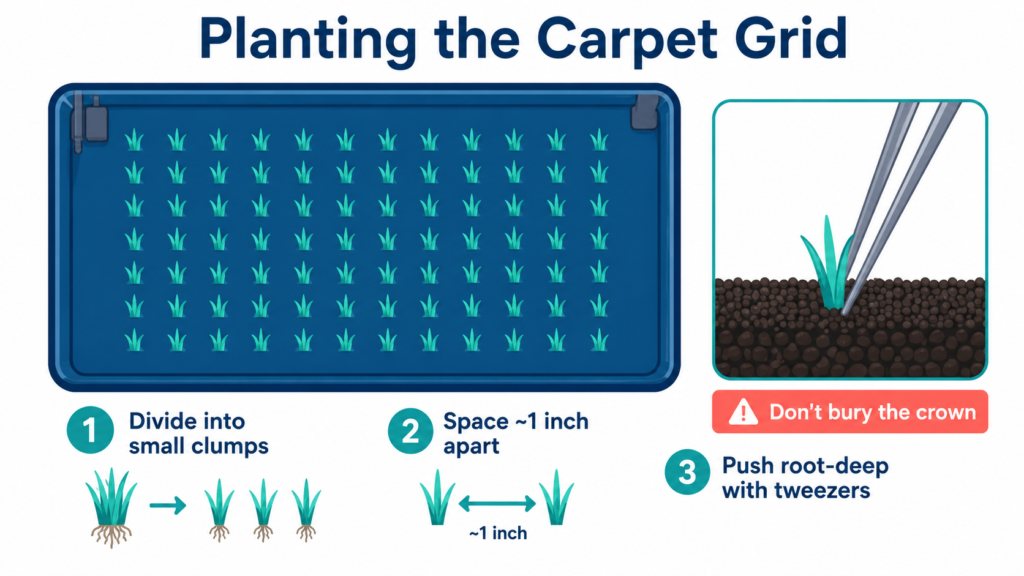
- Rinse and divide. Gently rinse the rockwool/gel off the roots under dechlorinated water. Split the pot into many small clumps — ideally 2-4 blades per clump. Small clumps spread faster than a few big ones.
- Trim the blades. Cut blades down to about 1.5-2 in (4-5 cm). Trimming the tops actually encourages the plant to put energy into horizontal runners instead of tall blades.
- Plant the grid. Using tweezers, push each small clump root-deep into the substrate, spacing clumps about 1-1.5 in (2.5-4 cm) apart in a grid. Closer spacing carpets faster.
- Lower the water slowly. Fill with a cup or onto a plate to avoid uprooting your work. Run the light on its timer from day one.
- Be patient through the lag. Weeks 1-3 may look like nothing is happening underground. That is normal root and runner establishment.
The Honest Week-by-Week Timeline
This is the part most articles fudge. Below is a realistic low-tech (no CO2) timeline. With CO2 and strong light, growth is markedly faster — but for a beginner nano tank, plan around the slower curve and you will never be disappointed.
| Stage | Weeks (low-tech) | What you should see | What to do |
|---|---|---|---|
| Establishment lag | Weeks 1-3 | Little visible growth; some old blades may melt | Don’t panic, don’t re-plant, keep photoperiod steady |
| First runners | Weeks 3-6 | Thin horizontal runners and new blades between clumps | Begin light fertilizing; watch for early algae |
| Spreading | Weeks 6-10 | Visible thickening; clumps start to connect | First trim to encourage density |
| Carpet forms | Weeks 8-14 | Continuous lawn across the planted zone | Regular trims; thin if it lifts off substrate |
Water Parameters and the Early Algae Window
Dwarf hairgrass is tolerant, but it has preferences. It does best in tropical-to-temperate water, roughly 68-78°F (20-26°C), soft to moderately hard, around 2-8 dKH, at a pH near neutral (about 6.5-7.5). This is a classic tropical-leaning plant, so if you are deciding the temperature philosophy of your whole tank, the Coldwater vs Tropical Nano Tank comparison is worth reading before you commit livestock.
The real hazard in weeks 2-6 is not the grass — it is algae. A new tank is nutrient-unstable, and a half-grown carpet is not yet consuming enough to outcompete algae. This is where most carpet attempts quietly die. Keep the photoperiod short and consistent, do regular small water changes, and resist the urge to crank the light to “speed things up.” A clean-up crew of nano-friendly grazers (such as small shrimp or snails) helps enormously; see the Best Nano Tank Fish for Beginners guide for tankmates that won’t uproot a young carpet.
For the botanical background on this species — native range, growth habit, and naming — the Eleocharis acicularis entry on Wikipedia is a solid, non-commercial reference.
Troubleshooting: When the Carpet Won’t Spread
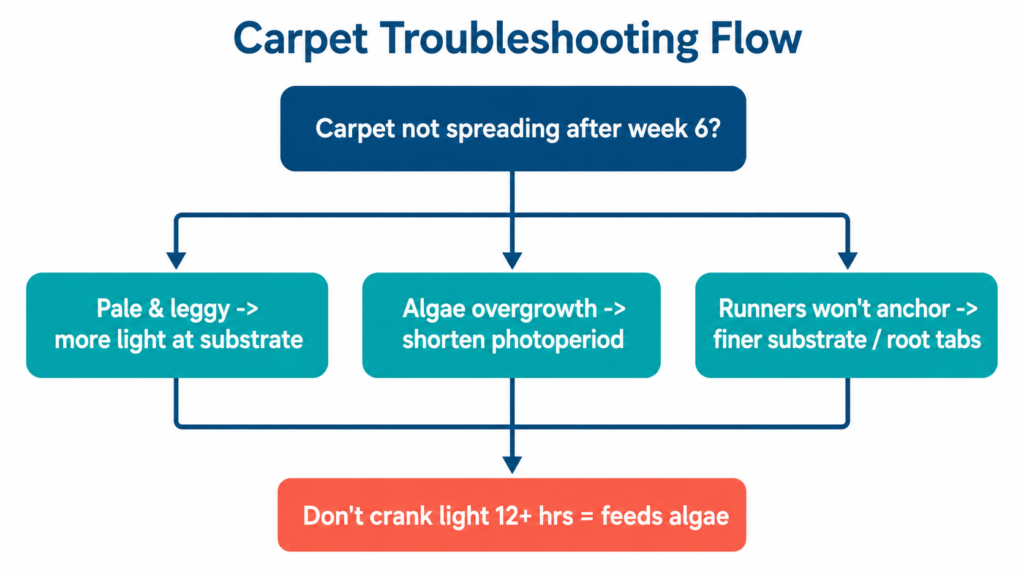
If you are past week 6 and nothing is happening, work down this list before assuming the plant is bad. Nine times out of ten it is light reaching the substrate, photoperiod length, or substrate type — not the grass.
| Symptom | Likely cause | Fix to try first |
|---|---|---|
| Blades thin, pale, leggy | Not enough light at substrate | Lower fixture / raise tank floor / brighter LED |
| Lots of algae, slow grass | Photoperiod too long; nutrients unstable | Cut light to 6-7 hrs; more frequent water changes |
| Runners form but won’t anchor | Substrate too coarse | Add fine cap or root tabs under the zone |
| Carpet lifts off in mats | Too dense / roots shaded out | Thin and re-trim; vacuum debris underneath |
| Old blades melting at start | Normal transition (emersed to submersed) | Wait; new submersed growth will follow |
Maintaining the Lawn Long-Term
Once it carpets, dwarf hairgrass is low-effort but not no-effort. Trim it every few weeks with scissors; trimming keeps it short, dense, and stops the lower layer from being shaded and dying back. After a heavy trim, the clippings will float — net them out or they decay and feed algae. Keep up modest fertilizing and your normal water-change routine, and the lawn will hold for many months. If your overall maintenance habits are still forming, the 9 Beginner Aquarium Mistakes roundup covers the small routine errors that quietly wreck planted nano tanks.
Keep Exploring NanoTank Lab
- How to Set Up a Nano Aquarium — the full start-to-finish build your carpet lives in.
- Nano Tank Size Guide (3 vs 5 vs 10 gallon) — pick a footprint with the floor space a carpet needs.
- How to Cycle a New Aquarium (fishless cycling) — establish stable water before adding livestock.
- Best Nano Tank Fish for Beginners — carpet-safe tankmates and clean-up crews.
- Nano Aquarium Starter Checklist — make sure your gear list is complete before you plant.
Frequently Asked Questions
Can I grow a dwarf hairgrass carpet without CO2?
Yes — dwarf hairgrass is one of the few aquarium carpet plants that genuinely carpets without injected CO2. The trade-off is speed: expect roughly 8-14 weeks to a full lawn low-tech, and noticeably faster with CO2 and strong light. Adequate light reaching the substrate matters far more than CO2 for simply getting a carpet to form.
How long does it take to carpet a nano tank?
Plan on 8-14 weeks for a continuous carpet in a typical low-tech nano tank. The first 1-3 weeks look like nothing is happening because the plant is establishing roots and runners underground; growth then accelerates because it spreads geometrically. Warmer water, stronger light, and CO2 all shift the timeline earlier, but results vary by setup.
What substrate is best for carpeting plants?
A fine-grained, nutrient-rich aquasoil is best because hairgrass has short, fine roots that need to grip and feed near the surface. Large inert gravel makes anchoring and spreading much harder. If you must use sand or gravel, place root tabs under the planting zone as a compromise and expect a slower fill-in.
Why is my carpet growing tall instead of spreading sideways?
Tall, vertical growth usually means the plant is reaching for light, so improve light intensity at the substrate and trim the blades down. Trimming the tops redirects the plant’s energy into horizontal runners, which is exactly what produces a dense, low carpet rather than a tall, patchy one.
Will shrimp or snails hurt a new hairgrass carpet?
No — small nano shrimp and most snails actually help by grazing algae off blades and substrate during the vulnerable early weeks. Avoid larger fish that dig or uproot plants until the carpet is well rooted. Choosing gentle, carpet-safe tankmates is the safer route while the lawn establishes.
How often should I trim a dwarf hairgrass carpet?
Trim roughly every two to four weeks once the lawn is established. Regular trimming keeps the carpet short and dense and prevents the shaded lower layer from dying back. Always remove the floating clippings afterward, since decaying trimmings add nutrients that can fuel an algae bloom.