
Understanding aquarium water parameters is the difference between a tank that thrives and one that mysteriously loses fish — but beginners almost always focus on the wrong number. Endless worry goes into pH, while the two parameters that actually kill fish, ammonia and nitrite, get ignored. The good news: you only need to understand a handful of measurements, and once you know which ones matter most, keeping water healthy becomes routine rather than mysterious.
Most parameter guides dump a chart of numbers without telling you which ones are life-or-death, which are “nice to have,” and why stability beats chasing a perfect reading. This guide explains each of the key aquarium water parameters in plain language, ranks them by how much they actually matter, and backs it with three original reference tables and a simple testing schedule — so you spend effort where it counts.
The Parameters That Matter (and Their Safe Levels)
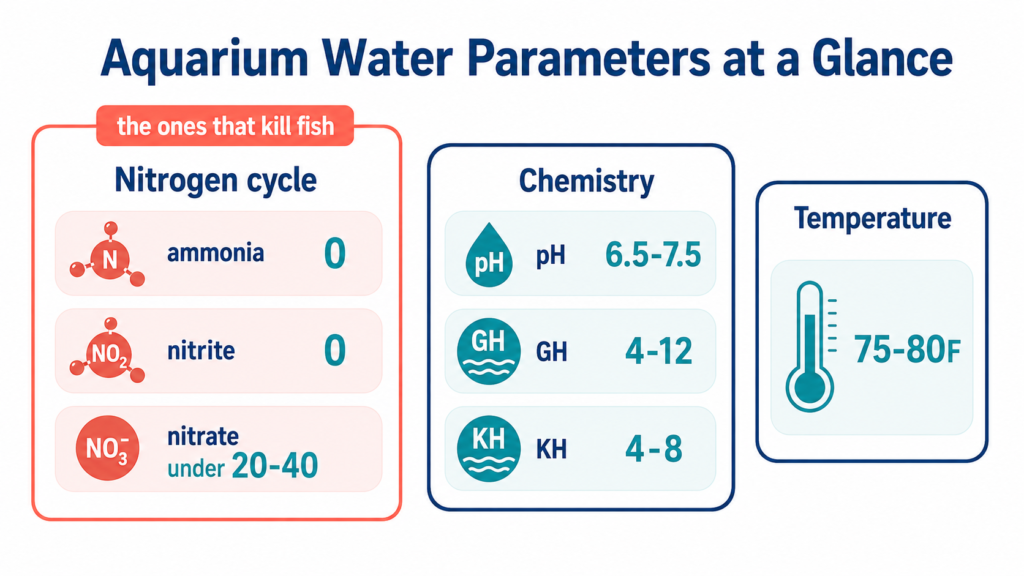
There are really only seven measurements worth knowing for a freshwater nano tank, and they fall into three groups: the nitrogen-cycle trio (ammonia, nitrite, nitrate), the chemistry pair (pH, hardness), and temperature. The nitrogen-cycle group is the one that determines whether fish live or die, which is why it tops every list. The quick-reference table below gives the target for each.
| Parameter | Safe level | What it is | How fussy? |
|---|---|---|---|
| Ammonia (NH₃) | 0 ppm | Toxic fish waste | Zero tolerance |
| Nitrite (NO₂) | 0 ppm | Toxic intermediate of the cycle | Zero tolerance |
| Nitrate (NO₃) | Below 20–40 ppm | Safer end product; builds up over time | Moderate |
| pH | ~6.5–7.5 (species-dependent) | Acidity/alkalinity | Stability > exact number |
| GH (general hardness) | 4–12 dGH (community) | Dissolved minerals (Ca, Mg) | Species-dependent |
| KH (carbonate hardness) | 4–8 dKH | pH buffer / stability | Helpful |
| Temperature | ~75–80°F (species-dependent) | Warmth | Stability matters |
Ammonia and Nitrite: The Silent Killers
If you remember only one thing, make it this: ammonia and nitrite must always read zero. Fish constantly produce ammonia through waste and respiration, and it is highly toxic — even small amounts burn gills and stress fish. Nitrite, the next step in the cycle, is just as deadly, blocking oxygen uptake in the blood. The only thing that keeps both at zero is a colony of beneficial bacteria, which is exactly what the nitrogen cycle builds.
This is why a new, uncycled tank is so dangerous, and why cycling before adding fish is non-negotiable. Nitrate, the cycle’s final product, is far less toxic and is what you remove with water changes. Letting nitrate climb is a slow problem; letting ammonia or nitrite rise is an emergency. The ranking table below puts the parameters in priority order.
| Priority | Parameter | Why | If it’s off |
|---|---|---|---|
| 1 (critical) | Ammonia & nitrite | Acutely toxic | Emergency: water change now, stop feeding |
| 2 (important) | Nitrate | Chronic stress if high | Water change; add plants |
| 3 (stability) | pH, KH | Sudden swings stress fish | Avoid chasing; keep steady |
| 4 (match species) | GH, temperature | Long-term health | Match to your livestock |
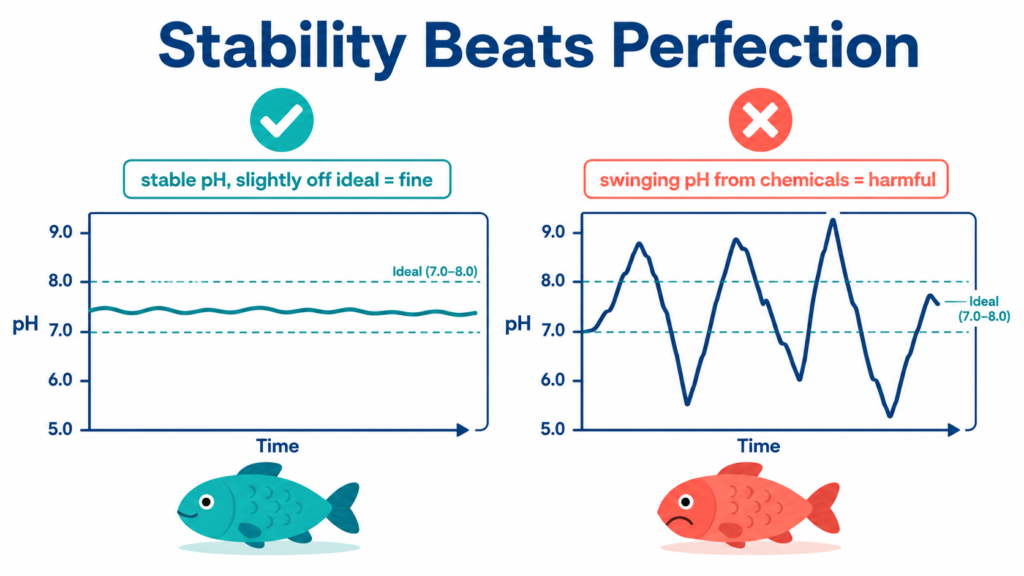
Tip: Do not chase a “perfect” pH with chemical adjusters. Most fish adapt fine to a stable pH that is slightly off their ideal, but they cannot handle the swings that pH-up and pH-down products cause. Stability beats the target number almost every time.
pH, Hardness, and Why Stability Wins
pH measures how acidic or alkaline your water is, and GH and KH describe its mineral content. They matter, but mostly in the sense of matching your fish and staying stable. Some species want soft, acidic water (like chili rasboras), others hard and alkaline (like Endler’s livebearers and most shrimp). KH is the quiet hero here: it buffers pH, so adequate KH prevents the sudden pH crashes that can wipe out a tank.
The practical approach is to test your tap water once, then choose fish that suit it rather than fighting your water chemistry forever. Temperature follows the same logic — pick species that match a stable temperature you can maintain, as covered in our coldwater vs tropical comparison. The testing schedule below tells you what to check and when.
| Test | When | Why |
|---|---|---|
| Ammonia & nitrite | Daily during cycling; weekly after | Catch toxic spikes early |
| Nitrate | Weekly | Tells you when to do a water change |
| pH | Weekly | Spot shifts before they harm fish |
| GH & KH | Monthly | Confirm buffering and mineral levels |
| Temperature | Daily (quick glance) | Catch heater failures fast |
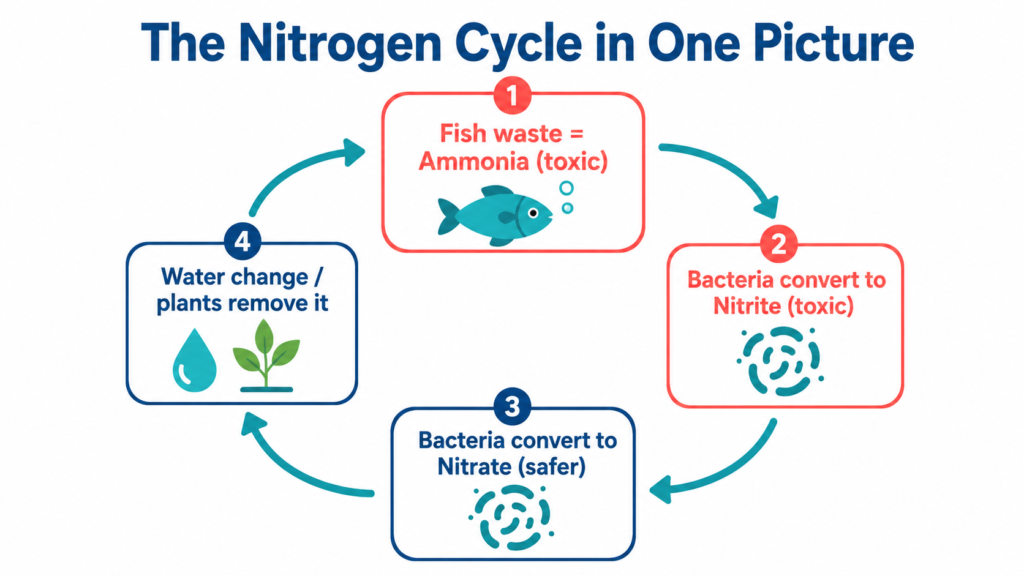
For a neutral, scientific primer on the process behind these parameters, the Wikipedia entry on the nitrogen cycle explains how ammonia is converted to nitrite and then nitrate.
Keep Exploring NanoTank Lab
- How to Cycle a New Aquarium (fishless cycling) — how to get ammonia and nitrite to zero.
- How Long Before You Can Add Fish — when your parameters are safe.
- 9 Beginner Aquarium Mistakes — the errors that wreck water quality.
- Coldwater vs Tropical Nano Tank — matching temperature to your fish.
- How to Set Up a Nano Aquarium — the full beginner build.
Frequently Asked Questions
What are the most important aquarium water parameters?
Ammonia and nitrite are the most important — both must always read zero, because they are acutely toxic to fish. Next is nitrate, which should stay below about 20 to 40 ppm and is controlled with water changes. pH, hardness (GH and KH), and temperature matter too, but mainly for matching your species and keeping conditions stable rather than hitting an exact number.
What is a safe ammonia and nitrite level?
Zero. The only safe level for both ammonia and nitrite is 0 ppm, because both are highly toxic even in small amounts. If either reads above zero, treat it as an emergency: do an immediate water change, stop feeding, and check that your tank is fully cycled. A reading above zero almost always means the tank is not cycled or is overstocked.
Should I adjust my aquarium’s pH?
Usually not. Most fish adapt well to a stable pH even if it is slightly outside their ideal range, but they suffer from the swings that chemical pH adjusters cause. Instead of fighting your water, test your tap water and choose fish that suit it. Stability is far more important than hitting a specific pH number.
What is the difference between GH and KH?
GH (general hardness) measures dissolved minerals like calcium and magnesium, which fish and shrimp need for health and, in shrimp, for molting. KH (carbonate hardness) measures carbonates that buffer the water and keep pH stable. In short, GH is about minerals for the animals, and KH is about pH stability. Both are tested monthly with a liquid kit.
How often should I test my water?
During cycling, test ammonia and nitrite daily. Once the tank is established, test ammonia, nitrite, nitrate, and pH weekly, and check GH and KH monthly. Glance at the temperature daily so you catch a heater failure fast. Liquid test kits are more accurate than strips, and regular testing catches problems before they harm your fish.
What causes high nitrate, and is it dangerous?
Nitrate builds up as the end product of the nitrogen cycle, rising from fish waste and uneaten food over time. It is far less toxic than ammonia or nitrite, but chronically high nitrate (above ~40 ppm) stresses fish and fuels algae. Control it with regular water changes, not overfeeding, avoiding overstocking, and live plants, which absorb nitrate as fertilizer.