Best Nano Aquarium Kit: All-in-One Tanks Compared
The best nano aquarium kit for you depends on a trade-off most beginners do not realize they are making: the sleek, hide-everything convenience of an all-in-one (AIO) tank versus the flexibility and value of buying components separately. AIO kits look beautiful and simplify setup, but the name is misleading — most do not actually include everything, and the gap usually trips up first-timers. Know what is in the box (and what is not) and you will buy the right tank with no surprises.
Most kit roundups just list products and prices and skip the practical truth: which kits omit a heater, which have weak stock lighting, and when a custom build beats a kit entirely. This guide compares the real options, spells out exactly what you still need to buy, and backs it with three original reference tables so your “all-in-one” tank is genuinely ready for fish.
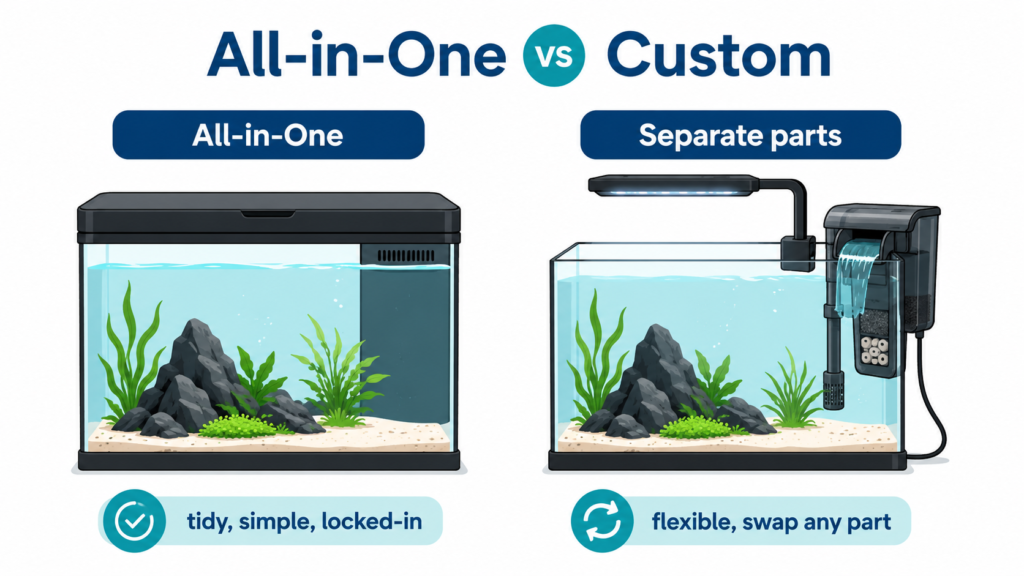
All-in-One vs Buying Components Separately
An all-in-one nano tank integrates filtration (and often lighting) into the tank itself, usually via a hidden rear chamber. The appeal is real: clean looks, no equipment cluttering the display, and a simpler first setup. The downside is flexibility — you are locked into the kit’s filter design, flow, and often proprietary media, and upgrading individual parts can be awkward.
Buying components separately (a bare tank plus a chosen filter, heater, and light) costs a similar amount but lets you pick the best part for each job and replace any piece independently. Neither approach is wrong; they suit different priorities. The table below lays out the trade-off.
| Factor | All-in-one kit | Separate components |
|---|---|---|
| Looks | Clean, equipment hidden | Equipment more visible |
| Setup ease | Simplest | A few more decisions |
| Flexibility | Locked to kit design | Swap any part freely |
| Upgrades | Often proprietary | Easy, part by part |
| Heater included? | Usually no | You choose and add one |
Popular Nano Kits Compared
A few kit families dominate the nano space, each with a clear personality. The Fluval Spec is a sleek small AIO (around 5 gallons) praised for excellent integrated filtration and a long, swim-friendly footprint — but its stock light is modest and it has no heater. The Fluval Flex steps up with a curved front, RGB lighting, and a roomy rear sump in 9- and 15-gallon sizes; it is a beautiful all-rounder, though again no heater and a non-adjustable pump. For pure value, a basic Aqueon-style starter kit bundles a hang-on-back filter, heater, and LED hood in a plain glass tank — less stylish, but genuinely complete and beginner-proof.
| Kit | Type | Strength | Watch out for |
|---|---|---|---|
| Fluval Spec (~5 gal) | AIO | Great filtration, sleek, long footprint | Modest light; no heater |
| Fluval Flex (9/15 gal) | AIO | RGB light, rear sump, looks premium | No heater; flow not adjustable |
| Aqueon-style kit (10 gal) | Complete starter | Cheap, includes heater + filter + light | Plain look; basic components |
| Bare tank + parts | Custom | Best part for each job; upgradeable | You assemble it yourself |
The pattern is clear: premium AIO kits (Fluval Spec and Flex) win on looks and integrated filtration but make you add a heater, while budget all-glass starter kits include more but look plainer. There is no single “best” — only the best fit for your budget, livestock, and how much you value a clean look. For a realistic budget breakdown, see our guide to how much a nano aquarium costs.
Tip: Before buying any “all-in-one,” check the spec sheet for a heater. The vast majority of stylish AIO nano tanks do not include one, and tropical fish will need it — budget for a small heater on top of the kit price.
What You Still Need to Buy
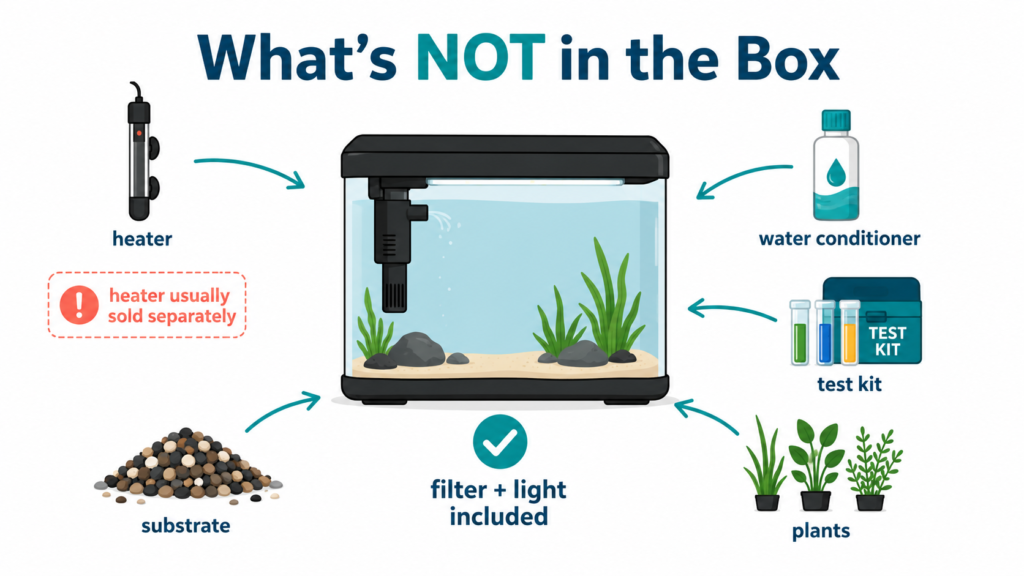
Even a good kit rarely makes you fish-ready on its own. Almost always you will still need a heater (for tropical fish), a water conditioner (dechlorinator), and a test kit for cycling. You will likely also want substrate, plants, and hardscape, plus food for whatever you stock. Treating the kit as a starting point rather than a complete solution prevents the classic “I bought everything but can’t add fish yet” letdown.
And whatever the box says, the most important “ingredient” is not in any kit: a cycled tank. No kit ships with the beneficial bacteria your fish need, so plan to run a fishless cycle after assembly. Our full nano aquarium starter checklist lists everything, and the gap table below shows what kits typically miss.
| Item | Usually in a kit? | You may need to add |
|---|---|---|
| Tank | Yes | — |
| Filter | Yes (AIO) / Yes (starter kit) | — |
| Light | Often (sometimes weak) | Upgrade for plants |
| Heater | Rarely in AIO; yes in starter kits | Add for tropical fish |
| Conditioner + test kit | Sometimes | Buy if missing |
| Substrate + plants | No | Add to plant the tank |
For a neutral overview of aquarium types and equipment, the Wikipedia entry on aquariums covers the basics of tanks and their life-support systems.
Keep Exploring NanoTank Lab
- How to Set Up a Nano Aquarium — the full build, kit or custom.
- Nano Tank Size Guide (3 vs 5 vs 10 gallon) — pick the right size first.
- How Much Does a Nano Aquarium Cost? — budget the whole setup honestly.
- Best Nano Tank Filter — what to choose if you go custom.
- Nano Aquarium Starter Checklist — everything you actually need.
Frequently Asked Questions
What is the best all-in-one nano aquarium kit?
There is no single best kit — it depends on your priorities. The Fluval Spec and Flex are top picks for looks and integrated filtration, but you must add a heater. A basic all-glass starter kit is the best value because it includes a heater, filter, and light, though it looks plainer. Choose based on budget, livestock, and how much you value a clean appearance.
Do all-in-one tanks come with a heater?
Usually not. Most stylish AIO nano tanks, including popular Fluval models, include filtration and lighting but not a heater. If you plan to keep tropical fish, budget for a small heater on top of the kit price. Plain all-glass starter kits are more likely to include a heater, which is part of why they offer better day-one value.
Are nano tank kits good for beginners?
Yes, kits are a great beginner starting point because they remove guesswork and bundle core equipment. Just remember a kit is not a complete solution: you will still need a heater (for tropical fish), conditioner, a test kit, substrate, and plants, plus time to cycle the tank. Treat the kit as a foundation, not a finished aquarium.
Is an all-in-one tank better than buying parts separately?
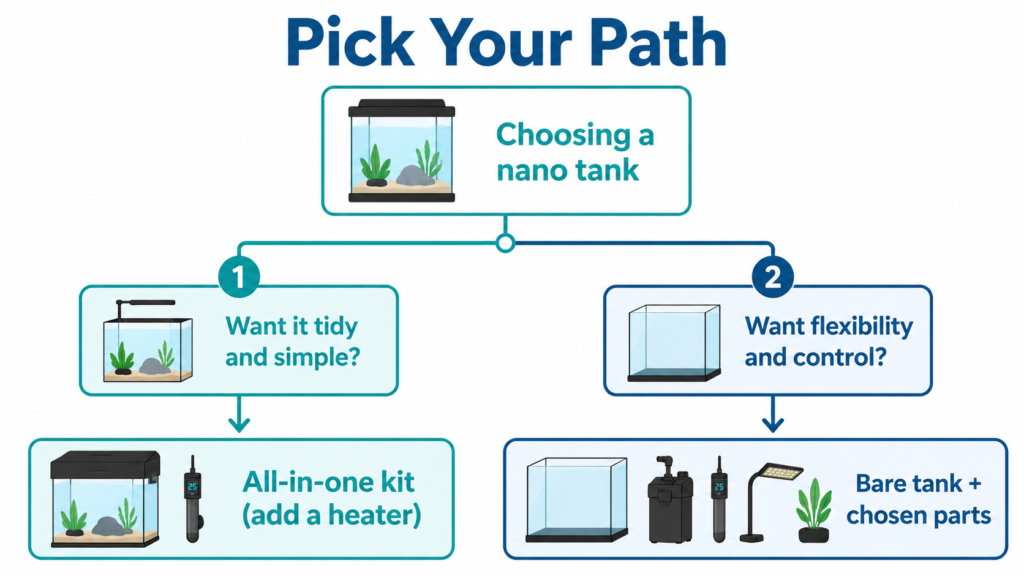
Neither is universally better. All-in-one tanks look cleaner and are simpler to set up, but lock you into their filter and flow design. Buying parts separately costs about the same and lets you choose the best filter, heater, and light, and upgrade any one independently. Pick AIO for tidiness and simplicity, custom for flexibility and control.
What size nano kit should a beginner get?
A 5- to 10-gallon kit is the beginner sweet spot. Larger water volumes are more stable and forgiving of mistakes than tiny 3-gallon tanks, while still fitting on a desk or shelf. A 10-gallon in particular gives you more stocking options and easier parameter stability. Check our size guide to match the tank to the fish you want to keep.
Can I add fish as soon as I set up a kit?
No. No kit ships with the beneficial bacteria that make a tank safe, so you must cycle it first. Set up the kit, then run a fishless cycle until ammonia and nitrite read zero, which usually takes a few weeks. Adding fish to a brand-new, uncycled kit is the single most common beginner mistake and a frequent cause of early fish loss.