
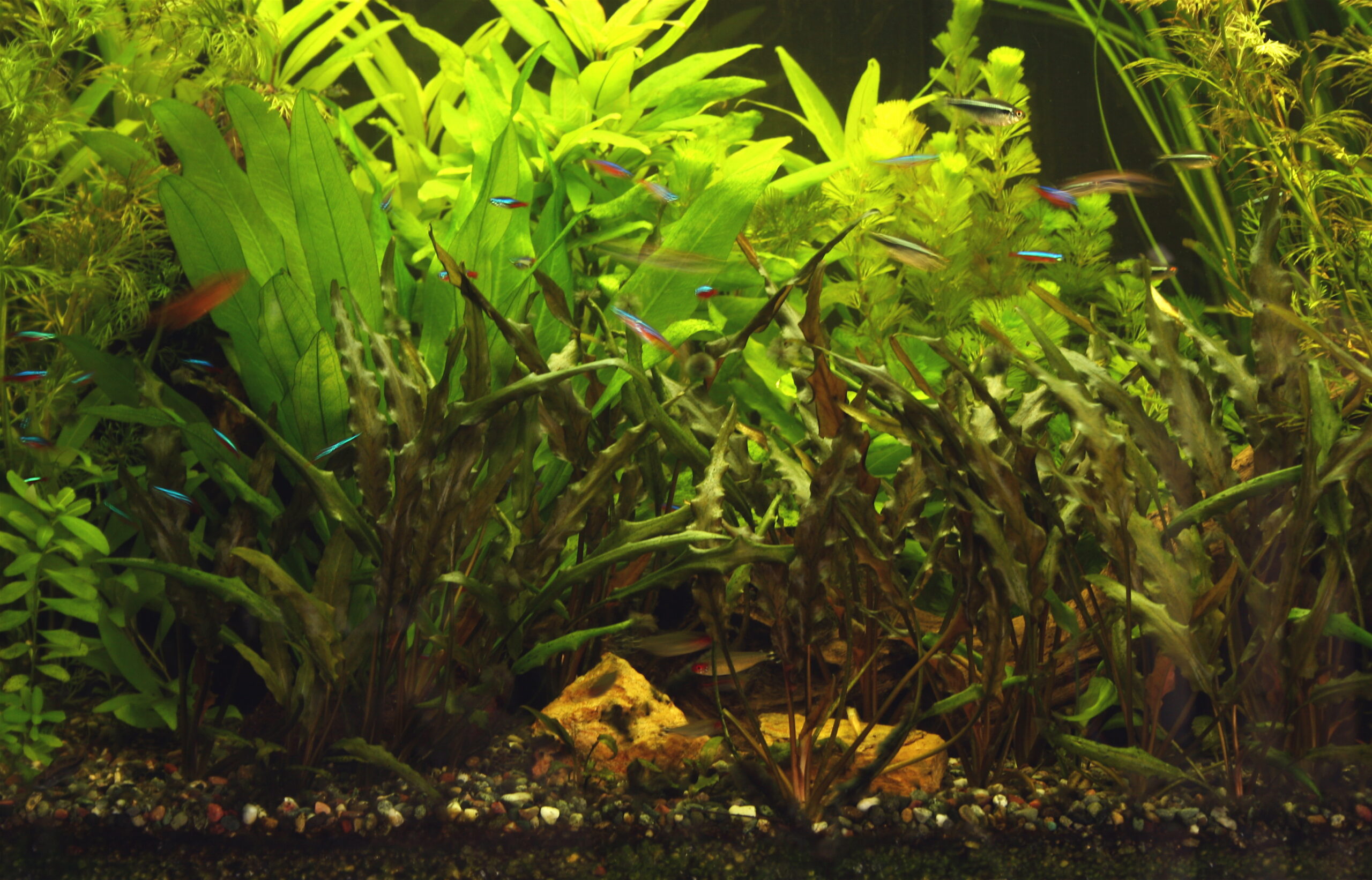
The best nano aquascaping ideas for beginners are not the ones that look hardest on Instagram — they are the layouts that survive month two, when the novelty fades and the algae shows up. There is a stubborn misconception that good aquascaping is mostly about expensive carpeting plants, pressurized CO2, and an artist’s eye. It is not. The single biggest predictor of whether your small tank still looks good in 90 days is the style you commit to on day one, and how well that style tolerates the mistakes every beginner makes. If you are nervous about getting it wrong, relax — the right style is forgiving on purpose.
Most “nano aquascaping ideas” articles dump a gallery of gorgeous tanks and leave out the part you actually need: a head-to-head comparison of the major styles by difficulty, cost, smallest sane tank size, and — the column everyone ignores — forgiveness. That is the gap this post fills. Below you get a real decision table first, a quick plain-English vocabulary primer, seven specific layouts you can build in a 5 to 10 gallon tank (each with a scannable plants/hardscape/what-kills-it block), honest numbers stamped for mid-2026, a build-order workflow, and a first-month timeline — so you choose with your eyes open instead of buying plants twice.
What “Aquascaping” Actually Means (Plain English)
Aquascaping just means arranging hardscape and plants on purpose, so an underwater tank reads as a deliberate landscape instead of a random box of decorations. Four words unlock almost everything else:
- Substrate — the bottom layer (sand, gravel, or nutrient “aquasoil”) that plants root into.
- Hardscape — the non-living structure: rocks and driftwood. It is the skeleton of the scape.
- Epiphyte — a plant that attaches to wood or rock instead of rooting in substrate (Anubias, Java fern, Bucephalandra). Beginner gold, because you tie it on and forget it.
- Rhizome — the thick horizontal “stem” of those epiphytes. Never bury the rhizome — it rots. Tie it onto the hardscape and let the roots grip.
Keep that one rule — never bury the rhizome — and you have already avoided the most common slow-motion failure in beginner scapes. For the broader history and schools of the hobby, the Wikipedia entry on Aquascaping is a solid, neutral overview.
Nano Aquascaping Ideas, Compared: Which Style Should a Beginner Pick?
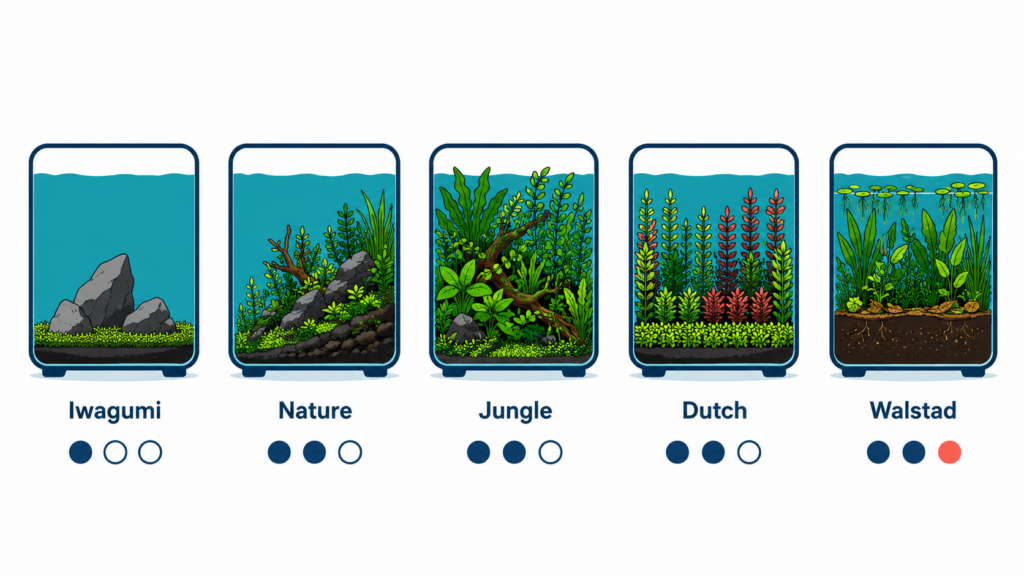
Before you fall in love with a photo, look at the tradeoffs. The five classic aquascaping schools each ask something different from you: minimalism and discipline (Iwagumi), patience and an eye for balance (Nature), benign-neglect tolerance (Jungle), pruning labor (Dutch), or biological patience (Walstad). The table below is my own synthesis after setting these up repeatedly in small tanks — ranked roughly from most forgiving to most demanding. The “forgiveness” column is the one beginners ignore and regret, and the “smallest sane size” column keeps you from cramming a layout into a cube that will fight you.
| Style | Look | CO2 needed? | Difficulty (1-5) | Forgiveness | Smallest sane size | Weekly upkeep | Setup cost (mid-2026) |
|---|---|---|---|---|---|---|---|
| Jungle | Dense, wild, overgrown | No | 2 | High — hides mistakes | 5 gal / 19 L | 15-25 min | $70-$140 |
| Walstad (low-tech) | Soil-capped, heavily planted, natural | No | 3 | High once established | 5 gal / 19 L | 10-20 min | $60-$120 |
| Nature (Amano) | Layered hardscape + mixed plants | Helpful, not required | 3 | Medium | 5 gal / 19 L | 30-45 min | $120-$220 |
| Hardscape-only | Rocks/wood, no plants | No | 2 | High — nothing to melt | 2 gal / 7.5 L | 10-15 min | $50-$110 |
| Blackwater biotope | Tannin-stained, leaf litter, moody | No | 3 | Medium-high | 3 gal / 11 L | 15-25 min | $70-$150 |
| Iwagumi | Minimal: stones + carpet | Strongly recommended | 5 | Low — algae shows instantly | 8 gal / 30 L | 45-60 min | $160-$260 |
| Dutch | Rows of colored stem plants, no hardscape | Strongly recommended | 5 | Low — needs constant pruning | 10 gal / 38 L | 60-90 min | $150-$280 |
The honest beginner pick: a Jungle or Walstad-leaning Nature layout. Both are high-forgiveness, need no CO2, and let plant mass out-compete algae while you learn. Iwagumi and Dutch are gorgeous and worth growing into, but they punish the exact mistakes beginners make — uneven trimming, unstable CO2, and impatience. Save them for your second or third scape. If you are still choosing the tank itself, our nano tank size guide comparing 3 vs 5 vs 10 gallon pairs naturally with the styles above — more water volume means more forgiveness on top of whatever style you pick, and you can sanity-check the budget against how much a nano aquarium really costs.
Tip: Pick your hardscape first, plants second. A tank that looks balanced empty will look great grown in — and choose the style for the maintenance you will actually do on a busy week, not the maintenance you imagine on a perfect one. A great Jungle tank beats a neglected Iwagumi every single time.
A 30-Second Primer on Layout (Why a Scape “Reads” Well)
Before the styles, one bit of composition theory pays off forever. Most good nano scapes follow one of three shapes, and just picking one keeps your hardscape from looking like a random pile:
- Triangular — mass high on one side sloping down to the other. The easiest, most natural-looking layout for a first tank.
- Island — a single focal mound in the middle with open space around it. Striking but needs negative space to breathe.
- Concave (U-shape) — taller plants on both sides, a low valley in the center that draws the eye into the tank.
Pick one before you place a single rock. A consistent shape is most of what separates a “designed” tank from a busy one — and it costs nothing.
The 7 Beginner Nano Aquascaping Ideas That Actually Work
These seven layouts are ordered from most forgiving to most demanding. Each is sized for a 5 to 10 gallon nano tank and gets a scannable three-line block: the plants that work, the hardscape, and the single mistake that most often kills it.
1. The Low-Tech Jungle (start here)
A controlled-chaos wall of green where dense, hungry plants soak up nutrients before algae can. No CO2, no carpet, no aquasoil required — the most forgiving scape in existence.
- Plants that work: Java fern, Anubias nana, Hygrophila or Rotala rotundifolia, water sprite, plus floating plants up top.
- Hardscape: optional — a branch or two of spiderwood; structure comes from plant mass, not rock.
- Kills it most often: planting too sparsely on day one. Go heavy immediately — a full tank is a stable tank.
2. The Walstad Low-Tech (set-and-mostly-forget)
Diana Walstad’s method caps roughly half an inch to an inch of organic potting soil with sand or fine gravel and leans on heavy planting plus modest light to balance the system biologically — minimal water changes once it stabilizes. The lowest-maintenance approach here. You can read about the method and its originator on the Wikipedia entry for Diana Walstad.
- Plants that work: fast stems and heavy root-feeders — water sprite, Hygrophila, Cryptocoryne, plus floaters to mop up early ammonia.
- Hardscape: light and optional; the soil cap and planting do the work.
- Kills it most often: impatience. The first few weeks can be murky and ammonia-prone as the soil settles — stock lightly and wait it out.
3. The Anubias & Driftwood Hardscape
One nice piece of driftwood, a few epiphytes tied to it, a patch of moss, and plain sand. The cleanest-looking “Nature-lite” scape a beginner can pull off, and because everything is slow-growing and attached, trimming is rare.
- Plants that work: Anubias nana petite, Bucephalandra, Java fern, a little Christmas moss.
- Hardscape: a single sculptural piece of manzanita or spiderwood over fine sand.
- Kills it most often: burying the Anubias rhizome in substrate — it rots. Tie it onto the wood and let the roots grip.
4. The Hardscape-Only Scape (composition first)
No plants at all — just rock and wood arranged into a deliberate shape. It sounds like cheating, but it is a smart on-ramp: you learn composition and proportion with zero plant-care pressure, then add epiphytes later once the cycle is solid. It also suits the smallest 2 to 3 gallon cubes and pairs beautifully with a single betta.
- Plants that work: none required — add Anubias or moss later if you want.
- Hardscape: a triangular or island arrangement of seiryu-style stone or manzanita; this is the scape.
- Kills it most often: a symmetrical, centered pile. Use an odd number of stones and an off-center focal point so it reads as natural.
Building around a betta? The betta fish care in a nano tank guide covers the heat, flow, and footprint a hardscape-plus-betta tank needs.
5. The Blackwater Biotope (moody and low-key)
Tannin-stained, tea-colored water over a bed of leaf litter and wood — a slice of a shaded forest stream. The tannins from botanicals gently soften and acidify the water and look fantastic with a betta or a small school. Forgiving because it leans low-light and low-plant.
- Plants that work: minimal and shade-tolerant — Java fern, Anubias, moss; plants are accents, not the star.
- Hardscape: spiderwood plus catappa (Indian almond) leaves and alder cones for the tannin stain.
- Kills it most often: expecting crystal-clear water. The brown tint is the point; replace leaf litter as it breaks down to keep it fresh.
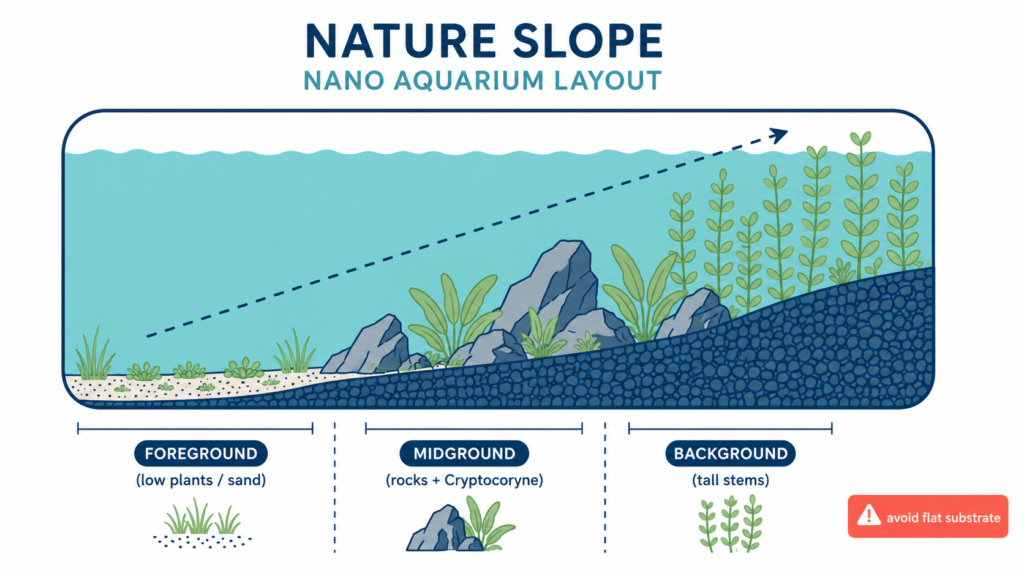
6. The Carpet-Free Nature Slope
Classic Amano-style depth — substrate sloping up toward the back, rocks and wood forming a focal triangle, midground and background plants creating layers — but deliberately skipping the difficult carpet. This delivers most of the “Nature aquarium” look at a fraction of the difficulty.
- Plants that work: Cryptocoryne wendtii (nearly bulletproof once rooted) for the midground, dwarf sagittaria up front, stems at the back.
- Hardscape: a triangular rock-and-wood focal point on a slope built up toward the rear glass.
- Kills it most often: a flat substrate. Depth comes from the slope — build it up before you plant.
7. The Dutch-Inspired Stem Garden (your stretch goal)
The most ambitious idea here: rows of contrasting stem plants — greens against reddish Ludwigia or Rotala — arranged by height and color, with no hardscape at all. It is plant-husbandry on hard mode and the only style on this list I would not start with. Treat it as a goal to grow toward once you have kept stems alive in an easier scape first.
- Plants that work: Ludwigia, Rotala rotundifolia, green Hygrophila — grouped in single-species rows by height.
- Hardscape: none; the plants are the entire composition.
- Kills it most often: skipping relentless weekly pruning and good ferts/light. Without them the rows leggy out and lower leaves rot.
Beginner-Proof Plants and Their Conditions
Style is the frame; plants are the paint. The plants below consistently survive a beginner’s learning curve in a small tank with modest light and no injected CO2. The numbers are typical comfortable ranges — aquarium keeping is full of “results vary,” and your light, water, and stocking all shift these — but they are a sane starting point.
| Plant | Role in scape | Light need | Temp range | CO2? | Best for which idea |
|---|---|---|---|---|---|
| Java fern | Midground attach | Low | 68-82°F (20-28°C) | No | Jungle, Hardscape, Blackwater |
| Anubias nana petite | Foreground/mid attach | Low | 72-82°F (22-28°C) | No | Hardscape, Iwagumi nod |
| Cryptocoryne wendtii | Midground root | Low-med | 72-82°F (22-28°C) | No | Nature slope |
| Java moss | Texture/focal | Low | 65-80°F (18-27°C) | No | Moss accents, Wabi-kusa |
| Dwarf sagittaria | Easy foreground | Med | 68-82°F (20-28°C) | Optional | Mini-Iwagumi, Nature slope |
| Water sprite | Fast background/float | Med | 68-82°F (20-28°C) | No | Jungle, Walstad |
| Rotala rotundifolia | Background stem | Med-high | 72-82°F (22-28°C) | Optional | Nature slope, Dutch goal |
| Ludwigia (red) | Color accent stem | High | 72-82°F (22-28°C) | Helpful | Dutch stretch goal |
Notice the pattern: the easiest plants are low-light and CO2-free, which is exactly why the Jungle and Walstad ideas top the beginner list. Their general-hardness and pH preferences are wide too, so you rarely need to chase chemistry. Match your livestock to your plants and temperature, not the other way around; our roundup of the best nano tank fish for beginners lists species that suit these planted, tropical setups, and if you are torn between a heated and an unheated build, see coldwater vs tropical nano tank.
Water Conditions: Aim for a Range, Not a Magic Number
Beginners obsess over hitting one perfect parameter. Don’t. For the hardy, low-tech plants above, stability matters far more than any exact number — a steady “okay” reading beats a perfect one that swings daily. These are comfortable ranges, with metric conversions, that suit the whole beginner plant list.
| Parameter | Comfortable range | Metric / ppm equivalent | Note |
|---|---|---|---|
| Temperature | 72-80°F | 22-27°C | Tropical; most beginner plants overlap here |
| General hardness (GH) | 4-12 dGH | ~70-215 ppm | Very wide tolerance; soft to moderately hard |
| Carbonate hardness (KH) | 3-8 dKH | ~54-143 ppm | Buffers pH; avoid wild swings |
| pH | 6.5-7.8 | — | Stability beats a “perfect” value |
| Nitrate | 10-40 ppm | — | Light plant food; keep below 40 with water changes |
If your tap water sits anywhere inside these bands, use it as-is and skip the additives. Chasing chemistry is how beginners destabilize a tank that was already fine.
How to Actually Build It: A 7-Step Starter Workflow
“Which style” is half the job; “in what order” is the other half. This is the build sequence for a low-tech nano scape, with rough mid-2026 cost bands and the pitfall that bites at each step. Plan on a weekend of hands-on time spread across setup, then a patient month of cycling.
| Step | Do this | Time | Rough cost (mid-2026) | Beginner pitfall to avoid |
|---|---|---|---|---|
| 1. Plan | Pick style + layout shape; sketch it | 30 min | $0 | Skipping the sketch and “winging” the hardscape |
| 2. Substrate | Lay sand/gravel or capped soil; slope to back | 30-45 min | $15-$40 | Flat, even substrate with no depth |
| 3. Hardscape | Place rock/wood in your chosen shape first | 30-60 min | $15-$50 | Centered, symmetrical pile |
| 4. Plant | Heavy planting; tie epiphytes onto wood | 45-90 min | $30-$80 | Planting sparse; burying rhizomes |
| 5. Fill slowly | Pour onto a plate/plastic bag to avoid clouding | 15 min | $0 | Blasting water in and uprooting everything |
| 6. Cycle | Fishless cycle; lights 6-7 hrs/day | 4-6 weeks | $10-$25 | Adding fish before the cycle finishes |
| 7. Stock | Snails/shrimp first, then fish slowly | over weeks | $20-$60 | Fully stocking on day one |
Doing this in order — and filling slowly onto a plate so you don’t blow a crater in your substrate — is most of what separates a clean first scape from a muddy redo. For the full hardware and substrate decisions underneath these steps, our walkthrough on how to set up a nano aquarium and the nano aquarium starter checklist cover what you genuinely need versus what the store upsells.
Your First-Month Aquascape Timeline
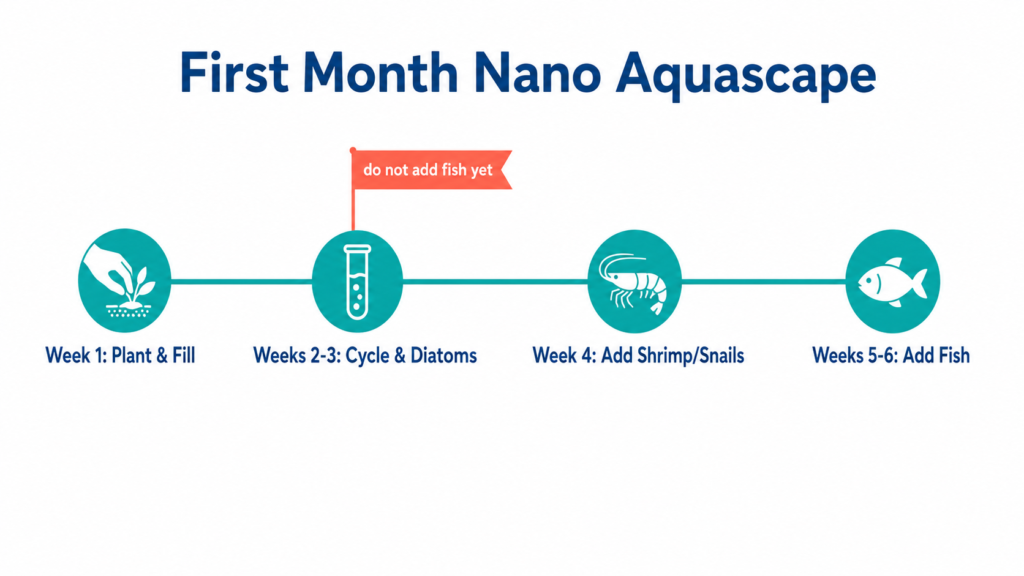
A beautiful scape is built on a boring foundation: a cycled tank and a patient first month. Skipping the cycle is the number-one reason new aquascapes crash, and it is featured prominently in our list of 9 beginner aquarium mistakes. Here is the honest week-by-week sequence — including the part nobody warns you about: some brown diatom algae in weeks two to three is normal, not failure.
| Phase | Do this | Watch for | Add livestock? |
|---|---|---|---|
| Week 1 | Hardscape + substrate + heavy planting; fill; start fishless cycle | Cloudy water (normal); soil leaching if Walstad | No |
| Weeks 2-3 | Dose ammonia; test for nitrite spike; lights ~6-7 hrs/day | First diatom (brown) algae — normal, just wipe it | No |
| Week 4 | Cycle completing: ammonia & nitrite read 0 ppm, nitrate present | Plant melt/adjustment; trim dead leaves | Snails/shrimp first |
| Weeks 5-6 | Stable parameters; 25-30% weekly water change | Hair/green algae if light too long — cut photoperiod | Add fish slowly |
| Ongoing | Trim, top off, weekly water change, light fert dosing | Overgrowth (good problem); shading of lower plants | Fully stocked |
The cycle is non-negotiable, and it is the step beginners most want to skip. If the term is new to you, walk through our guide on how to cycle a new aquarium with fishless cycling before you add a single fish, and check how long before you can add fish so your timeline expectations are realistic.
Setting Honest Expectations
Three truths that save beginners a lot of grief. First, every scape looks sparse and a little awkward on day one — that is normal; it fills in. Second, some first-month algae is part of the process, not a sign of failure — a new tank’s biology is still finding balance. Third, “low-tech” means low-equipment, not no-work: you still trim, top off, and do a weekly water change. Aquascaping is a slow craft, and the people who enjoy it most are the ones who stopped expecting an Instagram tank in week one.
Common Aquascaping Mistakes (and the Quick Fix)
Most beginner scapes fail for a short, predictable list of reasons. Knowing them in advance is worth more than any plant.
- Planting too sparsely. Empty space is algae’s invitation. Plant heavily from day one — you can always thin later.
- Lights on too long. 6-7 hours is plenty for low-tech tanks. More light without more CO2 just feeds algae. A timer fixes this instantly.
- Burying rhizome plants. Anubias and Java fern rot if their rhizome is in substrate. Tie them to wood or rock instead.
- Chasing a carpet too early. Hairgrass and Monte Carlo (or HC Cuba) do best with CO2 and high light. Start with sagittaria or moss.
- Skipping the cycle. An uncycled tank kills livestock and stalls plants. Always cycle first — there are no shortcuts that work.
- Disturbing it constantly. New tanks need stability to mature. Resist the urge to re-scape weekly.
One last opinion: postpone the carpet-plus-CO2 dream scape. It will still be there in six months, and by then you will have the reflexes to pull it off instead of feeding algae while you learn.
Keep Exploring NanoTank Lab
- How to Set Up a Nano Aquarium — the full hardware-and-substrate foundation under every scape.
- Nano Tank Size Guide (3 vs 5 vs 10 gallon) — bigger volume buys you forgiveness for any style.
- How to Cycle a New Aquarium (fishless cycling) — the non-negotiable step before livestock.
- Best Nano Tank Fish for Beginners — species that suit these planted, tropical scapes.
- Betta Fish Care in a Nano Tank — the perfect occupant for a hardscape or blackwater layout.
Frequently Asked Questions
What is the easiest nano aquascaping style for a complete beginner?
A low-tech Jungle style is the easiest, because dense, fast-growing plants out-compete algae and forgive inconsistent care. It needs no CO2 and no carpet — just heavy planting with hardy species like Java fern, Anubias, and water sprite. A Walstad-style soil tank is a close second for low maintenance once it stabilizes, and a plant-free hardscape-only scape is the easiest of all if you want to learn composition before plant care.
Do I need CO2 for a nano aquascape?
No — you do not need CO2 for most beginner nano aquascaping ideas. Iwagumi carpets and Dutch stem gardens benefit strongly from injected CO2, but Jungle, Walstad, moss, hardscape-only, and blackwater scapes thrive without it. Skipping CO2 lowers cost and difficulty, which is exactly why those styles top the beginner list.
What is the smallest tank size for aquascaping?
You can aquascape a tank as small as 2 to 3 gallons (about 7 to 11 liters), but the smaller you go, the less forgiving it gets — tiny volumes swing in temperature and water parameters fast. Hardscape-only and minimal blackwater layouts handle the smallest cubes best because there is little plant mass to destabilize. For a first planted scape, a 5 gallon (19 L) tank is the sweet spot, and within the nano range, choose the largest size your space and budget allow.
How many plants should I start with in a nano tank?
Start with far more than feels necessary — covering most of the plan, plantable area on day one is the goal. Heavy initial planting is the single best defense against algae in a new tank, because the plants consume nutrients that algae would otherwise use. You can always thin and re-arrange as things grow in.
Why does my new aquascape keep growing algae?
The most common cause is too much light for too little plant mass — long photoperiods feed algae faster than sparse young plants can compete. Cut your lights to 6-7 hours a day with a timer, plant more heavily, and make sure the tank is fully cycled. A brown diatom film in the first few weeks is normal and usually fades on its own; persistent green or hair algae almost always traces back to light duration or excess nutrients.
How long until a nano aquascape looks “grown in”?
Most low-tech nano scapes look genuinely filled in around 6 to 12 weeks, though this varies widely with light, plant choice, and whether you run CO2. Fast stems and floaters fill space within weeks, while slow growers like Anubias and Bucephalandra take months. Patience is part of the craft — a tank that is rushed almost always battles algae first.