
When your fish died overnight — healthy at lights-out, gone by morning — nearly every article you find will tell you the tank was not cycled. That answer is popular, it is easy to give, and in this specific case it is usually wrong.
The reason is timing. Ammonia and nitrite poisoning is a slow killer: fish deteriorate visibly over days, not in one dark eight-hour window. To check whether experienced keepers say the same, we read 869 replies across fourteen of the busiest “all my fish died overnight” threads on r/Aquariums, r/bettafish and r/PlantedTank. The cycle came up constantly — and just as constantly, long-time keepers pushed back on it with the same objection: an uncycled tank does not wipe out a stocked aquarium between midnight and breakfast. This article covers what does: the four causes that genuinely act overnight, how to tell them apart from the clues left behind, and what to do in the first hour before you make it worse.
Why “your tank isn’t cycled” doesn’t explain an overnight wipeout
An uncycled tank is genuinely dangerous, and it does kill fish. But it kills on a schedule you can watch: ammonia climbs over days as waste accumulates, fish spend that time breathing hard, sitting near the surface, clamping their fins and losing colour, and losses come one or two at a time. The nitrogen cycle is a process measured in weeks, and its damage matches that pace.
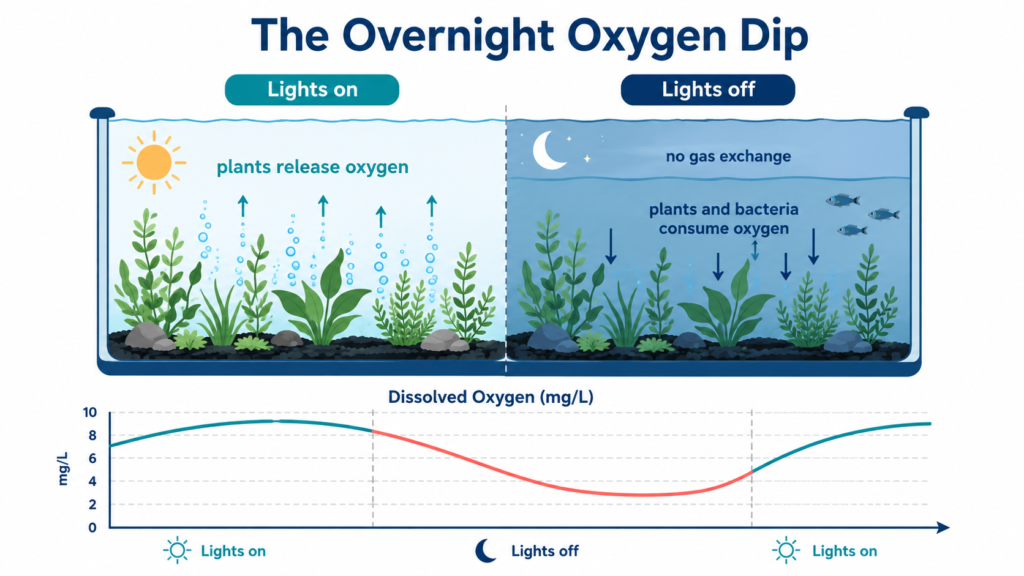
So the useful question is not “what kills fish” but “what kills fish fast, at night, all at once“. That narrows the field considerably, because most water-quality problems are simply too slow to qualify. The four that are fast enough all share one trait: they change something in the tank while you are asleep and not looking.
| Cause | How fast it kills | Fits an overnight wipeout? |
|---|---|---|
| Uncycled tank (ammonia/nitrite) | Days to weeks, with visible decline first | Rarely |
| Night-time oxygen crash | Hours, in the dark specifically | Yes |
| Heater failure | Hours | Yes |
| Room temperature swing | Overnight, on a timer or thermostat | Yes |
| Chlorine, chloramine or airborne contaminant | Minutes to hours | Yes |
| Disease | Days, usually one fish at a time | Rarely |
Cause 1: the night-time oxygen crash
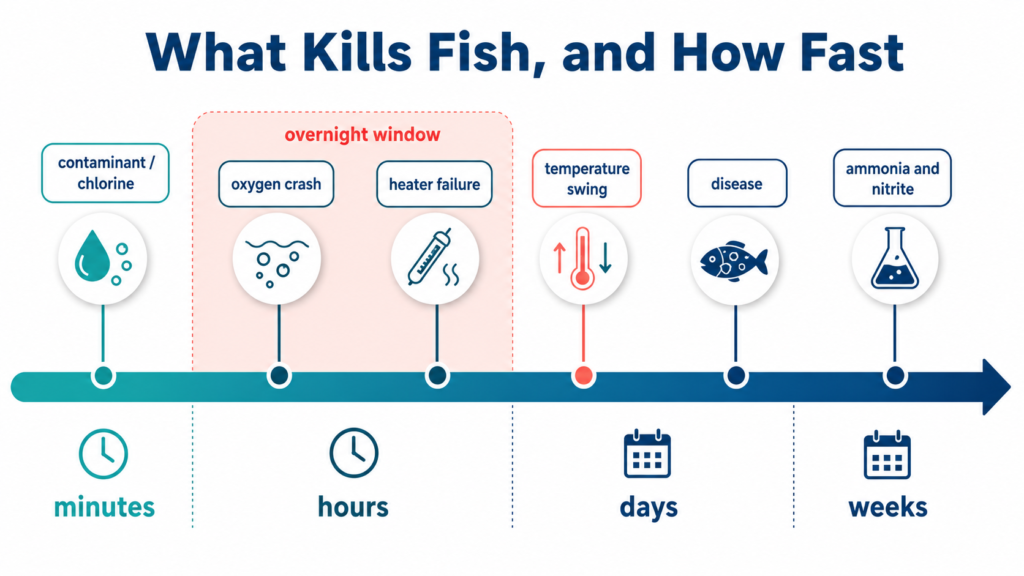
This is the one that fits the symptom best and gets the least coverage. Aquarium plants photosynthesise under light and release oxygen — but in the dark they do the opposite, respiring and consuming it. Beneficial bacteria consume oxygen around the clock. A bacterial bloom consumes a great deal of it. Add a still water surface, where gas exchange happens, and warm water, which holds less dissolved oxygen to begin with, and a heavily planted or freshly disturbed tank can run its oxygen down through the night and back up again after lights-on, leaving no trace by the time you look.
In the threads we read, this was the mechanism experienced keepers kept arriving at once the obvious answers were ruled out — described in exactly those terms, with plants and a bloom drawing down oxygen overnight while carbon dioxide accumulated. The tell is behavioural, and it happens before the deaths: fish crowd the surface and gulp. As one keeper put it, fish only turn to the air when there is not enough oxygen in the water.
The fix is cheap and immediate. What matters is not “adding oxygen” but moving the surface, because that is where gas exchange happens:
- Air pump and air stone — the standard answer, and the one thing that runs independently of your filter and your lights.
- Raise or angle the filter outflow so it visibly ripples the surface instead of pushing water sideways below it.
- Do not run CO₂ injection overnight in a planted tank; on a timer, it should switch off before the lights do.
- Watch the temperature in summer. Warm water holds less oxygen, so a heatwave and a still surface are a bad combination.
If your tank is heavily planted, this is worth doing pre-emptively rather than after a loss — see our guide to whether aquarium plants need CO₂ for how lighting, CO₂ and night-time respiration interact.
Cause 2: the heater that failed while you slept
Aquarium heaters fail in two directions, and both are overnight events. A heater that sticks on cooks the tank; a heater that quits lets it fall to room temperature. Keepers describe waking up to whole tanks lost this way, and the same avoidable mistake shows up again and again: the heater was plugged into a timer or a smart plug that was also controlling the lights, so it switched off every night by design.
Three rules from that, all free:
- Never put a heater on a timer or a light-controlled smart plug. It needs continuous power to hold a temperature.
- Keep a thermometer that is not part of the heater — a heater’s own dial tells you what it thinks it is doing, not what the water is doing.
- Check the temperature in the morning, not the evening. The overnight low is the number that matters, and the evening reading hides it.
Small tanks are hit hardest here because a low volume tracks its surroundings quickly. Our breakdown of whether a nano tank needs a heater covers sizing and the failure modes in more detail.
Cause 3: the room, not the tank
This one is easy to miss because nothing about the aquarium changed. Air conditioning on a night schedule, a window left open, a heating system that shuts off at 11pm, a tank sitting in afternoon sun — all of them move the water temperature on a daily cycle that you never see, because you only ever check the tank when you are awake and the room is at its normal temperature.
The diagnostic question that experienced keepers ask in these threads is a good one: are the fish always dying while you are asleep? If the answer is yes, and the tank equipment checks out, look at what else in the house runs on a timer. A cheap thermometer with a min/max memory answers this in one night, and costs less than the fish did.
Cause 4: something got into the water
Two versions of this, and both are fast. The first is tap water: chlorine and especially chloramine going in during an evening water change without enough conditioner, or with a conditioner that does not handle chloramine. Chloramine is far more stable than chlorine and does not gas off if you let water stand, so the old advice about leaving a bucket out overnight does not cover it. Municipal water treatment also changes seasonally, so a routine that worked all year can fail in a single week.
The second is airborne. Aerosol sprays, cleaning products, paint, insecticide and scented candles used in the same room all end up in the water through the surface, and a tank with good surface agitation absorbs them efficiently. If the deaths followed cleaning, decorating or pest treatment in that room, that is your candidate — not the cycle.
💡 Add the conditioner to the new water before it goes in the tank, not after. It is the single most-repeated correction in these threads.
Read the clues: a diagnostic table
You usually have more evidence than you think. Work backwards from what you saw.
| What you observed | Most likely cause | How to confirm |
|---|---|---|
| Fish at the surface gulping the evening before | Oxygen crash | Add air stone; check whether surface was still. A bloom or heavy planting supports it. |
| Water noticeably warm or cold to the hand | Heater stuck on, or failed | Thermometer in the morning; unplug and test the heater in a bucket. |
| Everything died, plants and snails included | Contaminant or chlorine | Ask what was sprayed, cleaned or painted nearby; check conditioner dose and chloramine coverage. |
| Snails and shrimp fine, fish dead | Oxygen or temperature | Invertebrates tolerate low oxygen longer; this pattern points away from poisoning. |
| Deaths one at a time over several days | Cycle, or disease | Test ammonia, nitrite and nitrate. This is the case where the standard advice is right. |
| Happened right after a large water change | Temperature shock or chlorine | Compare tap and tank temperature; review conditioner timing and dose. |
What to do in the first hour
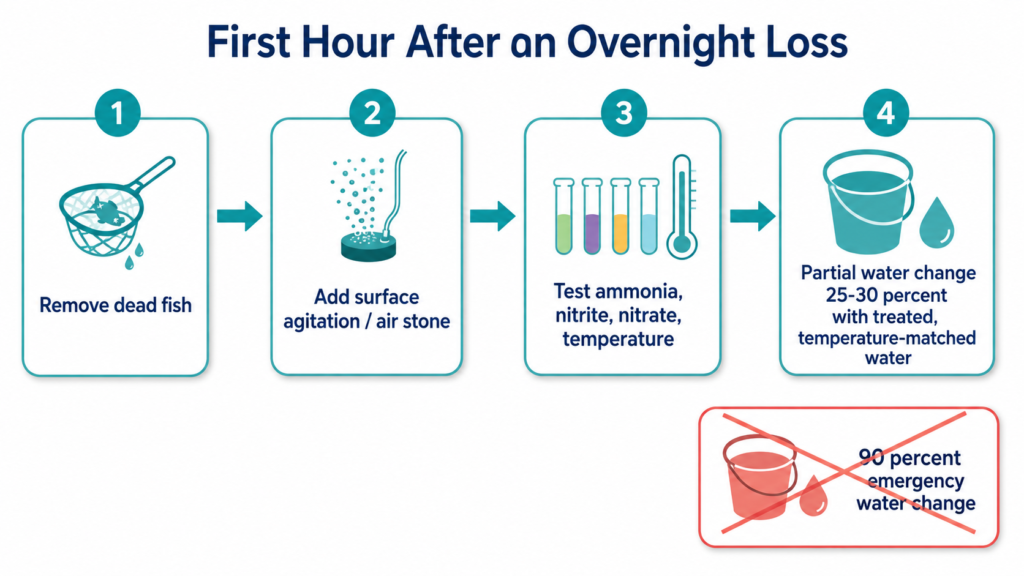
Resist the urge to do something dramatic. A panicked 90% water change with untreated, temperature-mismatched tap water is itself one of the ways tanks get wiped out, and it appears in these threads more than once.
- Remove the dead fish — decomposition adds ammonia quickly to a small volume.
- Increase surface movement now. An air stone costs a few dollars and rules out the most likely cause.
- Test ammonia, nitrite, nitrate and temperature with a liquid test kit before changing anything else, so you have a reading rather than a guess.
- Change 25–30%, not 90%, with dechlorinated water matched to tank temperature.
- Do not restock for at least a week. Buying replacement fish into an unexplained tank is how people lose two batches instead of one.
If the numbers do come back high, then the cycle really is your problem and fishless cycling is the fix. If they are clean, believe them and look at oxygen, heat and contaminants instead.
Keep Exploring
The follow-ups that prevent a repeat:
- How to cycle a new aquarium — the slow killer, done properly before fish arrive.
- Aquarium water parameters explained — what to test and what the numbers mean.
- Does a nano tank need a heater? — sizing, placement and failure modes.
- Why is my aquarium water cloudy? — bacterial blooms, which are part of the oxygen story here.
- How long before you can add fish — the timeline that prevents most early losses.
Frequently Asked Questions
Why did all my fish die overnight but the water tests fine?
Because the most likely overnight causes leave no trace in a morning test. Oxygen recovers once the lights come on and the surface moves, a heater failure can correct itself as the room warms, and a contaminant may already be diluted. Clean test results point away from the cycle and towards oxygen, temperature or something that got into the water.
Can an uncycled tank kill fish overnight?
It is unusual. Ammonia and nitrite poisoning normally shows itself over days, with laboured breathing, clamped fins and losses one at a time. A cycled-tank failure can catch up with you suddenly if a filter has been off for hours, but a whole stocked tank dying in one night usually has a faster cause.
Do plants cause low oxygen at night?
They consume oxygen at night rather than producing it, so a heavily planted tank with a still surface has its lowest oxygen just before lights-on. It is rarely a problem on its own, but combine it with warm water, a bacterial bloom and no surface agitation and it becomes one. An air stone running overnight removes the risk.
My fish died after a water change — what happened?
Usually one of three things: chlorine or chloramine that was not neutralised, a temperature mismatch between tap and tank, or a change so large that the water chemistry shifted sharply. Treat the new water before it goes in, match the temperature by hand, and keep routine changes to roughly a quarter of the tank.
Why did my fish die but the shrimp and snails are fine?
That pattern argues for oxygen or temperature rather than poisoning. Shrimp and snails generally tolerate low dissolved oxygen for longer than fish and can also leave the water at the glass line, whereas fish have nowhere to go. Most true contaminants hit invertebrates first, so healthy invertebrates are informative.
How long should I wait before buying more fish?
At least a week, and longer if you have not identified a cause. Use that time to run an air stone, log the morning temperature and test the water on a couple of consecutive days. Restocking into an unexplained tank is the most common way a single loss becomes a repeated one.