
If you have ever asked do aquarium plants need CO2, you have probably also been told the discouraging answer that haunts every beginner forum: that without a pressurized CO2 cylinder your plants are doomed to melt. That is the misconception worth breaking on day one. The honest reality is that the vast majority of beginner-friendly aquarium plants grow perfectly well in a nano tank with zero injected CO2 — what they actually need is the right species, enough light to use what carbon is already present, and a little patience.
Here is the gap most articles leave wide open: they answer “do aquarium plants need CO2” with a flat yes or no, then sell you a regulator. They rarely tell you which plants thrive without it, how much dissolved carbon your tank already holds, or where the real ceiling sits. This post delivers that — a plain-language map of low-tech versus high-tech, two original reference tables with honest numbers, and the trade-offs nobody mentions until your wallet is already open.
The Short Answer: No, But It Depends
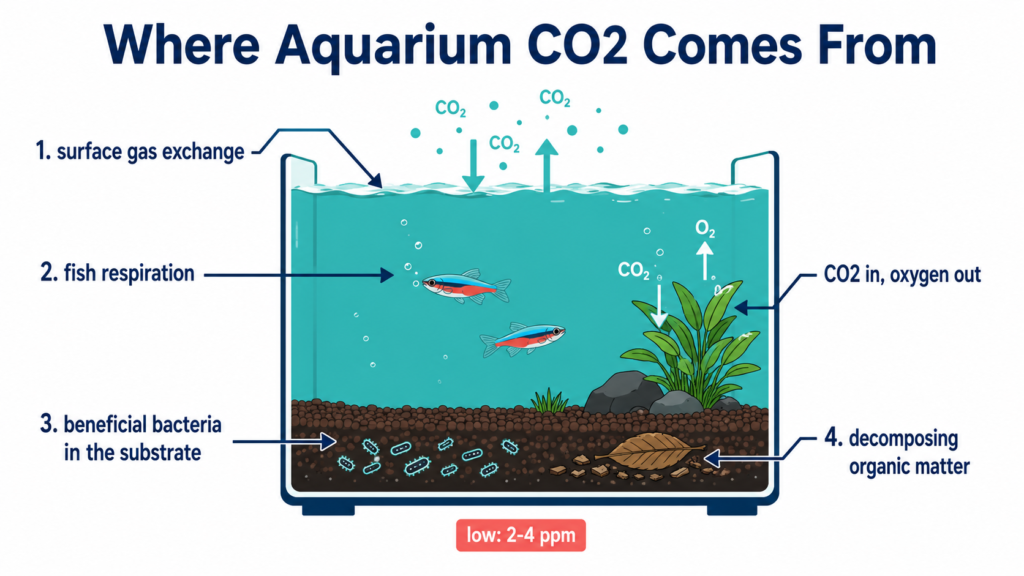
So, do aquarium plants need CO2 to survive? No. Plants build tissue from carbon, and a small amount of dissolved CO2 already exists in every stocked tank — it comes from fish respiration, beneficial bacteria, and gas exchange at the water surface. In a typical lightly stocked nano tank, dissolved CO2 commonly sits somewhere around 2-4 ppm, well above the roughly 0.5-1 ppm a bare, fishless tank would settle toward at atmospheric equilibrium. That is enough to keep slow, hardy plants healthy indefinitely.
CO2 injection becomes worth discussing only when you want fast growth, dense carpets, vivid red coloration, or those magazine-cover aquascapes. Injected systems push dissolved CO2 up toward 20-30 ppm, often around ten times the ambient level in a stocked tank. More carbon plus strong light equals faster photosynthesis — and also faster algae if your other settings are off. That is the bargain: speed and drama in exchange for cost, tuning, and risk.
Tip: Treat CO2 as the accelerator pedal, not the engine. A low-tech tank still drives forward — it just cruises instead of races. Beginners almost always benefit more from choosing the right plant than from buying a regulator.
Low-Tech vs High-Tech: The Honest Comparison
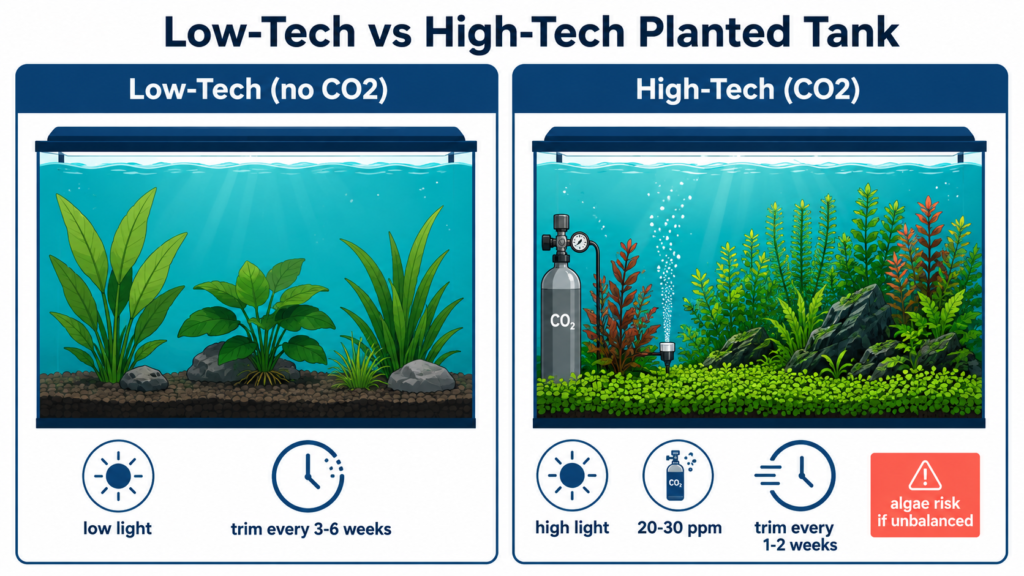
“Low-tech” simply means a planted tank without injected CO2. “High-tech” means CO2 injection paired with strong light and richer fertilization. Neither is better — they are different hobbies that happen to use the same glass box. The table below lays out what actually changes when you cross that line. Dollar figures are stamped mid-2026 and reflect typical US hobby pricing for nano-scale gear.
| Factor | Low-Tech (no CO2) | High-Tech (injected CO2) |
|---|---|---|
| Dissolved CO2 | ~2-4 ppm (ambient) | ~20-30 ppm (target) |
| Growth speed | Slow to moderate | Fast, often 2-3x |
| Light needed | Low to medium | Medium to high |
| Plant options | Hardy/slow species | Carpets, stems, reds |
| Startup cost (mid-2026) | $0 extra | $60-180 (nano kit) |
| Weekly tuning | Minimal | Regular, dialed-in |
| Algae risk | Lower, forgiving | Higher if unbalanced |
| Maintenance trimming | Every 3-6 weeks | Every 1-2 weeks |
Notice the last two rows. Faster growth sounds purely good until you realize it means trimming a dense stem jungle every week or two and pruning before it shades out everything below. Many people discover that the low-tech “slow” tank suits a real-life schedule far better. If you are still deciding on tank dimensions before any of this, the nano tank size guide comparing 3, 5, and 10 gallon builds is the place to start, because water volume affects how stable your carbon and light balance will be.
Plants That Thrive Without CO2
This is the part the regulator-sellers skip. A genuinely large catalog of attractive plants grows happily at ambient CO2. The trick is matching species to your light and water. Below is a checklist-style starter table for a low-tech nano tank, with the conditions each plant actually tolerates. Temperatures are given in both Fahrenheit and Celsius, and hardness in dKH so you can check against your own water.
| Plant | Light | Temp range | Hardness (dKH) | Difficulty |
|---|---|---|---|---|
| Java fern | Low | 68-82°F / 20-28°C | 3-15 | Very easy |
| Anubias nana | Low | 72-82°F / 22-28°C | 3-12 | Very easy |
| Java moss | Low-med | 59-82°F / 15-28°C | 2-15 | Very easy |
| Cryptocoryne wendtii | Low-med | 72-82°F / 22-28°C | 3-12 | Easy |
| Marimo moss ball | Low | 59-77°F / 15-25°C | 2-15 | Very easy |
| Amazon sword | Med | 72-82°F / 22-28°C | 3-12 | Easy |
| Bucephalandra | Low-med | 71-82°F / 22-28°C | 2-12 | Easy |
Every plant in that table attaches to rock or wood, sits in the substrate, or simply floats — and none of them demands injected carbon. Java fern and Anubias are nearly indestructible; they are the plants I hand to anyone setting up their first tank. Notice the Marimo moss ball range dips cool, which makes it one of the few plants that suits a coldwater versus tropical nano setup without a heater. Build a low-tech tank from this list and the answer to “do aquarium plants need CO2” becomes a confident no.
If You Skip CO2, Get the Other Two Things Right
Carbon is only one leg of the plant-growth tripod. The other two — light and nutrients — matter far more in a low-tech tank, because they are the levers you actually control. The common beginner failure is not “no CO2.” It is too much light over too few nutrients, which simply feeds algae. This is one of the classic beginner aquarium mistakes worth reading before you buy a single plant.
- Light: In a low-tech tank, less is safer. Aim for a modest LED and a photoperiod of about 6-8 hours. More light without more carbon usually means more algae, not more plant.
- Nutrients: A nutrient-rich substrate or a gentle liquid fertilizer covers most low-tech needs. Plants pull nitrogen and phosphorus from fish waste too, so a lightly stocked tank often feeds itself.
- Patience: Low-tech plants establish over weeks, not days. A new tank looks bare at first; that is normal, not failure.
- Flow and surface movement: Gentle circulation spreads what carbon you have and keeps oxygen healthy without gassing off CO2 too aggressively.
If you want the underlying science, the overview of photosynthesis on Wikipedia explains why carbon, light, and water together drive plant growth — and why removing any one slows the whole process rather than stopping it outright.
What About Liquid Carbon?
You will see bottled “liquid carbon” products marketed as an easy alternative to gas injection. The honest take is that this is debated. These products are not literally dissolved CO2; they supply a carbon-bearing compound (typically glutaraldehyde-based) that some plants can use and that doubles as a mild algae suppressant. Results vary widely by plant, and several species — certain mosses and Vallisneria in particular — are known to react badly to it and can melt.
For a low-tech beginner tank, liquid carbon is optional, not required. If you are tempted, treat it as a minor boost rather than a CO2 replacement, start gently, and watch how your specific plants respond. It will never turn a low-light tank into a high-tech carpet machine, and any seller who implies otherwise is overselling.
Setup Cheat-Sheet by Goal
Decide your goal first, then the CO2 question answers itself. This action table maps three common ambitions to a sensible starting setup. Costs are extra-equipment estimates stamped mid-2026 for nano-scale builds, on top of your basic tank.
| Your goal | CO2 needed? | Light level | Extra cost (mid-2026) | Start here |
|---|---|---|---|---|
| Easy green tank, low effort | No | Low | $0 | Java fern + Anubias |
| Lush jungle look | No | Low-med | $0-20 | Crypts + swords + moss |
| Optional small boost | Liquid carbon | Med | $15-25 | Dose gently, observe |
| Dense carpet / red plants | Yes | High | $60-180 | Nano CO2 kit + timer |
Three of those four rows need no injected CO2 at all. Only the last — the competition-style aquascape — truly requires it. For everyone else, the money is better spent on a good light and quality substrate. When you are ready to assemble the rest of the build, the nano aquarium starter checklist covers the gear that matters more than carbon for a thriving first tank.
Keep Exploring NanoTank Lab
If a low-tech planted nano tank is your goal, these guides walk you through the rest of the build, step by step.
- How to Set Up a Nano Aquarium — the full start-to-finish walkthrough.
- Nano Tank Size Guide (3 vs 5 vs 10 gallon) — pick the volume that stays stable.
- Nano Aquarium Starter Checklist — the gear that actually matters first.
- 9 Beginner Aquarium Mistakes — avoid the light-and-algae trap.
- Coldwater vs Tropical Nano Tank — decide if you even need a heater.
Frequently Asked Questions
Do aquarium plants need CO2 to survive at all?
No, aquarium plants do not need injected CO2 to survive. Every stocked tank already contains a small amount of dissolved CO2 (commonly around 2-4 ppm) from fish respiration and surface gas exchange, which is enough to sustain hardy, slow-growing species indefinitely. Injection only becomes relevant when you want faster growth or demanding carpet and stem plants.
What aquarium plants grow best without CO2?
The best no-CO2 plants are Java fern, Anubias, Java moss, Cryptocoryne, Bucephalandra, Amazon sword, and Marimo moss balls. These tolerate low light and ambient carbon, attach to rock or wood or root in substrate, and are forgiving of beginner mistakes, which makes them ideal for a first low-tech nano tank.
Will my plants grow slower without CO2?
Yes, plants generally grow more slowly without added CO2, and that is usually a feature rather than a flaw. Slower growth means less frequent trimming (every 3-6 weeks instead of weekly) and a more forgiving, lower-algae tank, though exact growth speed varies with your light and nutrient levels.
Is liquid carbon a real substitute for CO2?
Not exactly, and its value is debated. Liquid carbon supplies a carbon-bearing compound some plants can use and works as a mild algae suppressant, but it is not the same as gas injection and will not enable a high-light carpet. Several plants, including certain mosses and Vallisneria, react poorly to it, so treat it as an optional minor boost and observe how your tank responds.
How much does a nano CO2 setup cost?
A small nano-scale CO2 injection kit typically runs about $60-180 as of mid-2026, depending on whether you choose a disposable cartridge or a refillable cylinder with a regulator. A low-tech planted tank, by contrast, costs nothing extra for carbon, which is why most beginners are better served spending that budget on lighting and substrate.
Does more light help if I do not use CO2?
Not usually — in a low-tech tank, extra light without extra carbon tends to feed algae rather than plants. Keep a modest LED and a 6-8 hour photoperiod so light, carbon, and nutrients stay balanced; this balance matters far more than raw brightness for a healthy no-CO2 planted nano tank.