
Cloudy water after a water change is one of the few aquarium problems where the timing tells you the answer. A tank that goes hazy within minutes of refilling and a tank that turns milky the next morning have completely different causes — and the fix that helps one makes the other worse.
Most articles on cloudy water treat it as one problem with a list of possible causes, which leaves you guessing. This guide splits it by when the cloud appeared, because that single observation narrows it down to one or two candidates every time. It also covers the case that generic guides never address: what it means when your tank clouds up after every single water change, which is a routine problem rather than a tank problem.
Start here: when did it go cloudy?
| Timing | Appearance | Most likely cause | What to do |
|---|---|---|---|
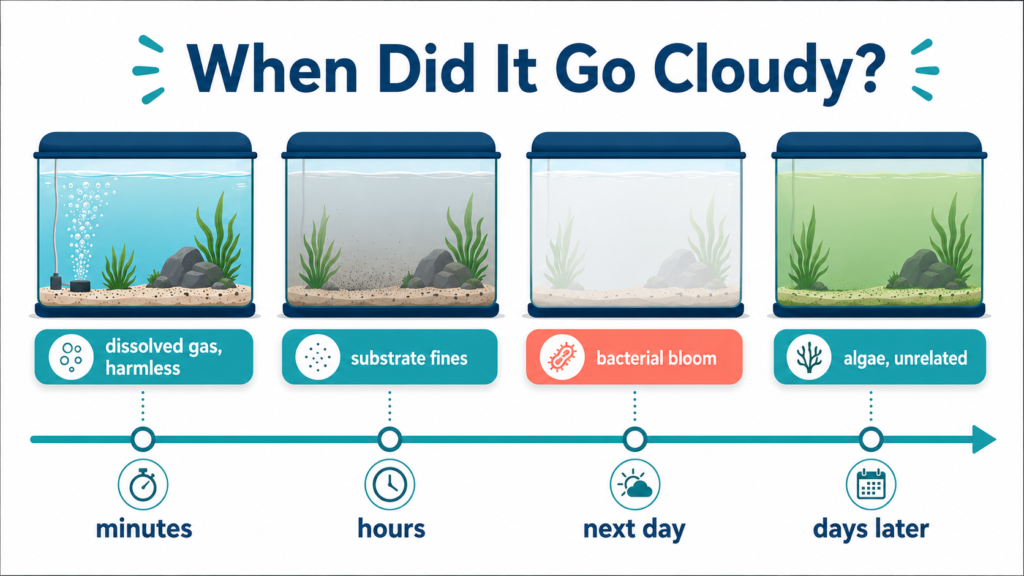
| Within minutes | Fine white fizz, clears from the bottom upward | Dissolved gas — micro-bubbles from cold pressurised tap water | Nothing. It clears in 15 minutes to a few hours. |
| Within minutes | Grey or brown haze, settles downward | Substrate fines stirred up, or dust from new sand or gravel | Nothing, or run filter floss for a day. |
| Within an hour | Slightly milky, does not settle | Minerals or sediment from the tap supply itself | Compare against a glass of standing tap water; consider pre-mixing. |
| 12–48 hours later | Uniform milky white, gets worse before better | Bacterial bloom — heterotrophic bacteria feeding on released organics | Wait it out. Test ammonia and nitrite; do not chase it with big changes. |
| Days later | Green tint | Algae bloom, unrelated to the water change | Cut light duration and check nutrient load. |
Minutes: it is usually just gas
Cold tap water arrives under pressure with more dissolved gas than it can hold once it warms up and reaches atmospheric pressure in your tank. That gas comes out of solution as microscopic bubbles, which scatter light and turn the whole tank into what looks like a glass of lemonade. It is harmless, and it is the easiest cloud to identify: it clears from the bottom upward as the bubbles rise, and it is gone within a few hours at most.
The same effect coats the glass and decorations in tiny bubbles. If you can see that, you have your answer and no action is needed. Letting refill water stand for an hour, or mixing it to temperature in a bucket first, avoids it entirely — which is worth doing anyway for temperature matching.
Next day: the bacterial bloom, and why more water changes make it worse
The milky cloud that appears the day after is a population explosion of heterotrophic bacteria — the ones that consume dissolved organic matter rather than ammonia. A water change that involved a deep gravel vacuum, a rescape, a filter clean or a disturbed substrate releases a pulse of organics into the water column, and those bacteria multiply to match the food supply. They are free-floating, which is what makes the water look milky, and they are not directly harming your fish.
The shape of it is predictable: haze appears 12–48 hours after the disturbance, peaks around day two, and clears over the following three to five days in a normally stocked nano. Here is the counter-intuitive part, and it is the most useful thing on this page: responding with another large water change usually prolongs it. Fresh water dilutes the bacteria temporarily, so the tank clears for a few hours — but the organic load in the substrate is untouched, the bacteria multiply straight back, and you get another bloom within a day. The bloom ends when the food runs out, which happens on its own schedule regardless of how clear the water looks.
- Do test ammonia and nitrite with a liquid kit — about $30, and the only way to tell a cosmetic bloom from a cycle problem. Zero on both means you can wait.
- Do keep feeding light for a few days — uneaten food is exactly the fuel driving it.
- Do make sure the surface is moving. A bloom consumes oxygen, and that combination has killed fish overnight in tanks with a still surface — see our guide to what actually kills fish overnight.
- Do not add clarifier products. They flocculate particles into the filter and treat the symptom, not the organic load.
- Do not replace or deep-clean filter media now. The bloom will pass faster with a mature colony intact.
💡 A bloom in a tank with zero ammonia and zero nitrite is a patience problem, not a water quality problem. Most clear on their own within one to seven days.
One genuine exception: if ammonia or nitrite is reading above zero, the bloom is a symptom of a cycle that is struggling — a filter media rinse in tap water, a long power cut or a big medication dose can all cause that. In that case, act on the cycle, not the cloud. Our cycling guide covers recovery.
“It goes cloudy after every water change”
If this happens every single time, stop treating it as an incident and look at the routine. Something you do each week is either introducing particles or releasing organics on schedule. Work down this list in order — the fixes are all free.
| Routine habit | Why it clouds the tank | Change it to |
|---|---|---|
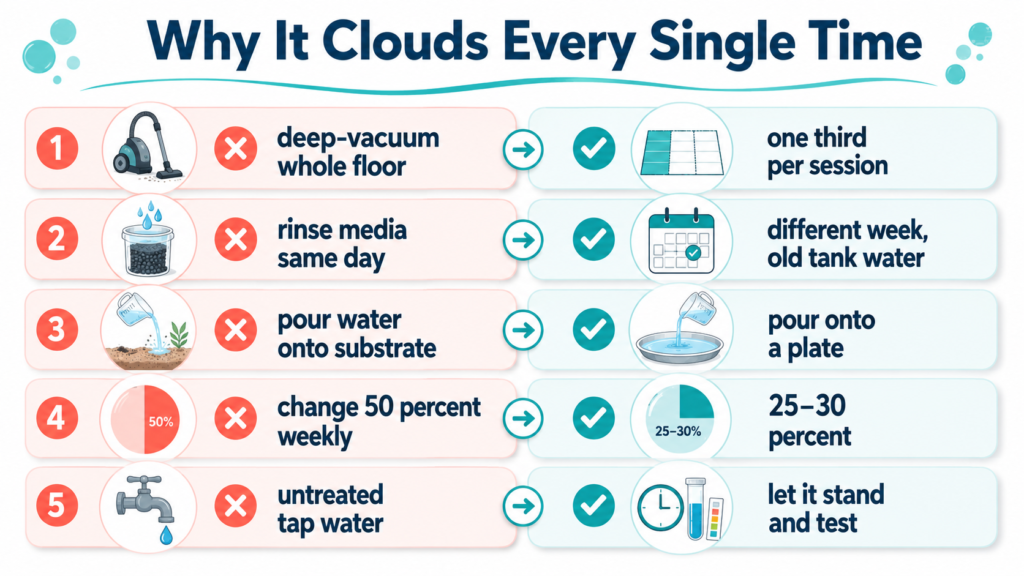
| Deep-vacuuming the whole substrate every time | Releases the entire organic reserve at once and disturbs the bacteria living in it | Vacuum a third of the floor per session, rotating areas week to week |
| Rinsing filter media during the same session | Strips the colony and dumps trapped detritus into the water | Rinse media in old tank water on a different week from the substrate clean |
| Refilling by pouring straight onto the substrate | Blasts fines into the water column | Pour onto a plate, a bag or your hand to break the stream |
| Changing 50%+ every week | Repeatedly resets the water and stresses the bacterial balance | 25–30% weekly is enough in a normally stocked nano |
| Untreated hard or well water | Sediment and precipitating minerals cloud on contact | Let a glass of tap water stand for an hour — if it clouds too, the supply is the cause |
| New sand or soil added recently | Fines keep releasing for weeks | Run filter floss for a few days; it will settle out for good |
The tap water test at the bottom of that list is the one people skip, and it settles the question in an hour for free. If a glass of your tap water goes cloudy standing on the counter, no amount of aquarium maintenance will fix it — pre-mix and let water stand before it goes in, or use a different source.
What not to do
Three reflexes that cost people their cycle, in rough order of how often they happen:
- Emergency 90% water change. Large, hurried changes bring temperature mismatch and dechlorinator errors with them, and in a small tank those are far more dangerous than cloudy water ever was.
- Replacing the filter cartridge to “clean the water”. The cartridge is where your bacteria live. Throwing it out mid-bloom is how a cosmetic problem becomes an ammonia problem.
- Stacking clarifiers and bacteria supplements. One dose of a bacterial starter is reasonable after a cycle disruption; a shelf of additives is guesswork with no feedback loop.
The general principle in a small tank: fewer, gentler interventions beat dramatic ones. That is also the thread running through our nano tank maintenance schedule, which spaces these jobs out so they never stack in one session.
Keep Exploring
- Why is my aquarium water cloudy? — the full set of causes, including new-tank cloudiness.
- Aquarium water parameters explained — what to test when the water looks wrong.
- Nano tank maintenance schedule — a routine that does not trigger blooms.
- How to cycle a new aquarium — and how to recover a cycle you disturbed.
- Fish died overnight? — why a bloom plus a still surface is a genuinely risky combination.
Frequently Asked Questions
Is cloudy water after a water change dangerous?
Usually not by itself. Gas bubbles and stirred-up fines are harmless, and a bacterial bloom is not directly toxic. The risk is indirect: a bloom consumes oxygen, so make sure your surface is moving, and test ammonia and nitrite to confirm the cycle is holding.
How long does a bacterial bloom last?
Typically one to seven days. It ends when the dissolved organic matter feeding it is used up, not when you change water. If it is still going after a couple of weeks, something is continuously feeding it — overfeeding, a dead fish out of sight, or decaying plant matter in the substrate.
Should I do another water change if the tank is cloudy?
Not for the cloudiness alone. If ammonia and nitrite are at zero, another change clears it briefly and the bloom returns. Change water because a test result tells you to, not because the tank looks hazy.
Why is my tank cloudy after every water change?
Something in the routine is repeatable. The usual culprits are deep-vacuuming the whole substrate every session, cleaning filter media at the same time, or pouring refill water directly onto the sand. Also check the supply: if a glass of your tap water clouds while standing, that is the source.
Why does my water look like it has tiny bubbles in it?
Dissolved gas coming out of cold, pressurised tap water as it warms. It clears from the bottom up within minutes to a few hours and needs no action. Pre-mixing refill water in a bucket avoids it and helps you match temperature at the same time.
Can I use a water clarifier to fix it?
You can, but it treats appearance rather than cause. Clarifiers clump particles so the filter can catch them, which does nothing about the organic load driving a bloom and adds another variable to a tank you are already troubleshooting. Test, wait, and feed lightly instead.