
Finding the best low light aquarium plants is the single fastest way to turn a bare, struggling tank into a lush green scene, and no, you do not need a pricey high-output LED, pressurized CO2, or “expert hands” to pull it off. The widespread belief that live plants are a fussy, advanced hobby is one of the most stubborn myths in the freshwater world. The plants on this list will grow in the same dim glow that came bundled with your starter kit.
Here is the gap. Most “easy plant” listicles just dump ten Latin names on you with a one-line blurb and zero numbers, leaving you guessing on tank size, temperature, and how long things actually take. This guide does the opposite: every one of these best low light aquarium plants comes with honest growth-speed expectations, a placement zone, real temperature ranges in F and C, and a “what kills it” note so you skip the rookie mistakes. Let’s get planted.
What “Low Light” Actually Means in a Planted Tank
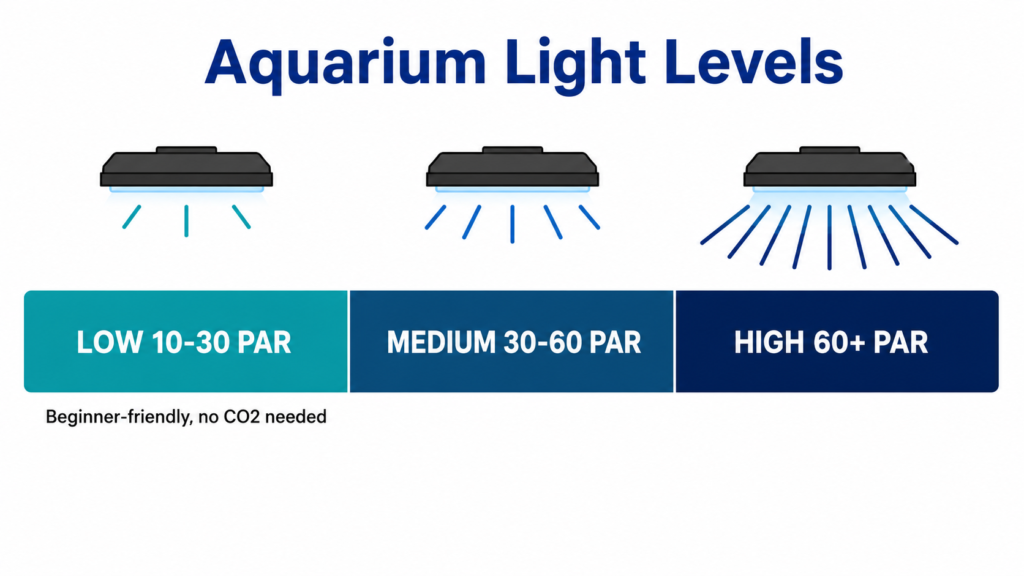
“Low light” is a frustratingly vague term, so let’s pin it down. In aquarium terms it usually means roughly 10 to 30 PAR (photosynthetically active radiation) at the substrate, which translates to a modest LED or even a basic kit hood running 6 to 8 hours a day. You are not chasing brightness here; you are choosing plants that evolved in shaded, slow rivers and the dim understory of jungle streams, so they treat your weak light as plenty.
The trade-off is honest: low-light plants grow slowly. That is a feature, not a flaw. Slow growth means less pruning, less fertilizer, and far less algae drama for a beginner. If you want a jungle in three weeks, this is not the path, but if you want a forgiving tank that looks good and mostly runs itself, read on.
The 8 Best Low Light Aquarium Plants for Beginners
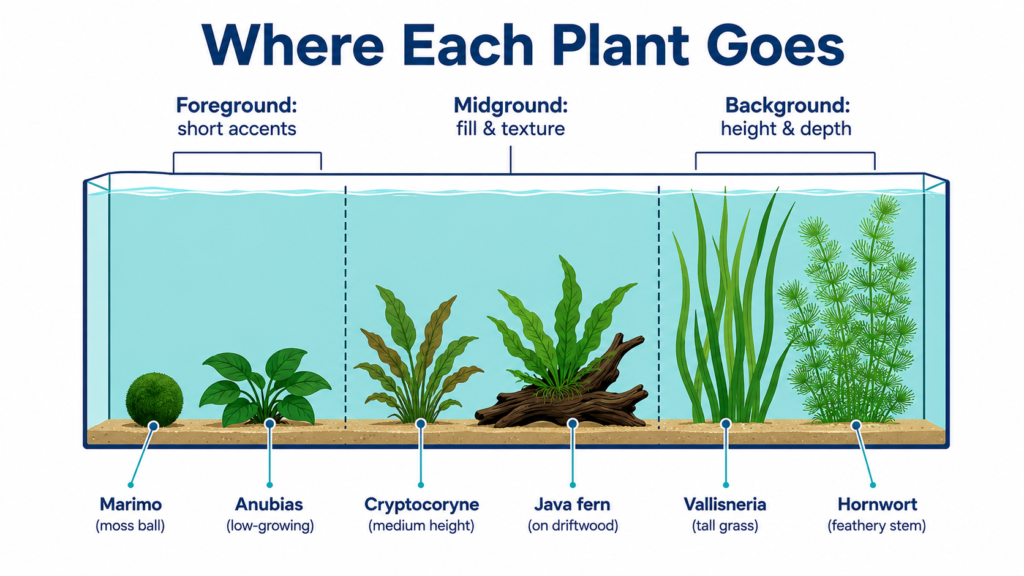
Each pick below is genuinely hardy, widely sold, and proven in dim tanks. I have grouped them by where they go in the tank so you can build a layered scene instead of a random green pile. Placement matters: foreground plants stay short, midground fills the middle, and background plants give you height and a sense of depth.
1. Java Fern (Microsorum pteropus)
The undisputed champion of beginner plants. Java fern is an epiphyte, meaning it must NOT be buried in substrate. Tie or glue its rhizome to driftwood or rock and it will quietly thrive in almost any water. Tolerates 68 to 82F (20 to 28C) and a huge pH range. The one way to kill it is planting the rhizome under gravel, where it rots. (You may also see it sold under its newer botanical name, Leptochilus pteropus — same plant.)
2. Anubias (Anubias barteri & nana)
Thick, dark-green, almost plastic-looking leaves that algae and even hungry fish tend to leave alone. Another rhizome plant, so attach it to hardscape rather than burying it. Anubias is famously slow, sometimes one new leaf a month, which is exactly why it is bulletproof. Great in shaded spots beneath taller plants.
3. Java Moss (Taxiphyllum barbieri)
A no-roots carpet of soft green that you simply drape over wood, rock, or mesh. Wonderful cover for shrimp and fry, and it asks for nothing. In very low light it grows looser and “wispier” rather than dense, which most beginners find charming anyway.
4. Cryptocoryne wendtii
A true rooted plant for your midground that comes in green, brown, and reddish forms. Be warned: “crypts” often melt (drop all their leaves) after you plant them as they adjust to new water. Do not panic and do not pull it. The roots are fine and fresh leaves return in 2 to 4 weeks.
5. Amazon Sword (Echinodorus bleheri)
A dramatic rooted centerpiece for tanks 10 gallons and up, since it can reach 12 to 16 inches tall. It is a heavy root feeder, so tuck a root tab into the substrate near its base every couple of months and it rewards you with broad, sword-shaped leaves.
6. Hornwort (Ceratophyllum demersum)
Feathery, fast even in low light, and totally rootless. Let it float for instant shade and nutrient export, or weigh down a stem in the background. It is a fantastic ammonia sponge for a young tank, though it does shed needle-like bits that you will occasionally scoop out.
7. Marimo Moss Ball (Aegagropila linnaei)
Technically a velvety ball of algae, not a plant, but it is the most foolproof green thing you can own. Roll it in your palm under tap water once a week to keep its shape, and it lives for years. Cool-water lovers especially appreciate it. Learn more about this oddball at the Wikipedia entry on Marimo.
8. Vallisneria (Vallisneria spiralis)
Tall, grassy ribbons that sway in the current and send out runners to form a natural background curtain. It is a rooted plant that does best in tanks 10 gallons and taller. Plant the crown just above the substrate, not buried, or it will rot.
Quick Comparison: All 8 Plants at a Glance
| Plant | Placement | Growth Speed | Temp Range | Plant in Substrate? |
|---|---|---|---|---|
| Java Fern | Mid / Background | Slow | 68-82F (20-28C) | No — tie to hardscape |
| Anubias | Foreground / Mid | Very slow | 72-82F (22-28C) | No — tie to hardscape |
| Java Moss | Carpet / Cover | Slow-Medium | 70-80F (21-27C) | No — drape over surfaces |
| Cryptocoryne wendtii | Midground | Slow | 72-82F (22-28C) | Yes — roots in substrate |
| Amazon Sword | Background centerpiece | Medium | 72-82F (22-28C) | Yes — heavy root feeder |
| Hornwort | Float / Background | Fast | 59-77F (15-25C) | No — float or weigh down |
| Marimo Moss Ball | Foreground accent | Very slow | 50-77F (10-25C) | No — sits on substrate |
| Vallisneria | Background | Medium-Fast | 64-82F (18-28C) | Yes — crown above substrate |
Tip: Buy two or three different plants from this list rather than ten of one. A young tank with mixed slow growers and one fast grower (like hornwort) outcompetes algae far better than a single-species planting, and it costs you about $8 to $15 total in mid-2026.
How to Plant Them Right the First Time
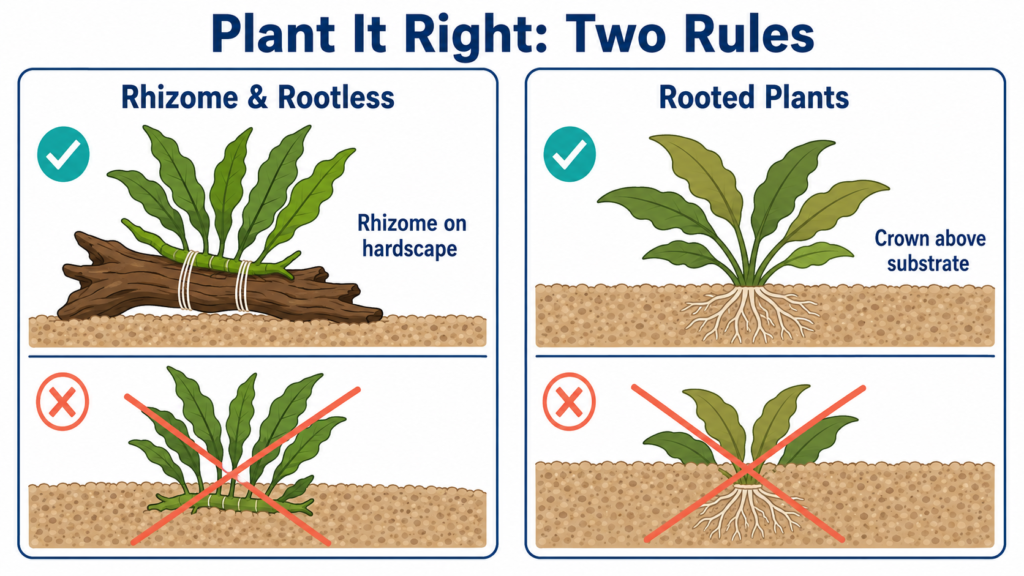
Half of all “my plant died” stories trace back to a planting mistake, not bad light. The golden rule splits plants into two camps. Rhizome and rootless plants (Java fern, Anubias, mosses, hornwort, Marimo) must never be buried; their rhizome or stem rots underground. Rooted plants (crypts, swords, Vallisneria) go into substrate, but you bury only the roots, keeping the crown where leaves emerge above the surface.
If you are still setting up the tank itself, walk through our full guide on how to set up a nano aquarium first, then come back to planting. And because new tanks need to establish their bacteria, it helps to understand fishless cycling before you add livestock — plants actually speed this process along.
Your First-Week Planting Checklist
Use this as a literal to-do list when your plants arrive. The numbers are conservative targets that keep a low-tech, low-light tank stable for a beginner.
| Step | Action | Target / Number | Why It Matters |
|---|---|---|---|
| 1 | Rinse new plants in dechlorinated water | 1-2 min, no soap ever | Removes snails, pests, gel pot residue |
| 2 | Sort into rhizome vs rooted piles | 2 piles | Decides bury vs tie-on |
| 3 | Attach rhizome plants to hardscape | Thread or gel super glue | Prevents rot, holds until anchored |
| 4 | Set photoperiod on a timer | 6-8 hrs/day | Longer invites algae, not growth |
| 5 | Keep water in a stable range | 72-78F (22-26C), 3-8 dKH | Most picks thrive, swings stress them |
| 6 | Dose liquid fertilizer (optional) | Weekly, half the label dose | Low light needs few nutrients |
| 7 | Add root tabs for heavy feeders | Every 6-8 weeks near swords/crypts | Root feeders pull food from substrate |
| 8 | Expect adjustment, not instant lushness | 2-4 weeks to settle | Melt and slow starts are normal |
Budget-wise, a beginner low-light setup is cheap: expect roughly $10 to $20 in plants, $0 extra for special lighting since your kit hood works, and an optional $6 to $10 bottle of all-in-one liquid fertilizer (all mid-2026 ballpark). If you want to see where plants fit into the bigger picture, our breakdown of what a nano aquarium really costs lays out every line item. You can also avoid the classic blunders in our roundup of 9 beginner aquarium mistakes, several of which are plant-related.
Matching Plants to Your Tank and Fish
Tank size shapes your plant choices more than people expect. In a tiny 3- or 5-gallon nano, skip the Amazon sword and Vallisneria, which will quickly outgrow the box; lean on Anubias nana, Java moss, and a Marimo instead. Our nano tank size guide comparing 3, 5, and 10 gallons helps you match ambition to glass. Once you hit 10 gallons, the taller background plants become realistic.
Temperature is the other big filter. A tropical betta tank sitting around 78F pairs beautifully with Java fern and Anubias, while a cooler, unheated room tank suits hornwort and Marimo. If you are weighing heated versus unheated setups, our coldwater vs tropical nano tank comparison spells out which plants and fish belong in each. Planning a betta specifically? Pair these plants with the husbandry in our betta fish care guide for nano tanks for a tank your fish will actually use as cover.
One sibling guide worth a look is a dedicated plant-and-shrimp pairing chart (internal link, coming soon), since dwarf shrimp adore the moss and Anubias on this list.
Keep Exploring NanoTank Lab
- How to Set Up a Nano Aquarium — the full step-by-step before you add a single plant.
- Nano Tank Size Guide (3 vs 5 vs 10 gallon) — pick the right footprint for these plants.
- How to Cycle a New Aquarium (fishless cycling) — your plants will thank you for it.
- 9 Beginner Aquarium Mistakes — several are plant blunders you can dodge.
- Best Nano Tank Fish for Beginners — stock these planted scenes with the right fish.
Frequently Asked Questions
Do low light aquarium plants need CO2?
No, none of the plants on this list require injected CO2. They evolved for slow, shaded waters and grow fine on the trace CO2 already dissolved in your tank. Adding pressurized CO2 can speed them up, but for a beginner it adds cost and complexity for little benefit, so it is genuinely optional here.
Why did my new plant lose all its leaves?
That is almost always “melt,” and it is normal, especially with Cryptocoryne species. Plants grown above water at the farm shed their old leaves while adjusting to being submerged in your specific water. Leave the roots undisturbed, keep your light and water stable, and fresh underwater-adapted leaves usually return within 2 to 4 weeks.
How many plants do I need for a 5-gallon tank?
For a 5-gallon nano, three to five small plants is a comfortable, non-crowded start: think one Anubias nana, a portion of Java moss, a Marimo ball, and maybe one small crypt. They will slowly fill in. Overbuying for an instant jungle tends to backfire as plants compete and some die back.
Can these plants survive without fertilizer?
Often yes, at least for a while, because fish waste supplies some nutrients. That said, results vary: rooted heavy feeders like Amazon swords benefit from root tabs, and a cheap weekly dose of all-in-one liquid fertilizer keeps colors and growth healthier long term. In a lightly stocked low-light tank you can start with little to none and add it only if growth stalls.
Will low light plants stop algae?
They help, but they are not a magic switch, and the cause-and-effect is debated among hobbyists. Healthy plants compete with algae for light and nutrients, and fast growers like hornwort soak up excess ammonia. But the bigger levers are a short 6-to-8-hour photoperiod and not overfeeding; plants plus discipline beat plants alone.
How long until my planted tank looks full?
Expect a gradual fill-in over 2 to 3 months with low-light species, not weeks. The first month is mostly the plants settling roots and recovering from transit, the second month is when you see real new growth, and by month three a well-placed mix starts to look like a scene. Patience genuinely is the main ingredient.