
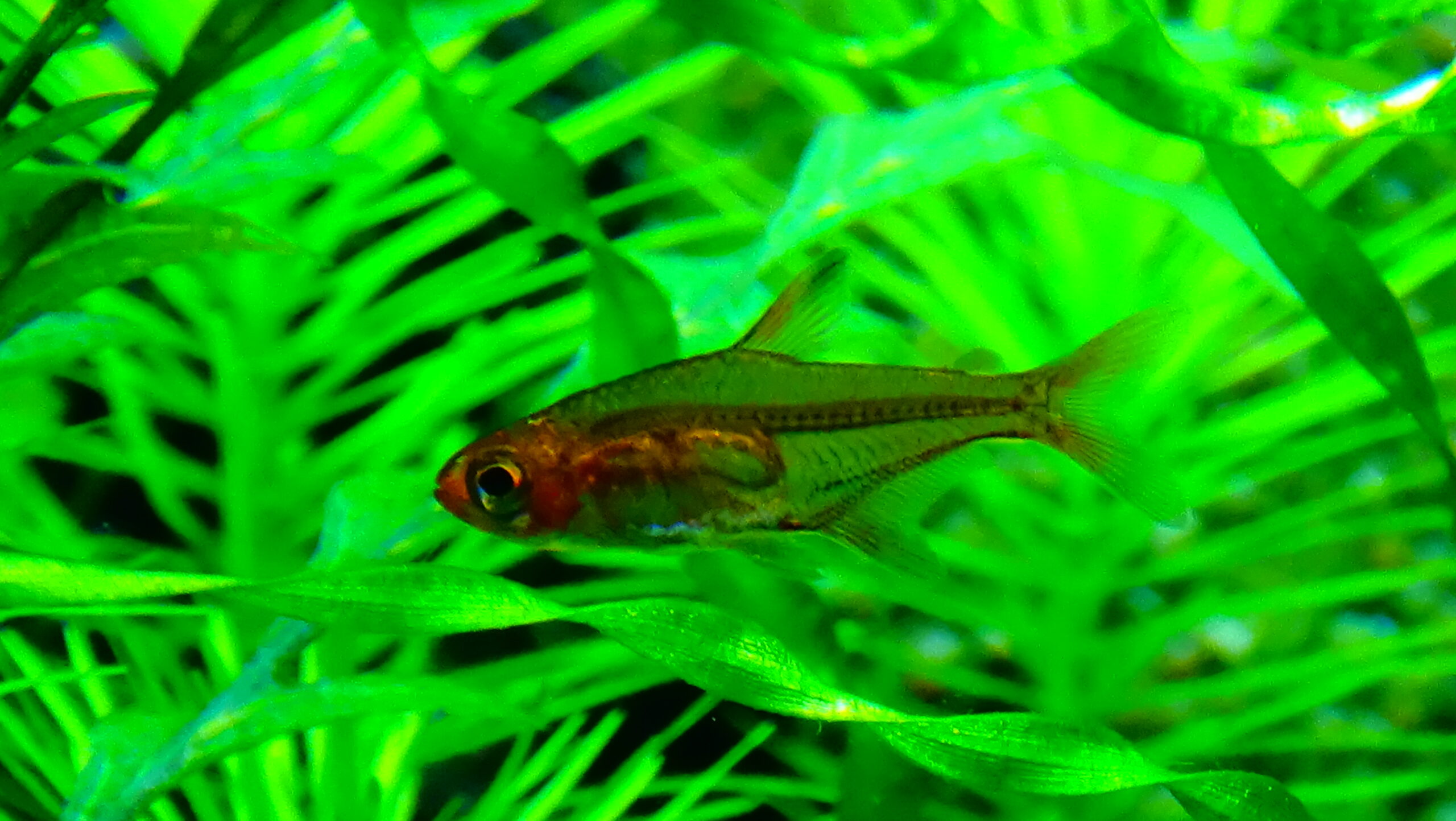
Choosing the best nano tank fish isn’t about which species looks coolest in a photo — it’s about which tiny, hardy fish will actually thrive in the few liters of water you’ve got. Most “top 10 nano fish” lists hand you a gallery of pretty species and stop there, leaving you to guess what fits a 5-gallon versus a 10, how many you can really keep, and which “popular” picks quietly fail beginners.
Take a breath — you don’t need a chemistry degree for this. This guide fixes the gaps: a proper shortlist of beginner-friendly nano fish, plus the parts other lists skip — a tank-size-to-species matchup, an honest beginner-friendliness rating, real minimum school sizes, and the common traps (looking at you, betta) that wreck small tanks. The only “math” tool you’ll ever need is a liquid test kit (a full freshwater master kit runs around $30–45) that reads the numbers for you. By the end you’ll know not just what to buy, but what fits your tank.
What Counts as a “Nano” Fish?
A nano fish is a small freshwater species — generally under about 1.5 inches (4 cm) at adulthood — suited to small tanks, usually those under 10 gallons. The smallest, like the chili rasbora and its Boraras cousins, top out under three-quarters of an inch. Small body, small bioload, big personality in a group.
The catch nobody warns beginners about: most nano fish are schooling species. That means you don’t buy “a fish” — you buy a group of six to ten of the same kind, or they get stressed, dull-colored, and short-lived. That single fact rewrites your whole stocking plan, so we’ll bake it into every recommendation below.
The 8 Best Nano Tank Fish for Beginners
This is our shortlist — chosen for hardiness, peaceful temperament, and how forgiving they are while you learn. The numbers are honest minimum group sizes, not the “you can keep one” myth. Temperature and pH ranges reflect what these species actually tolerate in a stable home tank.
| Species | Adult size | Min. group | Smallest tank | Beginner rating |
|---|---|---|---|---|
| Ember tetra | ~0.8 in / 2 cm | 6–8 | 5 gal | ★★★★★ boldest, most forgiving |
| Endler’s livebearer | ~1 in / 2.5 cm | 4–6 | 5 gal | ★★★★★ hardy, breeds easily |
| Chili (mosquito) rasbora | ~0.7 in / 1.8 cm | 8–10 | 5 gal | ★★★★☆ shy, needs plants |
| Green neon tetra | ~1 in / 2.5 cm | 6–8 | 10 gal | ★★★★☆ stunning in numbers |
| Celestial pearl danio | ~0.8 in / 2 cm | 8–10 | 10 gal | ★★★☆☆ shy, soft water |
| White Cloud Mountain minnow | ~1.5 in / 4 cm | 6 | 10 gal | ★★★★★ coldwater, very hardy |
| Pygmy corydoras | ~1 in / 2.5 cm | 6–8 | 10 gal | ★★★★☆ active bottom shoaler |
| Least killifish (Heterandria) | ~1 in / 2.5 cm | 4–6 | 5 gal | ★★★★☆ tiny, peaceful livebearer |
💡 Our take: if it’s your very first tank, start with ember tetras or Endler’s. They’re bold, brightly colored, and shrug off the small mistakes every beginner makes. Save the shy, soft-water specialists like celestial pearl danios for your second tank, once you’ve got water changes down to a habit.
Quick notes on each pick
- Ember tetra — a glowing orange shoal that uses the whole mid-water. Bolder than most nano fish, so you actually see them. Our top first-tank pick.
- Endler’s livebearer — neon-striped, endlessly active, and so hardy they breed in tap-water tanks. Keep more females than males or buy all-male groups to avoid a population boom.
- Chili rasbora — flecks of living red, but tiny and timid. They only show color in a dense planted tank with a group of 8+. Worth the patience.
- Green neon tetra — like a neon tetra but smaller and with a brighter blue-green line. Best in a 10-gallon where a school of 10+ can shimmer.
- Celestial pearl danio — the “galaxy” fish: peppered with pearls and orange fins. Gorgeous but shy and happiest in soft, slightly acidic water — a tier-two fish.
- White Cloud Mountain minnow — the hardy outlier that doesn’t even need a heater. A bulletproof coldwater starter.
- Pygmy corydoras — a darting little catfish that shoals in open water, unlike its bottom-hugging cousins. Adds movement to the lower tank.
- Least killifish — one of the world’s smallest fish; peaceful, livebearing, and perfect for a tiny planted setup.
Match the Fish to Your Tank Size
Here’s the section every other list leaves out. The single most common beginner mistake isn’t picking the “wrong” fish — it’s picking the right fish for the wrong-sized tank. A school that needs ten members simply won’t fit in a 3-gallon. Use this as a stocking sanity check before you buy anything.
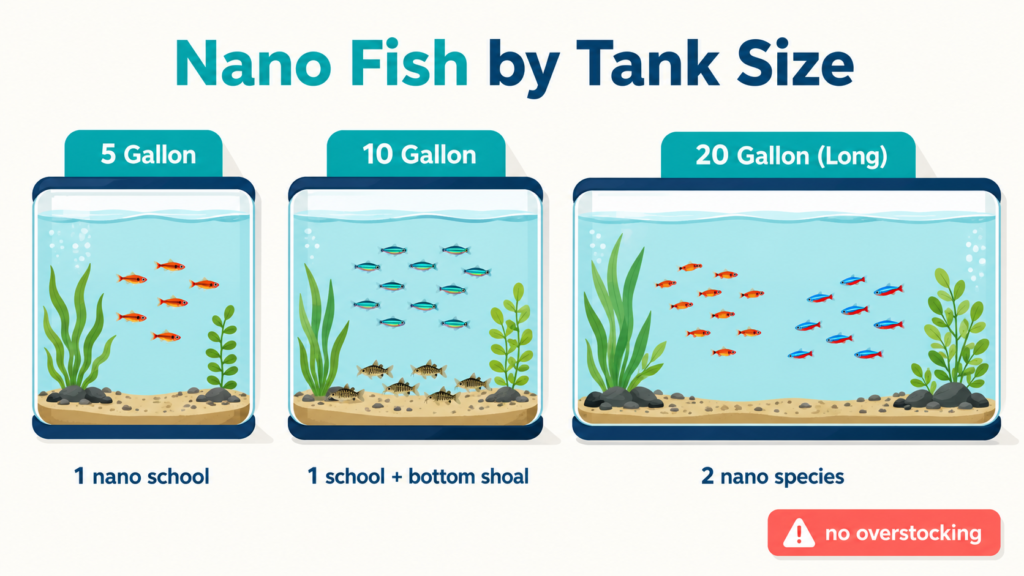
| Your tank | Realistic stocking | Best matches | Avoid |
|---|---|---|---|
| ~3 gal / 11 L | Shrimp colony, or 1 betta (debated) | Cherry shrimp; least killifish (tight) | Any schooling group — no room |
| ~5 gal / 19 L | One small school (6–8) | Ember tetra, Endler’s, chili rasbora | Pygmy cory, green neon (want more space) |
| ~10 gal / 38 L | One school + a bottom shoal | Green neon, CPD, pygmy cory, White Cloud | Big or nippy community fish |
| ~20 gal long / 76 L | Two nano species, peacefully | Any two from the shortlist above | Overstocking “because it’s bigger” |
Notice the pattern: a “nano” tank usually means one well-sized school, not a mixed zoo. More water buys you a second species, not ten random fish. If you’re still choosing a tank, our nano tank size guide comparing 3, 5 and 10 gallons breaks down the stability trade-offs in detail.
Why bigger water forgives a school: the dilution math
This is the honest reason a school belongs in the bigger tank. Overfeed a 10-gallon by one pinch and it dissolves into roughly 38 liters; the exact same pinch in a 2-gallon hits about five times the concentration. Fish waste, ammonia, and leftover food all work the same way — more water dilutes every mistake. That’s why “hardy” beginner fish so often die in tiny tanks: it isn’t the species, it’s the swing. More volume simply buys you a wider margin for the small errors everyone makes while learning.
🚨 Counterintuitive truth: smaller is harder, not easier. Less water means temperature, ammonia, and pH all swing faster — so the “starter” pico tank sold as low-effort is actually the least forgiving thing you can buy. When in doubt, go one size up.
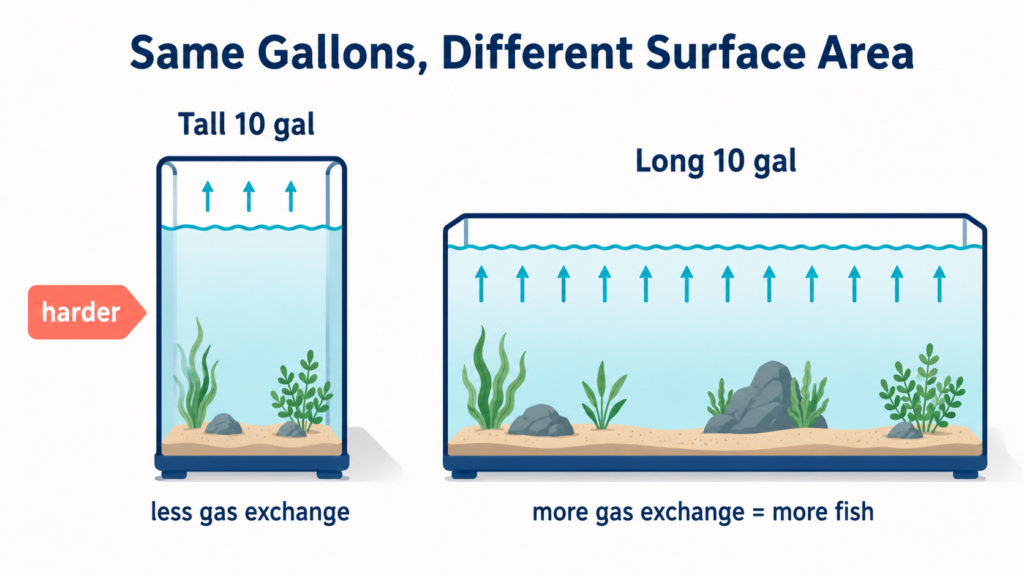
Surface area beats gallons
Two tanks can hold the same gallons and stock very differently. Oxygen enters where water meets air, so a wide, low tank out-performs a tall, narrow one of identical volume — more surface area means better gas exchange and more room for fish to spread out. This is exactly why a “10-gallon long” holds more nano fish comfortably than a tall 10-gallon cube. When you pick a tank, favor the longer footprint over the taller one.
Popular Picks That Trap Beginners
Some of the most-recommended “nano” fish online are actually poor first choices in a small tank. We’d rather tell you the honest version than pad a list:
- Betta — beautiful and sold for tiny tanks, but a betta wants at least 5 gallons of its own, gentle flow, and warm stable water. It’s a solo fish, not a community shoaler. Great pet, but not the “easy any-tank” fish the marketing implies.
- Neon tetra (standard) — mass-bred lines are often less hardy than their reputation, and they prefer 10+ gallons in a school of 10+. The smaller green neon is the better nano choice.
- Guppy — hardy and cheap, but fancy guppies breed relentlessly and can overload a 5-gallon fast. Endler’s are the more nano-appropriate livebearer.
- Dwarf shrimp as “starter fish” — shrimp are wonderful, but they’re invertebrates with different needs (no copper, very stable water). They’re a great addition, not a substitute for understanding fish stocking.
🚨 The bigger trap underneath all of these is timing: no nano fish belongs in an uncycled tank. Small water volumes spike ammonia fast, and that’s what actually kills “hardy” beginner fish — not the species choice.
The three stocking mistakes that kill nano fish
| Common mistake | Why it fails | Easy fix |
|---|---|---|
| Overstocking “because they’re tiny” | Small fish still add bioload; ammonia/nitrite climb fast in low volume | One well-sized school per nano tank; add a second species only at 10 gal+ |
| Buying one of a schooling species | Lone schoolers turn stressed, faded, and short-lived | Buy the full group of 6+ at once |
| Adding fish to an uncycled tank | No bacteria = ammonia poisoning in days, even for “hardy” fish | Cycle to 0 ammonia / 0 nitrite first, then stock |
These are the nano-specific versions of the wider beginner aquarium mistakes every new keeper should sidestep.
Before You Add Any Fish: One Non-Negotiable Step
You can pick the perfect, hardiest fish on this page and still lose them in a week if the tank isn’t cycled. A new aquarium has no beneficial bacteria to process the ammonia from fish waste, and in a few liters of water that ammonia climbs dangerously fast.
So the real order of operations is: set the tank up, cycle it for two to six weeks until it reads zero ammonia and zero nitrite, then add your first small group. The waiting is genuinely the hard part — there’s no fish to watch yet, just numbers on a test kit — but that invisible bacterial colony is where the real magic happens. Skip it and even bulletproof fish die; respect it and the rest of this hobby gets easy.
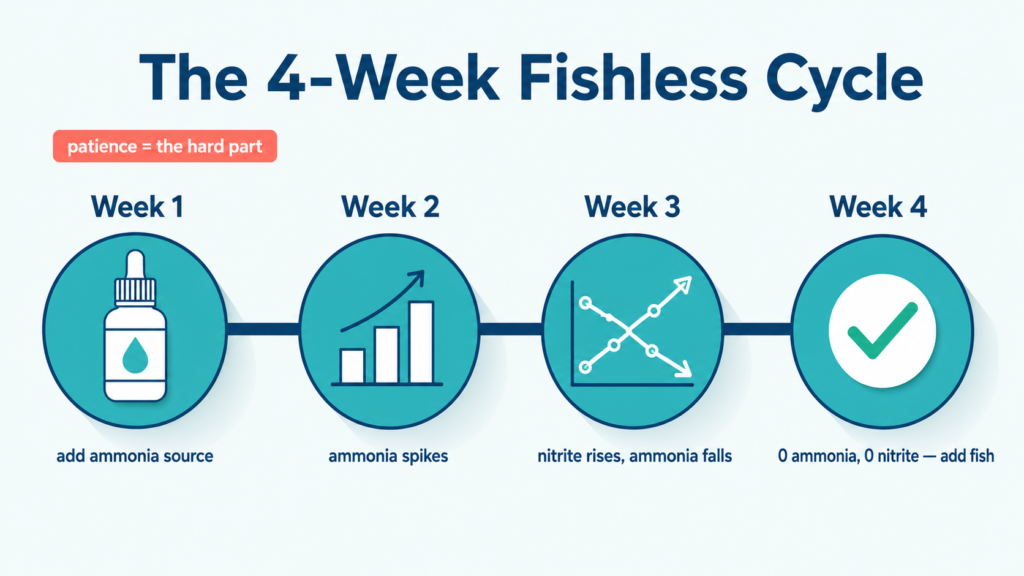
If you’re at the very start, follow our step-by-step nano aquarium setup guide first, and add fish only once it’s stable. Then run a full fishless cycle, step by step, before any fish go in.
Before You Buy the School: A Quick Checklist
Print this or screenshot it and take it to the fish shop. If you can’t tick all four boxes, you’re not ready to buy livestock yet — and that’s fine. Waiting one more week beats restocking a crashed tank.
| ✓ | Before you buy your school |
|---|---|
| ☐ | Tank is fully cycled — reads 0 ammonia and 0 nitrite |
| ☐ | You’re buying the whole group of 6+ at once, not one at a time |
| ☐ | The species fits your tank size (check the matchup table above) |
| ☐ | You have a written stocking plan — one school, not a random zoo |
How to Add Your School the Right Way
Step 1 — Buy the whole group at once
Schooling fish settle faster and color up better when introduced together. Buy your six-to-ten as one batch rather than dribbling them in one a week — it’s less stressful for the fish and easier on your cycle once the tank is established.
Step 2 — Acclimate slowly
Float the sealed bag in your tank for about 15 minutes to match temperature, then open it and add small amounts of your tank water to the bag every few minutes over 20–30 minutes before gently netting the fish in. Pour the bag water down the drain — never into your tank.
Step 3 — Feed light, watch your parameters
For the first week, feed a tiny pinch once a day and keep testing. New livestock is a new bioload; a small water change keeps everything stable while the bacteria catch up.
Keep Exploring NanoTank Lab
Ready to go deeper on any of these species? Dive into our care sheets and companion guides:
- Choosing your tank: Nano tank size guide — 3 vs 5 vs 10 gallon
- Getting started: How to set up a nano aquarium, step by step
- Single-fish setups: Betta fish care in a nano tank
- Heated or not: Coldwater vs tropical nano tank
- Avoid rookie errors: 9 common beginner aquarium mistakes (and fixes)
- Tiny red schoolers: Chili rasbora care guide (internal link, coming soon)
- Clean-up crew: Cherry shrimp care guide (internal link, coming soon)
Frequently Asked Questions
What is the best nano tank fish for an absolute beginner?
Ember tetras or Endler’s livebearers. Both are hardy, brightly colored, peaceful, and forgiving of the small water-quality mistakes new keepers make. Keep a group of at least six in a 5-gallon or larger.
How many nano fish can I keep in a 5-gallon tank?
Realistically one small school of about 6–8 tiny species (like ember tetras or chili rasboras), and that’s it. A 5-gallon is best treated as a single-species tank so your bioload stays low and stable.
How much does a school of nano fish cost?
As of mid-2026, expect roughly $4–6 per fish for common species like ember tetras or Endler’s, so a starter school of six runs about $24–36. Add the essentials — a liquid freshwater master test kit (around $30–45), a $5–10 dechlorinator, and food — and a fully stocked, cycled nano tank typically lands around $100–180 all-in, depending on whether you splurge on the tank and light.
Can I keep just one nano fish on its own?
Usually no. Most nano fish are schooling species that become stressed and faded when kept alone or in pairs. The main exception is the betta, which is a solo fish that should not be schooled.
Do nano fish need a heater?
Most tropical nano fish do, to hold a stable 24–26 °C (75–79 °F). The big exception is the White Cloud Mountain minnow, a coldwater species that’s happy at typical room temperature — making it a great unheated nano option.