
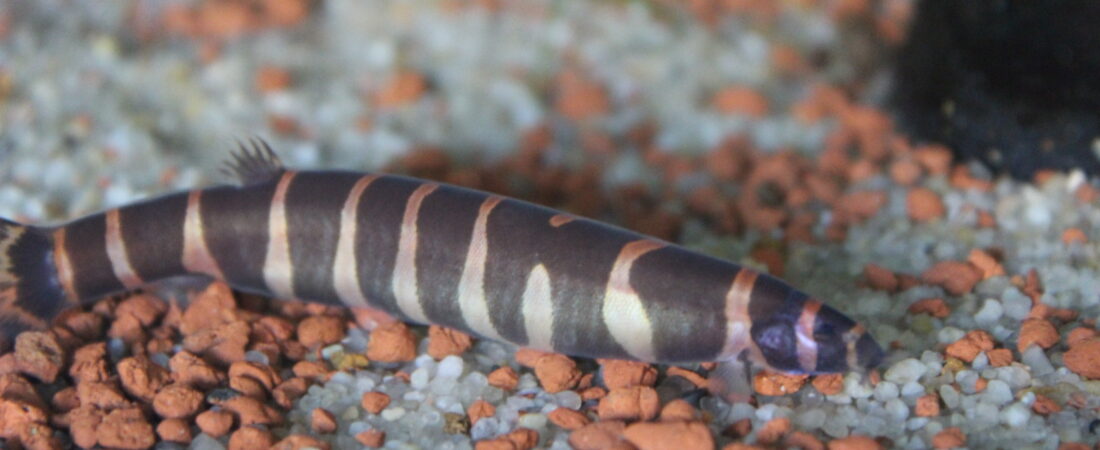
Kuhli loach hiding is the single most common complaint keepers have about this species, and the honest answer is that some of it is permanent: these are nocturnal, scaleless, mostly wild-caught fish that are built to stay out of sight. But 24/7 invisibility is not inevitable, and the variable that fixes it most reliably is not the one almost every care guide names.
Nearly every article on this problem gives the same one-line answer — “keep more of them” — and stops there. To find out whether that actually holds, we read through more than 700 keeper posts and comments across r/loaches, r/Aquariums, r/PlantedTank and r/bettafish, plus the comment thread on a widely watched kuhli care video. The pattern that came back was clearer than expected, and it contradicts the standard advice: keepers running large groups still reported all-day hiding, while keepers who changed their lighting reported the biggest behavioural swing. This article lays out all six variables that decide whether you ever see your loaches, which ones are worth changing first, and the two silent killers that make people think their fish are hiding when they are actually gone.
Why do kuhli loaches hide in the first place?
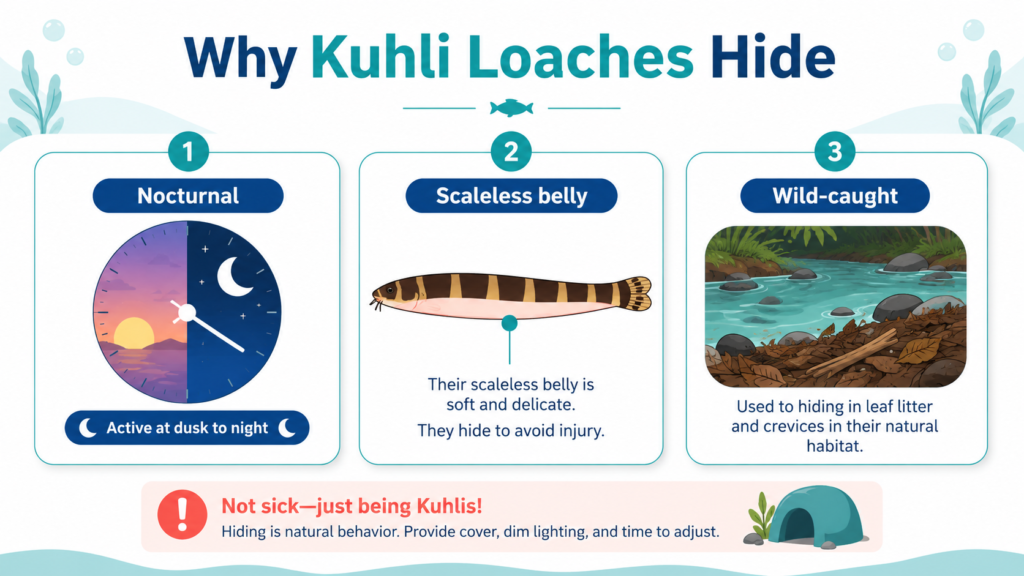
Three things stack up against you before you do anything wrong. Kuhli loaches are crepuscular-to-nocturnal, so their natural activity window is dusk and after dark. They are scaleless with soft bellies, which makes tight, enclosed spaces genuinely safer for them rather than merely preferred. And the overwhelming majority sold in shops are wild-caught rather than farmed, so they arrive carrying full wild predator-avoidance instincts instead of generations of tank habituation.
The species picture is also messier than most guides admit. “Kuhli loach” is a trade name covering more than 30 species in the genus Pangio, and shops routinely mix them in one tank. Keepers who own both the classic striped form and the plain brown “Java” form repeatedly report that the two behave differently in the same aquarium — so if your loaches act nothing like the ones in a video you watched, you may simply own a different fish.
The six variables that decide whether you ever see them
Visibility is not one setting. It is the product of six, and keepers who fix only the famous one usually stay disappointed. The table below ranks them by how often changing that variable alone produced a reported behaviour change.
| Variable | What keepers report | What to change |
|---|---|---|
| Light intensity | Strongest single lever. Switching from bright to dim or shaded light repeatedly flipped fish from strictly nocturnal to visible through the day. | Dim the fixture, add floating plants, and avoid lights that snap on at full power. |
| Tankmates | Species-only tanks produce the most daytime activity. Fast or boisterous fish suppress it hardest. | Remove or avoid high-energy tankmates; consider a species-focused tank. |
| Substrate | Fine sand lets them sift and settle. Dark substrate correlates with more visible fish than bright substrate. | Fine, smooth, dark sand. Pool filter sand is the most-recommended budget option. |
| Group size | Real but overrated. Confidence gains taper off; some keepers saw improvement at 4, others saw none at 20. | Five or more is a sensible floor, but do not expect it to solve visibility alone. |
| Feeding schedule | They are slow to the food and lose out to faster fish, so they learn to feed after lights-out. | Feed sinking food at dusk so their meal and your viewing window overlap. |
| Cover density | Contested. Most say more cover means more confidence; a minority report never seeing their fish even inside the caves. | Provide cover, but pair it with dim light rather than treating it as the fix. |
💡 If you only change one thing this week, change the light — not the head count. It is cheaper, reversible, and in keeper reports it moved the needle more than any other single adjustment.
Why “just add more kuhli loaches” is incomplete advice
Group size genuinely matters — a lone kuhli in a bare tank is a fish you will rarely see, and multiple keepers described going from one or two animals sighted a handful of times a year to a group that reliably turns up at feeding time. That part of the standard advice is sound.
The problem is treating it as sufficient. In the reports we read, the recommended minimum ranged from three to twenty depending on who was answering, with no agreement and no stated reasoning. More usefully, the counter-examples are easy to find: keepers running nine loaches for the better part of a year, and others with twenty-plus, still described animals that spent the overwhelming majority of the day out of sight. In at least one detailed account, the fix that finally worked was not adding fish at all — it was reducing light intensity and switching to a darker substrate.
The practical reading: treat five or more as a welfare floor because these are social animals, then stop expecting head count to buy you visibility. Once you are past that floor, light and tankmates are doing more of the work.
How bright is too bright?
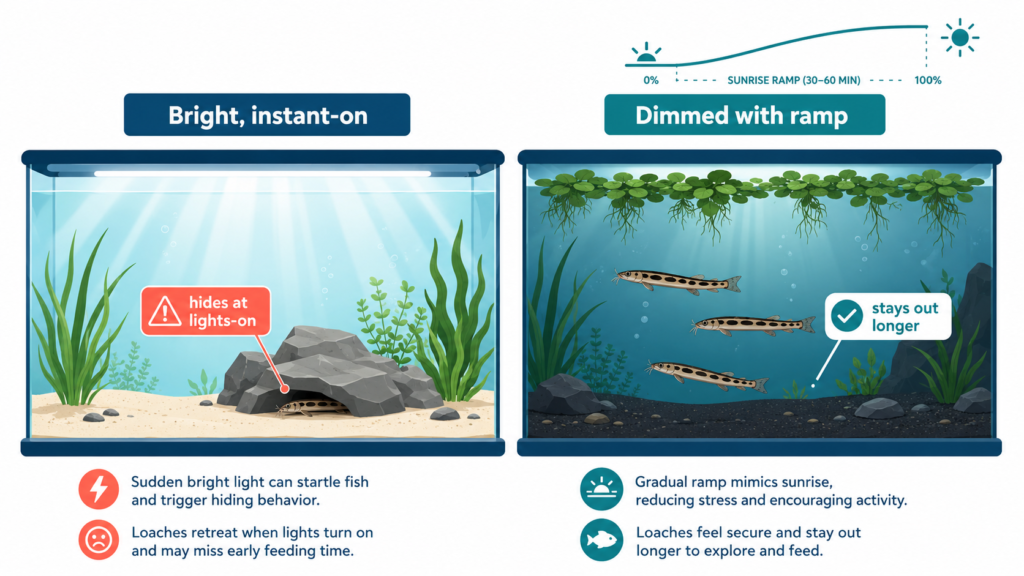
The behavioural detail that comes up again and again is not just brightness but suddenness. Keepers describe loaches panicking and scattering the instant a fixture snaps on at full output — and describe that panic disappearing after moving to a dimmable light or one that ramps up gradually. One keeper summarised the change as fish that used to throw themselves into hiding at lights-on now being in and out of cover all day.
Three adjustments, in order of cost:
- Free: add floating plants to break up the surface and cast shade. This also suits their leaf-litter native habitat.
- Cheap: run your existing fixture at a lower output, or shorten the photoperiod rather than blasting a long bright day.
- Costs money: move to a dimmable fixture with a sunrise/sunset ramp so there is no on/off shock. Our guide to choosing a nano aquarium light covers what to look for.
Dark substrate compounds the effect. A pale sand bed under a bright fixture is a high-contrast, exposed-feeling floor for a fish with no scales; a darker bed reads as safer and keeps them out longer. If you are also planting, our list of low-light aquarium plants pairs naturally with a dimmer setup.
The hard truth: some tanks will never show them
This is the part most guides leave out, and it is worth hearing before you spend money. If your kuhli loaches live in a busy community tank with active mid-water fish, under a bright fixture, on pale gravel, you can add loaches indefinitely and still rarely see one. Several long-term keepers described exactly that setup and simply accepted it — including one who kept the same animals for years and reported essentially never seeing them.
So decide honestly what you want. If you want a fish you watch, the setup has to be built around them: dim light, dark fine sand, minimal or no fast tankmates, dusk feeding. If you want a busy community tank, kuhli loaches can absolutely live in it happily — but treat them as a fish you occasionally glimpse rather than a display animal, and buy accordingly.
One more thing that should factor into that decision: this is a long commitment. Care guides commonly cite around ten years, and keepers routinely report individuals at thirteen and fourteen years old. Choosing a tank for them is a decision measured in a decade, not a season.
Before you panic: they are probably alive — but check these two things
The most repeated story in the whole dataset is the same one: a keeper assumes a loach died months ago, then finds it alive during a rescape, sometimes more than a year later. Kuhli loaches disappear into filter housings, under hardscape, inside decorations, and beneath the sand. A missing loach is very often a hiding loach, so do not tear the tank apart on day three.
That said, two genuine hazards do kill them, and both get one dismissive line in most care guides. They deserve more, because keeper reports of these are specific and frequent.
| Hazard | Why the usual advice fails | What actually works |
|---|---|---|
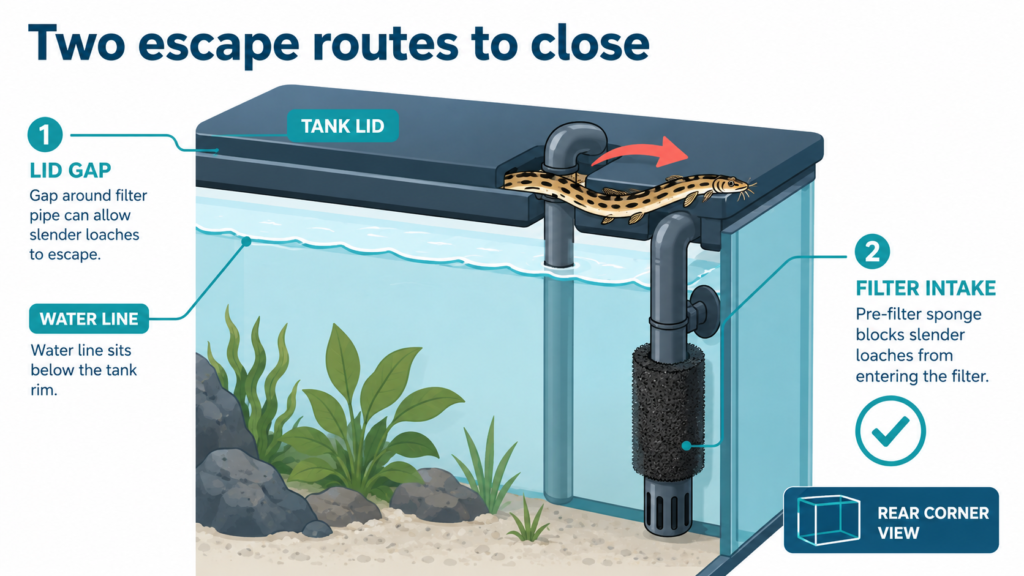
| Jumping out | “Keep a lid on it” is not enough — keepers repeatedly lost fish through the 1–2 cm gap at the back where the filter or cables pass through, with a lid fitted. | Close the cutout itself with mesh or a cut-to-fit cover, and lower the water line a couple of centimetres below the rim. Expect escape attempts in the first week after adding them. |
| Filter intake | Their body shape lets them wriggle up intake pipes; keepers report finding them living inside canister filters, and small juveniles are most at risk. | Fit a pre-filter sponge over the intake from day one. See our nano tank filter guide for intake options. |
There is a third, quieter issue: they lose the race to food. Keepers describe loaches arriving at the meal after the tetras, shrimp and corydoras have cleared everything. If yours look thin, move feeding to after lights-out and use sinking food so the slow fish get a fair share.
Keep Exploring
If you are still setting up or refining the tank these loaches live in, these guides go deeper on the pieces mentioned above:
- Kuhli loach care guide — tank size, sand, group requirements and everyday husbandry in full.
- Nano tank size guide — why floor area matters more than volume for bottom-dwelling fish.
- Best nano aquarium lights — dimmable and ramping fixtures, the single highest-impact change here.
- Best nano tank filters — including intake protection that keeps small loaches out of the plumbing.
- Pygmy corydoras care — another sand-first bottom-dweller, and a far more visible one during daylight.
Frequently Asked Questions
Why do my kuhli loaches hide all day?
Because they are nocturnal by nature and your tank is probably amplifying it. The biggest amplifiers are bright or instant-on lighting, active mid-water tankmates, and pale substrate. Dim the light, shade the surface with floating plants and feed at dusk before you consider adding more fish.
How many kuhli loaches do I need before they come out?
Five or more is a reasonable welfare floor for a social species, but head count alone does not buy visibility. Keepers with nine and even twenty-plus loaches still report all-day hiding when the lighting and tankmates are wrong, so fix those first.
Do kuhli loaches really burrow in sand?
Reports are genuinely split. Many keepers describe loaches diving under and sifting sand — some watch them spit it back out through the gill openings — while others say they have never once seen theirs burrow. Fine sand is still the right substrate because it protects a scaleless belly and their barbels, but do not treat burrowing as guaranteed behaviour.
Is my kuhli loach dead if I have not seen it in weeks?
Probably not. The single most common story keepers tell is finding a loach alive during a rescape months, sometimes over a year, after writing it off. They wedge into hardscape, decorations, filter housings and the substrate. Check the two real hazards instead: gaps in the lid where pipes pass through, and an unprotected filter intake.
Will kuhli loaches come out more in a species-only tank?
That is what keeper reports point to. One keeper comparing three of their own tanks found the loaches essentially invisible in a large community setup, occasionally visible with boisterous tankmates, and active almost all day in a small tank holding only loaches, snails and shrimp. Fewer fast fish means more daytime confidence.
How long do kuhli loaches live?
Longer than most beginners expect. Around ten years is the commonly cited figure, and keepers regularly report individuals reaching thirteen or fourteen. Some sources still quote three to five years, which the long-term keeper reports contradict. Plan the tank as a decade-long commitment.