
Cloudy aquarium water is one of the most common — and most alarming — sights for a new fishkeeper, but the haze itself is almost never the real problem you need to solve. In the vast majority of tanks the cloudiness is a harmless, temporary symptom of a young ecosystem finding its balance, and reaching for a bottle of “clarifier” is usually the worst thing you can do. Before you change anything, the single most useful move is to look closely at the color of the cloud, because each color points to a completely different cause and a completely different fix.
Most guides treat cloudy water as one problem with one cure, which is exactly why so many beginners “fix” it and watch it come straight back. This guide does the opposite: it diagnoses the haze by its color — milky white, green, white dust, or brown — explains the biology behind each one, and gives you the correct response for each (including the many cases where the right answer is to do nothing at all). Two original reference tables and a prevention checklist round it out so you can match what you are seeing to what you should do.
What the Color of Cloudy Aquarium Water Tells You
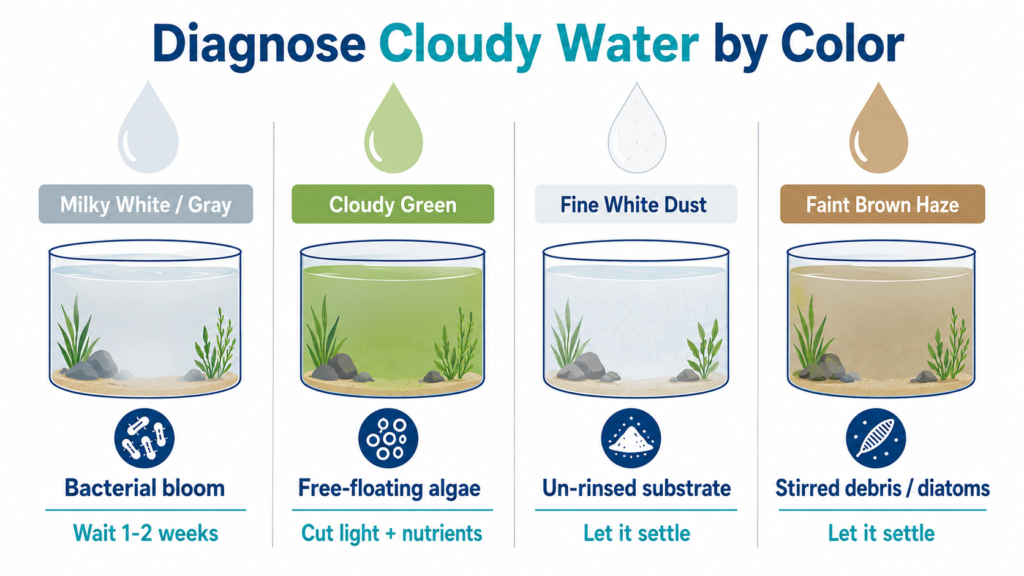
The first step in dealing with cloudy aquarium water is refusing to treat all cloudiness the same. A milky-white haze, a pea-green tint, a fine dusty veil right after setup, and a faint brown fog are four separate phenomena with four separate causes. Diagnosing by color takes ten seconds and saves you from the classic mistake of scrubbing your filter — which can make a bacterial bloom last far longer. Use the quick-reference table below to identify your situation, then jump to the matching section.
| What you see | Most likely cause | When it typically appears | Short answer |
|---|---|---|---|
| Milky white / gray | Bacterial (heterotrophic) bloom | New tank, or after overfeeding / adding too many fish / a dead fish or plant | Usually wait it out 1–2 weeks |
| Cloudy green | Free-floating algae (“green water”) | Too much light plus excess nutrients | Cut light and nutrients |
| Fine white dust | Un-rinsed substrate | Immediately after setup | Let it settle |
| Faint brown haze | Stirred-up debris or diatoms | After a water change, rescape, or in a young tank | Let it settle / gentle maintenance |
Milky White or Gray: A Bacterial Bloom
By far the most common cause of cloudy aquarium water is a bacterial bloom, which shows up as a milky white or grayish haze that makes the tank look like watered-down milk. It happens when heterotrophic bacteria — the microbes that break down organic waste — suddenly multiply because there is a feast of excess organics for them to eat. This is completely normal in a brand-new tank, where the biological filter has not caught up yet, and it is also triggered by overfeeding, adding too many fish at once, or an unnoticed dead fish or decaying plant leaf.
Here is the counterintuitive part: in a new tank, the best fix is to do nothing and wait one to two weeks while the biofilter matures — as long as your ammonia and nitrite are not climbing. The bloom is a passing phase of the nitrogen cycle establishing itself, and the beneficial bacteria that colonize your filter media will out-compete the free-floating bloom on their own. The one thing you must not do is rinse or replace the filter to “clean” the water — that strips out the very bacteria that will end the bloom, and it typically makes the cloudiness worse and longer-lasting.
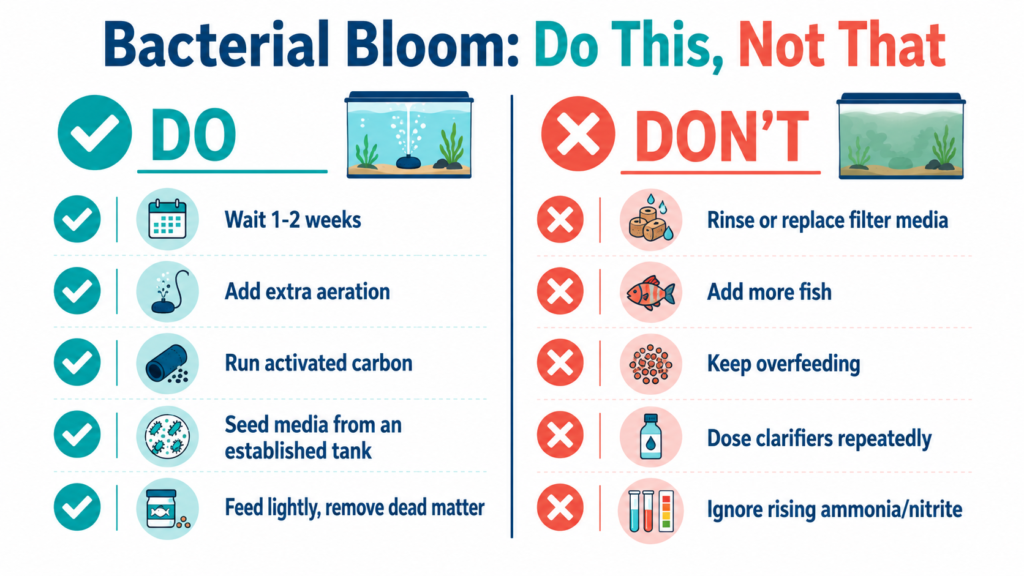
What you should do is keep a close eye on your parameters. A harmless bloom looks alarming but reads clean on a test kit; a genuine problem shows rising ammonia or nitrite. If you are unsure what those numbers should be, our guide to aquarium water parameters lays out the safe levels. While you wait, a few gentle helpers speed things along without disrupting the cycle — the table below separates them from the mistakes that prolong the haze.
| Helps end a bacterial bloom | Prolongs or worsens it |
|---|---|
| Waiting 1–2 weeks while the biofilter matures | Rinsing or replacing the filter media |
| Adding extra aeration (a bloom consumes oxygen) | Adding more fish while it is cloudy |
| Running activated carbon in the filter | Continuing to overfeed |
| Seeding gravel or media from an established tank | Dosing “instant clear” clarifiers repeatedly |
| Feeding lightly and removing any dead matter | Doing nothing while ammonia/nitrite climb |
Two of those helpers deserve a note. Extra aeration matters because a heavy bacterial bloom draws down dissolved oxygen, so bumping up surface agitation protects your fish while the bloom resolves. Seeding media or gravel from a mature, healthy tank is the single fastest way to shorten the whole episode, because you are importing an established bacterial colony instead of waiting for one to grow from scratch.
Cloudy Green: An Algae Bloom
If your water has turned a hazy pea-soup green rather than white, you are not looking at bacteria at all — you have a free-floating algae bloom, often called “green water.” Unlike the algae that grows on glass and decor, these are microscopic algae suspended throughout the water column, and they are driven by a simple recipe: too much light plus too many nutrients. The most common culprit is lighting that runs too long each day, and a tank sitting where it catches direct sunlight is especially prone to greening up fast.
The fix targets both halves of that recipe. On the light side, shorten your photoperiod to a modest six to eight hours a day, move the tank out of direct sun, and — for a stubborn bloom — try a full blackout: cover the tank completely for a few days so the algae, starved of light, dies back. On the nutrient side, feed less, remove uneaten food, and stay consistent with water changes to export the nitrate and phosphate the algae feeds on. Because green water is a lighting-and-nutrient issue, chasing it with the same tactics that fix a bacterial bloom simply will not work — this is exactly why diagnosing by color first matters so much.
White Dust and Brown Haze: Substrate and Debris
Two more types of cloudiness are mechanical rather than biological, and both are harmless. A fine white dust that clouds the whole tank in the first hours after filling it is almost always un-rinsed substrate — the powdery residue that clings to new gravel and sand. There is no biology to treat here; just let the filter and gravity do their work and it will settle within a day or two. The lesson is for next time: rinse new substrate thoroughly in a bucket until the water runs clear before you add it, and you will skip the dust cloud entirely.
A faint brown haze is the other mechanical case. It is usually nothing more than fine debris stirred up by a water change, a filter bump, or an enthusiastic rescape, and it clears on its own once everything resettles. In a young tank a light brown tint can also come from diatoms, a benign “new tank” film that fades as the system matures. Gentle, consistent upkeep — the kind laid out in our aquarium maintenance schedule — keeps this kind of haze from becoming a recurring nuisance.
How to Prevent Cloudy Water for Good
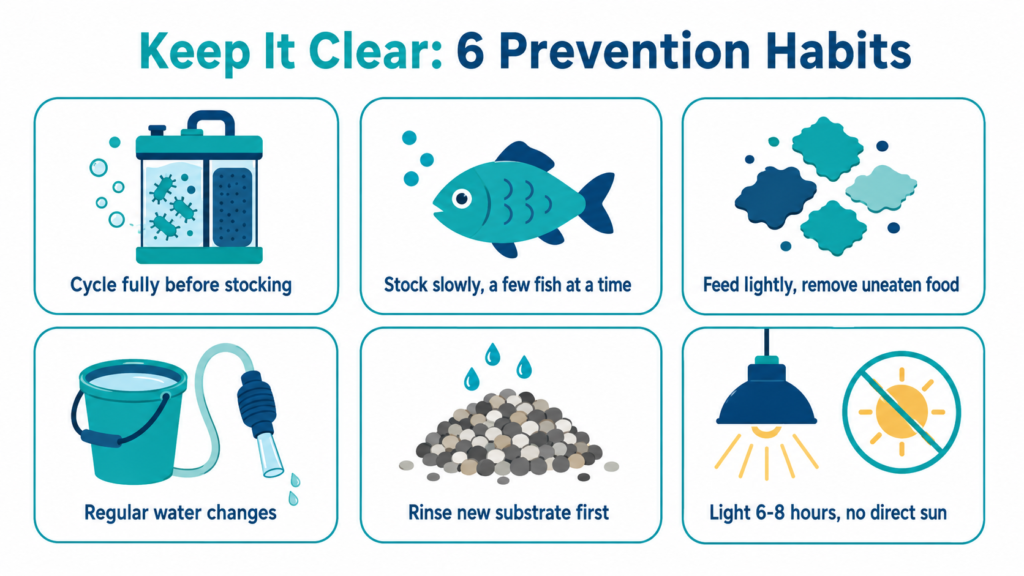
Almost every episode of cloudy water traces back to the same handful of habits, which means prevention is refreshingly simple. Cycle the tank fully before you add any livestock, stock slowly instead of all at once, feed lightly, and keep up regular water changes. Get those four right and blooms rarely get a foothold. Many of these overlap with the classic errors in our roundup of beginner aquarium mistakes, which is worth a read if your tank keeps clouding up. The checklist below sums up the prevention playbook.
| Prevention habit | Why it works |
|---|---|
| Cycle fully before stocking | Gives the biofilter time to mature before waste arrives |
| Stock slowly, a few fish at a time | Lets bacteria scale up to the bioload without a bloom |
| Feed lightly, remove uneaten food | Starves heterotrophic bacteria and algae of excess organics |
| Keep a regular water-change routine | Exports the nitrate and organics that fuel green water |
| Rinse new substrate before adding it | Prevents the white dust cloud at setup |
| Limit light to ~6–8 hours, avoid direct sun | Denies free-floating algae the energy to bloom |
For a neutral, scientific primer on the biology working behind the scenes here, the Wikipedia entry on the nitrogen cycle explains how bacteria convert fish waste into progressively safer compounds — the same process that ultimately clears a bacterial bloom.
Keep Exploring NanoTank Lab
- How to Cycle a New Aquarium — why a new tank clouds up and how to get through it safely.
- Aquarium Water Parameters Explained — the numbers that tell a harmless bloom from a real problem.
- 9 Beginner Aquarium Mistakes — the overfeeding and overstocking habits that cause cloudy water.
- Aquarium Maintenance Schedule — the routine that keeps water clear long-term.
Frequently Asked Questions
Why is my brand-new aquarium water cloudy?
A brand-new tank almost always clouds up because of a harmless bacterial bloom. Heterotrophic bacteria multiply rapidly while your biological filter is still establishing, producing a milky white haze. As long as ammonia and nitrite are not climbing, the best response is to wait one to two weeks and let the biofilter mature — the bloom clears on its own as the beneficial bacteria settle onto your filter media.
Should I do a water change to fix cloudy water?
It depends on the color and cause. For a milky bacterial bloom in a new tank, big water changes are usually unnecessary and can even slow things down — waiting it out works better. For a green algae bloom, regular water changes genuinely help by exporting the nutrients the algae feeds on. What you should never do for a bacterial bloom is rinse or replace the filter, which removes the bacteria that will clear it.
Why is my aquarium water green and cloudy?
Green cloudy water is a free-floating algae bloom, not a bacterial one. It is caused by too much light — often a photoperiod that runs too long or a tank in direct sunlight — combined with excess nutrients from overfeeding. Fix it by shortening the light period to six to eight hours, moving the tank out of the sun, feeding less, and keeping up water changes; a multi-day blackout clears stubborn cases.
Is cloudy water harmful to my fish?
Cloudy water itself is usually not harmful — the haze is a symptom, not a poison. A bacterial bloom looks dramatic but is generally safe as long as your ammonia and nitrite stay at zero, though a heavy bloom can lower oxygen, so adding aeration is wise. The real risk is not the cloud but the underlying cause, such as overfeeding or an uncycled tank, which is what your test kit helps you rule out.
How long does it take for cloudy aquarium water to clear?
Most cloudiness clears within one to two weeks. A new-tank bacterial bloom typically resolves in one to two weeks as the biofilter matures, while substrate dust settles within a day or two. A green algae bloom can take longer and only clears once you cut the light and nutrients feeding it. If cloudiness persists well beyond two weeks, revisit your feeding, stocking, and lighting rather than adding more chemicals.