
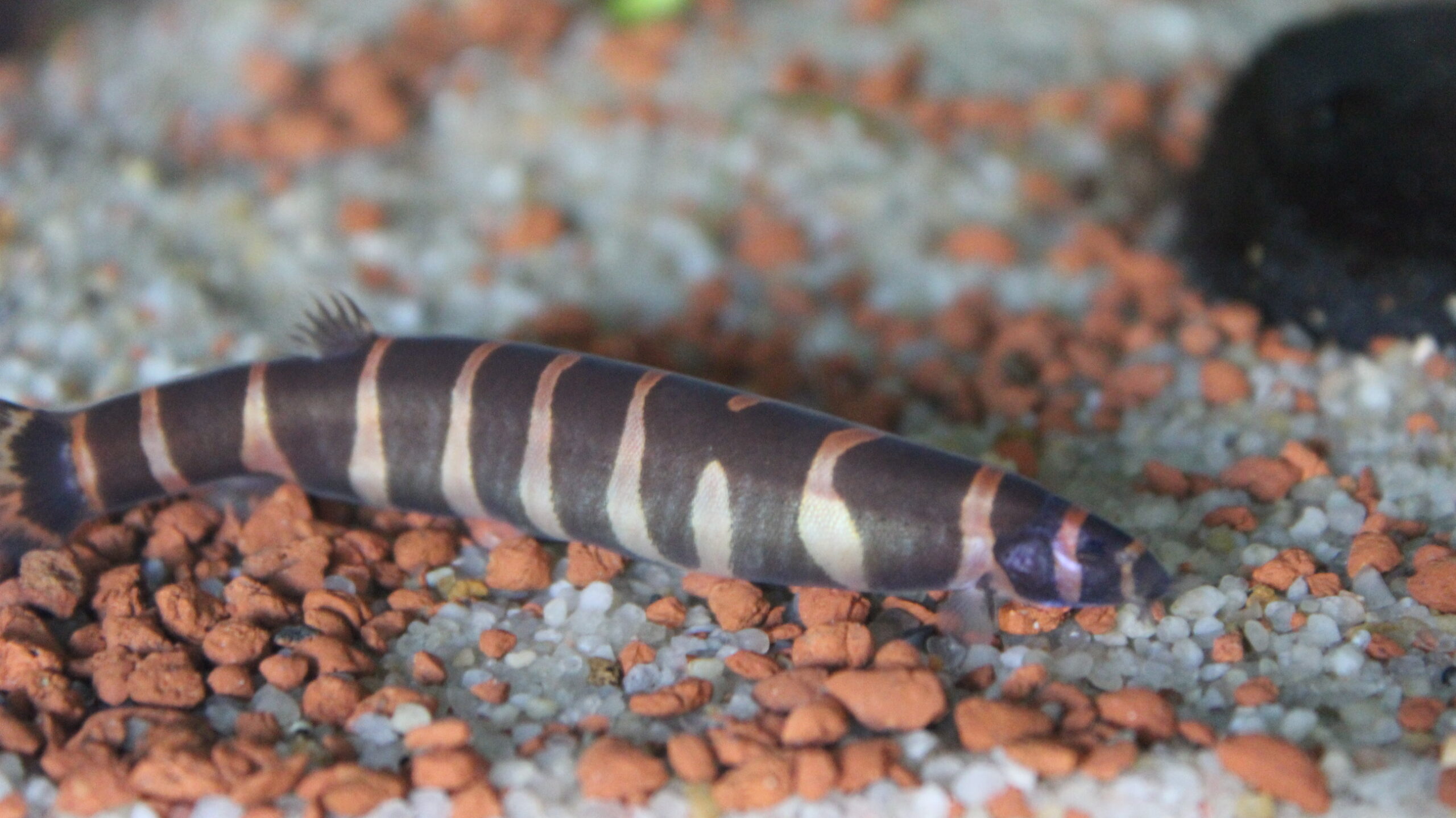
Kuhli loach care is refreshingly simple in most respects, which is exactly why this eel-like little bottom-dweller (Pangio kuhlii) keeps ending up on beginner shortlists — it is peaceful, undemanding about food, and produces almost no waste. The honest catch is not difficulty at all. It is footprint and social needs: kuhli loaches want a 20-gallon-plus floor, a soft sand bed, and a real group of friends before they will show you who they actually are.
Most kuhli loach guides skip the part that actually decides whether you succeed: they are quietly sold as “nano fish” for tiny 5-gallon tanks, then they hide 24/7, refuse to grow confident, and their keepers assume they bought a boring or sickly fish. This article fills that gap. We will be blunt about why a shoebox nano is the wrong home, and specific about the tank size, substrate, group count, and cover that turn a nervous ghost into an active, worm-wriggling character you will genuinely enjoy watching.
Meet the Kuhli Loach: A Beginner’s Bottom-Dweller
The kuhli loach is a slender, snake-shaped loach native to the slow, leaf-littered streams of Southeast Asia. Instead of the torpedo profile most aquarium fish have, it looks like a striped brown-and-cream earthworm with tiny fins and a set of whisker-like barbels around the mouth. Those barbels are sensory tools for sifting through soft substrate, which is your first big hint about what this species actually needs from a tank.
In the wild they live in shaded, gently moving water, wedging themselves under roots, leaves, and driftwood during the day and coming out to forage as the light fades. They are shy by instinct, not by defect. A kuhli loach that hides constantly is usually telling you something is missing — cover, sand, or company — rather than showing you its true temperament. Get those three things right and the same fish becomes surprisingly bold, weaving across the open bed in daylight and piling into caves together like a knot of ribbons.
They stay small, roughly three to four inches, and they have a wonderfully low bioload for their length because their bodies are so thin. That low waste output is part of why they pair so easily with community tanks and why beginners rarely run into water-quality trouble with them. If you are still assembling your stocking list, our roundup of the best nano tank fish puts kuhli loaches in context next to other peaceful, low-maintenance choices.
Why Kuhli Loach Care Starts With Tank Size
Here is the part the “nano fish” label gets wrong. Good kuhli loach care starts with floor space, and a genuinely small tank simply does not have enough of it. A single kuhli loach is small, but you should never keep just one, and a proper group needs room to spread out and forage without constantly bumping into each other. That pushes the realistic minimum to around 20 gallons, and closer to 25 gallons once you are keeping six or more.
It is the footprint — the length and width of the tank floor — that matters far more than the height, because these are bottom-dwelling foragers that use the whole base of the aquarium. A long, low 20-gallon with a big footprint beats a tall column of the same volume every time. If tank dimensions and gallons still feel abstract, our nano tank size guide breaks down footprint versus volume so you can judge what a given tank can really stock.
| Tank size | Suitable for kuhli loaches? | Why |
|---|---|---|
| 5 gallons (typical nano) | No | Too little floor for a group; leads to constant hiding and stress |
| 10 gallons | Not really | Only fits a partial group; footprint still too small for natural foraging |
| 20 gallons (long) | Yes — minimum | Enough floor for a group of five to six to spread out and stay visible |
| 25–29 gallons | Ideal | Comfortable for eight to ten plus tankmates; more cover, less competition |
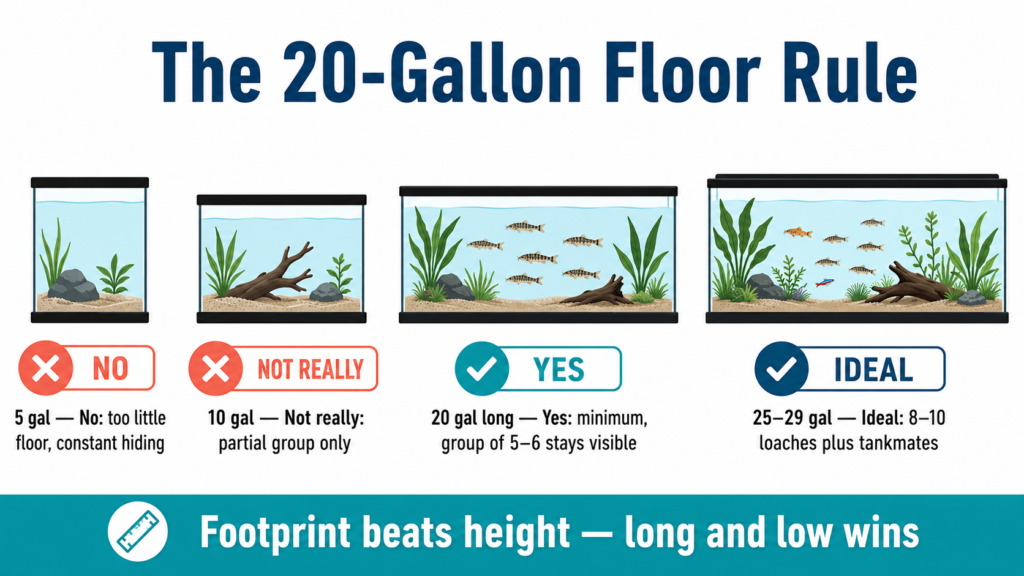
So the fish itself is beginner-friendly; the requirement is space. If your heart is set on a 5-gallon build, a kuhli loach is not the right resident, and honestly admitting that up front will save you months of watching an unhappy, invisible fish.
How many kuhli loaches should you keep?
Treat five to six as the floor and eight to ten as the goal. Kuhli loaches are highly social and take enormous comfort from numbers. In a real group they behave completely differently: they forage in daylight, chase each other in playful loops, and gather into shared hideouts instead of each cowering alone. Keep only one or two and you get the opposite — permanent nerves, near-total hiding, and a fish that never settles.
Sand Substrate Is a Health Requirement, Not a Preference
If you remember only one thing from this guide, make it this: kuhli loaches need fine, smooth sand, and that is a health rule rather than an aesthetic choice. Unlike most fish, they lack protective scales along the belly, and they instinctively burrow, sifting and diving into the substrate to feel safe and to hunt for scraps. Push that soft, scaleless body across sharp or coarse gravel and you get scrapes and abrasions that easily become infected.
Fine sand solves the problem cleanly. It lets them burrow the way they are built to, it protects their delicate underside, and it keeps their sensitive barbels intact so they can keep foraging. Coarse, jagged gravel does the reverse on every count. This is one of the few husbandry decisions where there is a genuinely right answer, so choose the substrate before you choose the fish.
| Substrate | Kuhli-safe? | Effect on the fish |
|---|---|---|
| Fine, smooth aquarium sand | Best | Natural burrowing, protected belly, healthy barbels |
| Very fine rounded gravel | Marginal | Some burrowing, but grains can still abrade over time |
| Coarse or sharp gravel | Avoid | Scrapes the scaleless belly and wears down barbels |
| Bare bottom | Avoid | No cover or burrowing; keeps them hidden and stressed |

Sifting bottom-dwellers as a group have similar needs, which is why sand keepers often pair kuhli loaches with other soft-substrate lovers. If you want a second gentle digger, our pygmy corydoras care guide covers a tiny cory with the same sand-first philosophy.
Hiding Spots, Lid Security, and Water Comfort
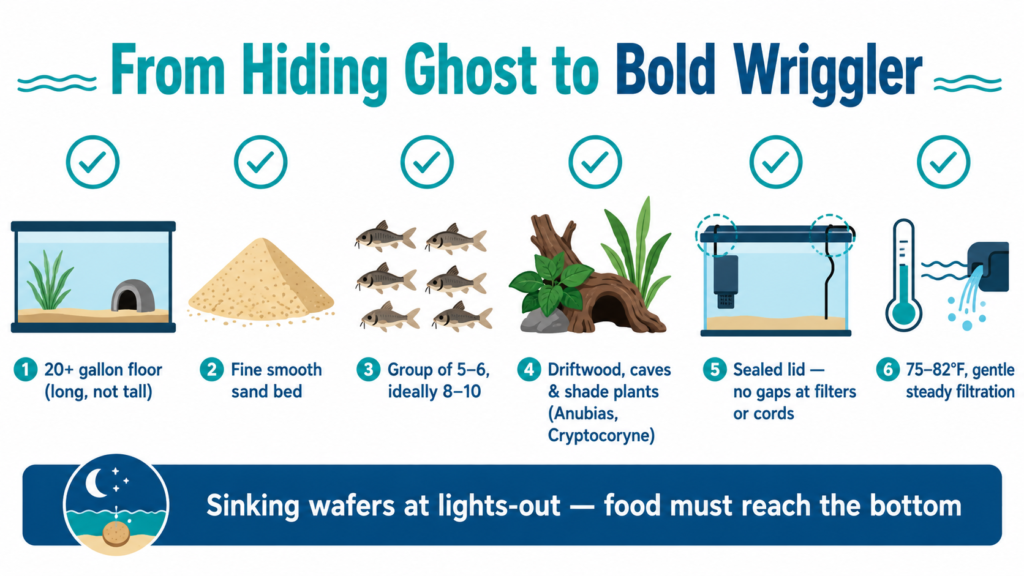
Cover is the other half of confidence. Kuhli loaches want places to disappear into whenever they choose, and paradoxically, the more hiding spots you give them, the more time they spend out in the open. Load the tank with driftwood tangles, smooth caves, and shady plants such as Anubias and Cryptocoryne, whose leaves cast the dim, sheltered light these stream fish evolved under. Broad-leaved and low-light plants do double duty as cover and as a calming canopy.
Next, respect their talent for escape. Kuhli loaches are eel-shaped and genuinely skilled at slipping through the smallest gap, and they will jump or wriggle out of an open tank. A tight-fitting lid with no unsealed holes is non-negotiable — check around filter cutouts and cord gaps in particular, since those are the usual escape routes. It is a small detail that quietly prevents a heartbreaking loss.
Water comfort is the easy part. Aim for a temperature of roughly 75 to 82°F with gentle, steady filtration and clean, stable parameters from regular water changes. They are not fussy about exact numbers as long as conditions stay consistent, which is another reason experienced keepers call them beginner-friendly once the tank is the right size. For layout inspiration that combines wood, caves, and shade the way loaches love, browse our nano aquascaping ideas.
The kuhli loach is not a hard fish — it is a misunderstood one. Give it sand, cover, a group, and a proper floor, and difficulty simply is not part of the equation.
Feeding and Everyday Routine
Feeding is delightfully low-effort. Kuhli loaches are omnivorous scavengers that happily take sinking pellets, wafers, and frozen or live foods like bloodworms and brine shrimp. Because they feed at the bottom and often after dark, make sure food actually reaches the substrate — fast mid-water tankmates can strip the surface before a loach ever notices dinner. Dropping a sinking wafer near their favorite hideout as the lights dim works well.
Their peaceful nature and low bioload make them excellent community citizens. They ignore other fish entirely, rarely compete aggressively for food, and add gentle activity along the bottom without churning up trouble. Pair them with other calm, similarly sized species and you get a lively, layered tank rather than a battlefield.
Keep Exploring
- Nano tank size guide — footprint versus gallons, and what each size can actually stock.
- Best nano tank fish — peaceful, low-maintenance species for small aquariums.
- Pygmy corydoras care — a tiny sand-loving cory with the same substrate philosophy.
- Nano aquascaping ideas — driftwood, caves, and shade layouts loaches love.
Frequently Asked Questions
Can I keep a kuhli loach in a 5-gallon nano tank?
No, a 5-gallon nano is too small for kuhli loaches. They need a group and a large floor, which realistically means about 20 gallons minimum and 25 gallons for six or more. In a tiny tank they hide constantly and never settle, so a small nano is the wrong home even though the fish itself is easy to care for.
How many kuhli loaches do I need to keep together?
Keep at least five to six kuhli loaches, and eight to ten is better. They are highly social, and only in a real group do they turn active and visible instead of hiding. Keeping one or two leaves them permanently nervous and mostly out of sight.
Why do kuhli loaches need sand instead of gravel?
Kuhli loaches need fine sand because they lack belly scales and instinctively burrow, so sharp gravel scrapes their soft underside and can lead to infected abrasions. Smooth sand lets them dig safely and protects their sensitive barbels. It is a health requirement, not just a look.
Are kuhli loaches good for beginners?
Yes, kuhli loaches are one of the most beginner-friendly bottom-dwellers once the tank is set up correctly. They are peaceful, undemanding about food, and produce very little waste. The only real hurdle is meeting their footprint and group needs, not any difficulty in day-to-day care.
Do kuhli loaches really jump out of the tank?
Yes, kuhli loaches can jump and slip through surprisingly small gaps because of their eel-like shape. A tight-fitting lid with no open holes around filters or cords is essential. Sealing those gaps is the simplest way to prevent an escape.
The bottom line on kuhli loach care: this is an easy, charming, genuinely beginner-safe fish that has been mismarketed as a tiny-tank nano. Give it 20 gallons or more, a soft sand bed, a group of at least five to six, plenty of shaded cover, and a sealed lid, and you will trade a hiding ghost for one of the most entertaining bottom-dwellers in the hobby. For the full species background, see Kuhli loach (Pangio kuhlii).