
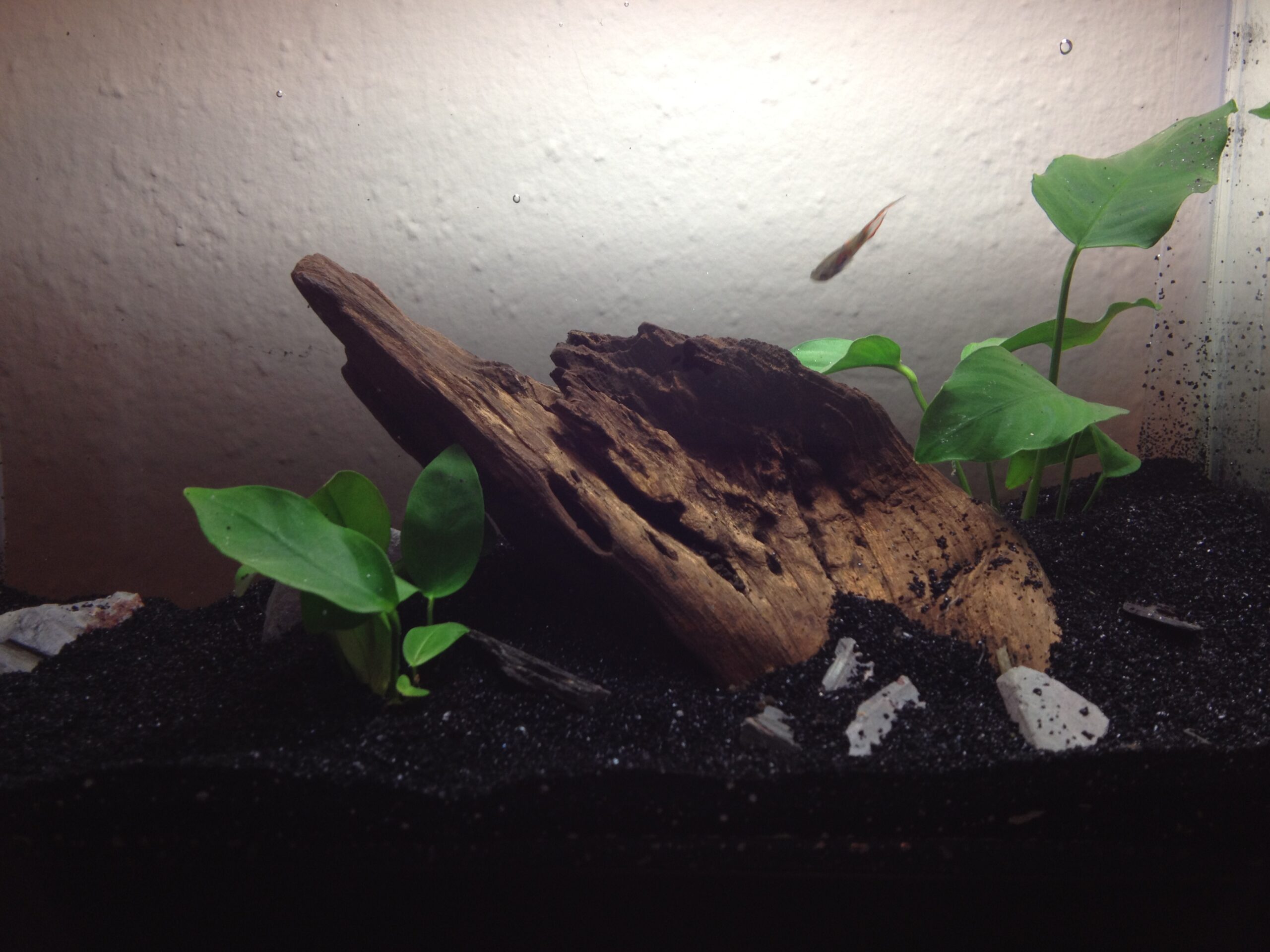
The best nano aquarium light is not the brightest one — it is the one matched to the plants you actually want to grow. Beginners reflexively buy the most powerful light they can afford, then spend months fighting an algae outbreak they accidentally caused. Lighting a planted nano tank is a balancing act between intensity, duration, and your plants’ demands, and once you understand that balance, choosing a light becomes simple.
Most “best light” lists just rank products by output and price, never explaining the thing that determines success: how to match light level to your plants, set a sensible photoperiod, and ramp up slowly to avoid algae. This guide covers all three with honest guidance, three original reference tables, and the algae-prevention strategy nobody includes — so your tank grows lush plants instead of green glass.
Light Levels: Match the Light to Your Plants
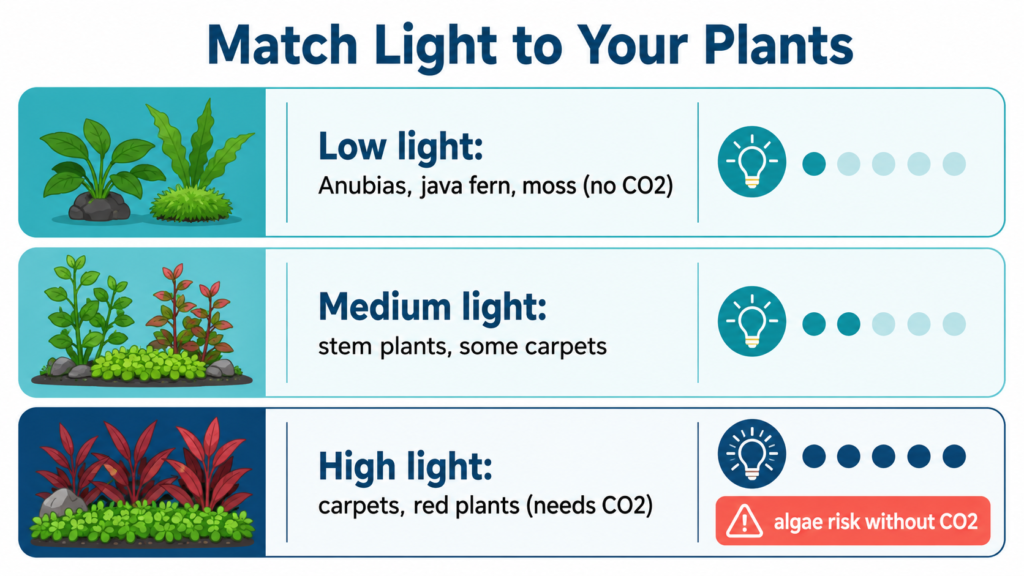
Aquarium lighting is usually described in three tiers, and your plant choices decide which you need. Low light grows hardy, forgiving plants with no added CO2 — the easiest, most algae-resistant setup. Medium light opens up more species and faster growth, often benefiting from fertilizer and sometimes CO2. High light drives demanding carpets and red plants but requires pressurized CO2 and careful management, or algae takes over. For most nano beginners, low to medium is the sweet spot.
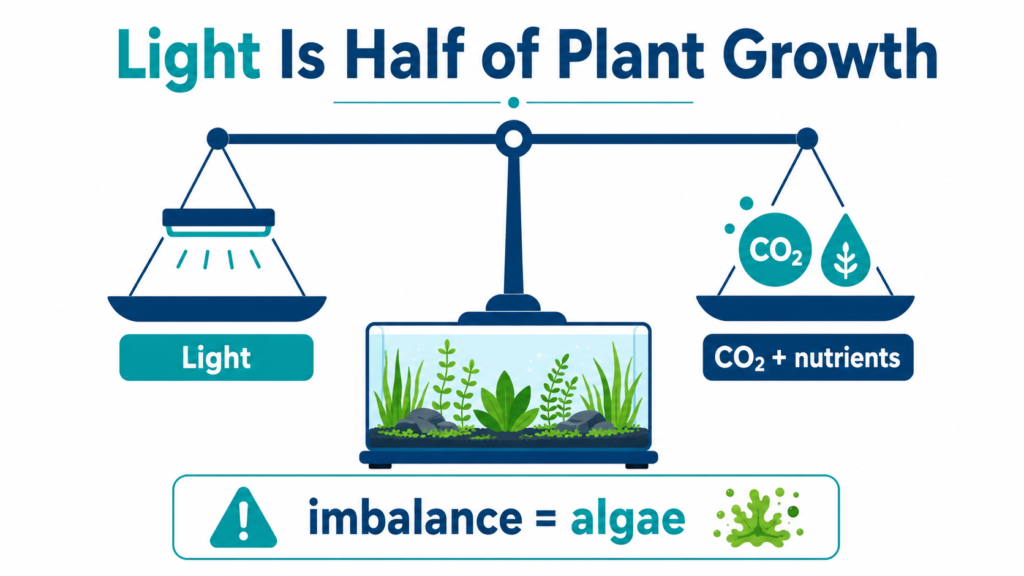
The single biggest mistake is running a high-output light over a low-tech tank with no CO2. Plants can only use so much light before the excess simply feeds algae. The table below matches light level to plants and CO2 needs.
| Light level | Grows | CO2 needed? | Difficulty |
|---|---|---|---|
| Low | Java fern, Anubias, Cryptocoryne, moss | No | Easiest, most algae-resistant |
| Medium | Most stem plants, some carpets | Optional/helpful | Moderate; fertilize regularly |
| High | Demanding carpets, red plants | Yes (pressurized) | Advanced; algae-prone if unbalanced |
If you want the easy route, pair a modest light with our picks for the best low-light aquarium plants and skip CO2 entirely — our guide on whether aquarium plants need CO2 explains why most nano tanks do not.
Photoperiod and the Algae-Free Ramp-Up
How long the light runs matters as much as how bright it is. For most planted tanks, a photoperiod of 6 to 8 hours is the sweet spot: plants max out their photosynthesis in that window, and extra hours beyond it mainly feed algae. A simple timer or a light with a built-in scheduler keeps this consistent, which plants love.
The pro move for a new tank is to start dim and ramp up. Begin at a low intensity or short photoperiod while plants establish, then increase gradually — roughly 10 percent every week or two — only as long as no algae appears. Remember the golden rule: algae is caused by imbalance, not light alone. A dimmable light is worth the small premium for exactly this reason. The ramp schedule below keeps it foolproof.
| Tank age | Photoperiod | Intensity | Goal |
|---|---|---|---|
| Weeks 1–2 | 6 hours | Low (20–40%) | Let plants root without feeding algae |
| Weeks 3–4 | 6–7 hours | Increase ~10% | Build up only if no algae |
| Weeks 5–8 | 7–8 hours | Target level | Settle into a stable routine |
| Ongoing | 6–8 hours | Stable | Consistency over intensity |
Tip: If you see algae creeping in, the first lever is almost always less light — shorten the photoperiod or dim the output before adding chemicals or more cleanup crew. Light is the cause you control most directly.
What to Look For When Buying
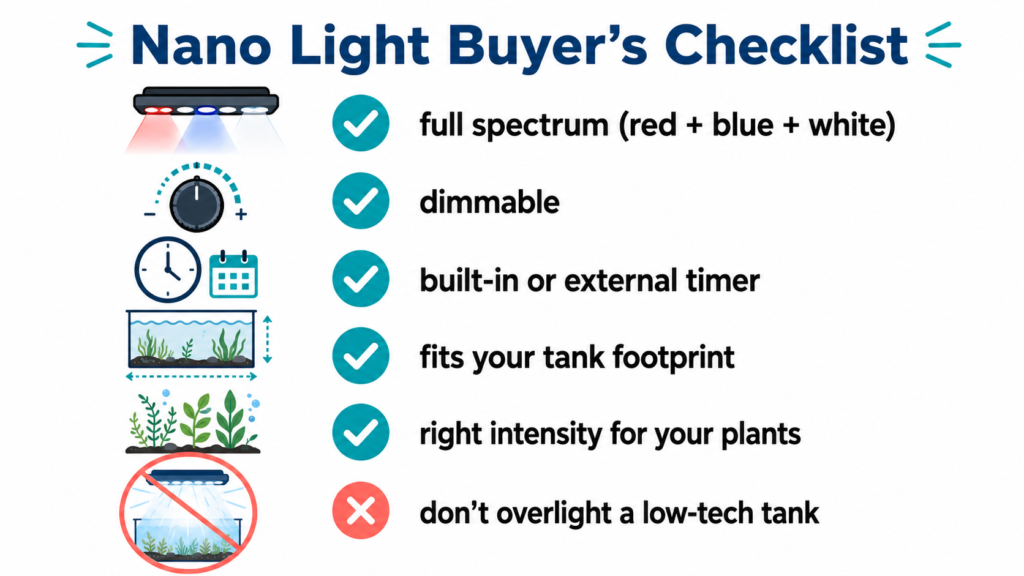
Beyond intensity, a few features make a nano light genuinely better. Look for a full spectrum output (plenty of red and blue, which drive photosynthesis, plus enough white to make fish and plants look natural), a dimmer for the ramp-up strategy above, and a built-in timer or compatibility with an external one. A clip or slim mount suits rimless nano tanks, and an appropriate footprint ensures even coverage across the whole tank.
You do not need to overspend. A mid-range LED with a dimmer covers low-to-medium-light nano planting beautifully, and the money you save on a giant high-output fixture is better spent on plants and a timer. For the full build context, see our nano aquarium setup guide and the broader design ideas in our nano aquascaping ideas. The buyer’s checklist below sums it up.
| Feature | Why it matters | Priority |
|---|---|---|
| Dimmer | Enables the algae-free ramp-up | High |
| Timer (built-in or external) | Consistent photoperiod = healthy plants | High |
| Full spectrum | Plant growth + natural colors | High |
| Correct footprint | Even coverage, no dark corners | Medium |
| Slim/clip mount | Suits rimless nano tanks | Medium |
For a neutral primer on the light plants actually use, the Wikipedia entry on photosynthetically active radiation (PAR) explains the wavelengths that drive plant growth.
Keep Exploring NanoTank Lab
- Best Low-Light Aquarium Plants — what to grow under a modest light.
- Do Aquarium Plants Need CO2? — why most nano tanks can skip it.
- Nano Aquascaping Ideas — design styles and how lighting sets the mood.
- Java Moss Care & Uses — a low-light, beginner-proof plant.
- How to Set Up a Nano Aquarium — where lighting fits in the build.
Frequently Asked Questions
What is the best light for a planted nano tank?
The best light is one matched to your plants, not the brightest available. For most nano beginners, a dimmable full-spectrum LED set to low or medium intensity grows hardy plants beautifully without triggering algae. Reserve high-output lights for high-tech tanks with pressurized CO2. Prioritize a dimmer and a timer over raw power.
How many hours should I run my aquarium light?
Run it 6 to 8 hours a day for most planted tanks. Plants reach their photosynthesis limit within that window, and extra hours mainly feed algae. Use a timer for consistency, and on a new tank, start nearer 6 hours and increase gradually only if no algae appears. Consistency matters more than a long photoperiod.
Will a brighter light cause algae?
Too much light for your setup absolutely can. Algae is caused by imbalance — typically more light than your plants can use given the available CO2 and nutrients. A high-output light over a low-tech tank with no CO2 is a classic algae recipe. If algae appears, the first fix is usually less light: shorten the photoperiod or dim the output.
Do I need a special light, or will any LED work?
For plants, use a light designed for plant growth, not a generic decorative LED. Plant lights provide the full spectrum — especially red and blue wavelengths — that drives photosynthesis. A basic decorative light may make the tank look nice but will struggle to grow anything beyond the toughest plants. A mid-range planted-tank LED is plenty for a nano.
Should I leave the light on for the fish?
No. Fish do not need light at night and benefit from a consistent day-night cycle, so leaving the light on around the clock stresses them and fuels algae. Stick to a 6-to-8-hour photoperiod on a timer, and let the tank go dark the rest of the time. Ambient room light is enough for fish to settle at night.
How do I light a tank without causing algae on a new setup?
Start low and ramp up. On a new tank, run the light at low intensity or a short 6-hour photoperiod while plants establish, then increase by about 10 percent every week or two, but only as long as no algae appears. This lets plants outcompete algae for nutrients. A dimmable light makes this strategy easy to follow.